



Pesticides: History, Production, and Environmental Impact
Background
A pesticide is any device, method, or chemical that eliminates plants or animals that threaten food production or are otherwise undesirable. The term covers insecticides, fungicides, herbicides, nematocides, and rodenticides. Because insects account for the majority of pest species, this overview focuses on agricultural insecticides.
Humans have controlled insect damage since the earliest agricultural societies (c. 7000 B.C.). Traditional strategies included planting schedules aligned with lunar phases, crop rotation, polyculture, and hand‑pest removal. Early chemical controls employed crushed pyrethrum petals, sulfur, and arsenic in the Middle East, Rome, and China. Natural predators, such as ants, were also harnessed by Chinese farmers.
Large‑scale, systematic pest control began in the 1840s when a North American powdery mildew strain devastated British crops. The epidemic was managed with extensive sulfur applications. By 1877, settlers in the western United States protected potato crops from the Colorado beetle using water‑insoluble chemicals like Paris green. Subsequent nineteenth‑century pesticides—derria, quassia, and tar oil—were modest in potency and often required complementary biological controls or grafting onto resistant rootstocks.
World War II accelerated pesticide chemistry. The war effort led to the commercial deployment of DDT (synthesized 1874, recognized as an insecticide in 1942), followed by chlordane (1945) and endrin (1951). German research on chemical warfare yielded organophosphorus compounds such as parathion. The ensuing decades produced hundreds of organophosphorus insecticides, including malathion, recently used in California to combat medflies.
Pesticide application methods evolved from manual hand‑sprays in the 1800s to large‑scale aerial spraying in the 1920s and controlled low‑altitude flights in the 1950s. Initial aerial doses were 4,000 L / ha of inert carrier; this was reduced to 100‑200 L / ha, and by the 1970s some formulations required as little as 0.3 L / ha of the active ingredient (e.g., malathion) applied directly to fields.
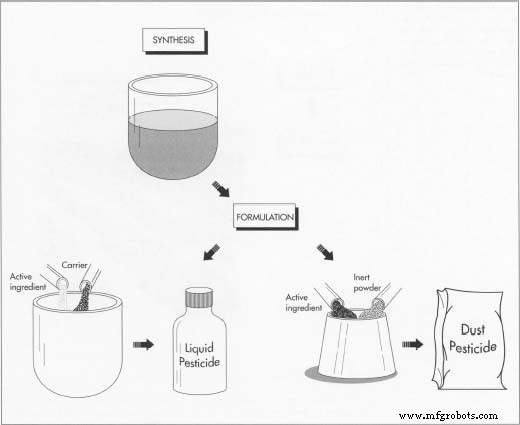
In production, the active ingredient is first synthesized in a chemical plant. A formulator then blends it with a carrier (for liquids) or inert powders (for dusts) before packaging. Liquid pesticides arrive in 200‑L drums for large operations or 20‑L jugs for smaller farms. Dry formulations are packaged in 5‑10 kg plastic or plastic‑lined bags.
Today, roughly 900 active chemicals are used in about 40,000 commercial preparations. The U.S. Environmental Protection Agency (EPA) estimates that pesticide use doubled between 1960 and 1980. Current annual consumption is over 372 million kg in the United States and more than 1.8 billion kg worldwide.
Raw Materials
A pesticide comprises an active ingredient—responsible for pest control—and inert ingredients that facilitate application, improve stability, and enhance performance. Active ingredients were once distilled from natural sources; modern production largely relies on laboratory synthesis. Nearly all active compounds are hydrocarbons derived from petroleum, often incorporating elements such as chlorine, oxygen, sulfur, phosphorus, nitrogen, and bromine.
Inert ingredients vary by formulation. Liquid pesticides traditionally use kerosene or other petroleum distillates; water has recently become a common alternative. Emulsifiers (e.g., soap) ensure uniform dispersion of the active ingredient. Dust formulations typically contain vegetable matter (ground nut shells or corn cobs), clays (diatomite or attapulgite), or powdered minerals (talc or calcium carbonate) to aid adhesion and delivery.
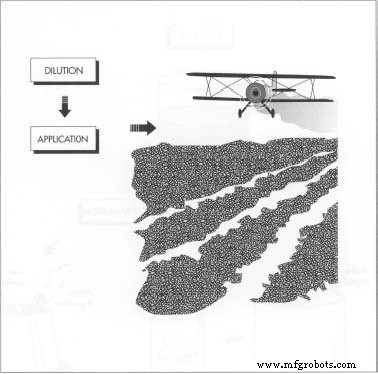
Farmers dilute commercial formulations with water before field application. Sprayers—ranging from small hand‑held units to tractor‑mounted boom systems—apply 150‑300 L / ha. The final applied concentration is typically 0.5‑1 % of the original active ingredient.
The Manufacturing Process
Producing a pesticide involves three core steps: synthesis, formulation, and field dilution.
Synthesizing the Pesticide
- Initial laboratory scale synthesis tests viability. Successful compounds enter factory production, often at 500 kg per batch or via continuous processes.
- Production requires skilled chemists, controlled environments, and precise reagent selection. The finished active ingredient is shipped to formulators under hazardous material regulations.
Formulating the Pesticide
- Formulators measure the correct quantity of active ingredient and blend it with carriers or inert powders. Liquid concentrates are typically 50 % active, facilitating transport.
- Packaging ranges from 200‑L drums for large‑scale users to 20‑L jugs for small farms. Dry formulations are packaged in 5‑10 kg bags.
Diluting the Pesticide
- Before use, applicators dilute concentrates with water to achieve the field‑use concentration, generally 0.5‑1 % active ingredient.
Applying the Pesticide
- Large‑scale aerial spraying employs 2,000‑L tanks and boom systems for flat terrains.
- Tractor‑mounted tanks and booms provide ground‑level coverage.
- Small farmers often rely on hand‑held sprayers with 3‑12 L or 200‑L tanks, applying 150‑300 L / ha.
Quality Control
Given their toxic nature, pesticides are subject to stringent safety and quality regulations. Manufacturers conduct comprehensive testing for potency, emulsification, density, color, pH, particle size, and suspension stability. Products typically exceed 95 % purity and must remain stable for at least one year. Accelerated shelf‑life tests expose samples to high temperatures to verify continued efficacy.
Certification is mandatory: U.S. farmers must complete training through the Agricultural Extension Service and obtain state certification before purchasing pesticides. Commercial applicators undergo similar training and written exams.
During dilution, applicators wear protective gear—coveralls, long‑sleeved shirts, gloves, boots, and, when required, goggles or respirators—per label instructions. Sprayers are calibrated with neutral solutions before each use to ensure even coverage and proper dosage.
Byproducts and Waste
Early enthusiasm for pesticides as yield enhancers waned after the 1950s when increasing volumes were needed to maintain efficacy. Rachel Carson’s 1962 book Silent Spring highlighted ecological risks, sparking widespread concern.
While pesticides target pests, they often kill natural predators, potentially causing pest resurgence. Over time, resistance develops, necessitating stronger chemicals. Misuse and inadequate application can render pesticides ineffective and pose health risks.
DDT exemplifies ecological harm: bioaccumulation in birds of prey led to endangered status and widespread bans. In 1972, the EPA prohibited most DDT uses. Several other chemicals have been banned or restricted, yet many remain exported to developing countries, contributing to an estimated 3 million pesticide poisonings and 20,000 deaths annually. This poses a contamination risk for imported produce.
Integrated Pest Management (IPM), introduced in the 1960s, promotes a diversified approach: biological control, cultural practices, mechanical removal, and selective chemical use. Techniques include deploying natural predators, biological insecticides, crop rotation, pheromone traps, and genetic modifications that disrupt pest reproduction. Ongoing research may further reduce reliance on chemical pesticides, enhancing sustainability.
Manufacturing process
- Titanium: Key Properties, Applications, and Industrial Uses
- Castanets: History, Craftsmanship, and Performance
- The History, Production, and Future of Glue: From Ancient Adhesives to Modern Innovations
- Thread: Types, History, Production, and Quality Control
- Acetylene: Production, Uses, and Handling – A Comprehensive Overview
- Comprehensive Overview of Asbestos: From Ancient Uses to Modern Health Risks
- The History, Design, and Manufacturing of Dice: From Ancient Tools to Modern Gaming
- Plywood: History, Production, and the Path Ahead
- Tin: From Bronze Age to Modern Industry – Uses, Production, and Future
- Silver: History, Properties, and Modern Applications