



The History, Materials, and Craftsmanship of Modern Umbrellas
Background
The umbrella, today synonymous with protection from rain, originally served as a sunshade. The Latin term umbra means “shade,” a heritage reflected in the word parasol—from French parare “to shield” and sol “sun.” Art and literature from ancient Africa, Asia, and Europe record widespread use of parasols and umbrellas. Egyptian mythology even depicts the goddess Nut covering the earth like a vast umbrella, her toes and fingertips barely touching the ground, shielding humanity from celestial dangers. Egyptians and Mesopotamians employed palm fronds and feathers, later introducing stretched papyrus for the canopy, producing a design recognizable to modern eyes.
By the 1st millennium BCE, the sun‑umbrella was a fashionable accessory among affluent Greek and Roman women. Its association with femininity was so strong that men who carried them faced mockery. In the first century AD, Roman women began oiling paper sunshades to create practical rain‑ready umbrellas. A 1st‑century lawsuit even debated whether women could open umbrellas in amphitheater events; the court ruled in favor of the women, affirming their right to carry them.
The umbrella’s popularity in England began in 1750 when Jonas Hanway deliberately used one in public, challenging social norms. Despite ridicule, Hanway’s persistence helped the umbrella become a staple. In the late 18th and early 19th centuries, it was even dubbed a “Hanway.” John MacDonald followed suit, further normalizing the device. By the 19th century, gentlemen’s outfits included hat, gloves, and umbrella as an etiquette standard.
Quality umbrellas balance a comfortable handle, smooth opening/closing, and tightly connected canopy ribs. These attributes reflect skilled craftsmanship and superior materials.
Raw Materials
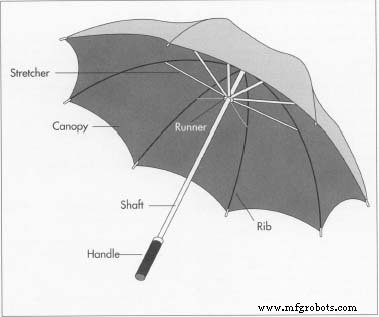
Umbrella technology has evolved dramatically. The pivotal breakthrough arrived in the early 1850s when Samuel Fox introduced U‑shaped steel ribs and stretchers, producing lighter, stronger frames. Prior models relied on cane or whalebone—bulky and less durable. Modern umbrellas are hand‑assembled by semi‑skilled workers, with careful material selection and quality control at each stage. The shaft may be wood, metal, or fiberglass; ribs and stretchers are typically U‑shaped steel. Contemporary rain‑umbrellas favor nylon fabrics that resist water, dry quickly, fold easily, and come in a wide array of colors and designs.
The Manufacturing Process
Hand‑assembly remains the core of umbrella production. Though the process can be executed by semi‑skilled labor, each decision—from material choice to final quality checks—impacts the end product’s durability and performance. The most recent innovation is the collapsible, telescoping umbrella, which folds into a ~1‑foot length. Though mechanically more complex than a standard stick umbrella, it shares the same foundational principles.
The Shaft
- 1. The shaft begins as a 3/8‑inch (≈0.95 cm) section of wood, steel, or aluminum. Fiberglass and other plastics are occasionally used, especially in large golf umbrellas. Wood shafts are commonly sourced from ash or Rowan (Asia), shaped on lathes or turning machines. Metal and plastic shafts are drawn or extruded to the required dimensions.
Ribs and Stretchers
- 2. Ribs and stretchers are first assembled from U‑shaped steel or other metals. Ribs lie beneath the canopy; stretchers connect ribs to the shaft. Ribs attach to the shaft via a narrow nylon or plastic notch with teeth, secured by thin wire. Stretchers engage the shaft through a plastic or metal runner that slides during opening and closing.
- 3. Ribs and stretchers are joined by a small metal hinge, allowing the umbrella to open or close through an angle exceeding 90°.
- 4. Each umbrella contains two catch springs housed in the shaft. The springs engage when the umbrella slides up or down, ensuring smooth operation. Metal shafts are hollow, permitting spring insertion; wood shafts require a carved cavity. A blocking pin prevents the canopy from sliding past the upper catch spring.
Canopy
- 5. The canopy is hand‑stitched from individual panels. Because each panel must conform to the curved shape, the canopy cannot be cut in one piece. Panels are sewn at rib edges and at a point roughly one‑third down the canopy. Typical umbrellas feature eight panels, though designs may vary from six to twelve. Historically, panel count hinted at quality, but today it reflects style and manufacturer preference.
The standard canopy material is a 190 T nylon taffeta, coated with acrylic on the underside and finished with a Scotch‑guard type protection on top. Fabric suppliers apply these finishes. Manufacturers may add patterns via rotary or silk‑screen printing for special orders. Alternative fabrics suit specific applications—e.g., patio umbrellas prioritize durability and aesthetics over lightness.
- 6. The tip of the shaft, passing through the canopy, may be finished with a metal ferrule or left bare, depending on design. The handle attaches at the shaft’s end; materials range from wood to plastic or metal. High‑quality umbrellas secure the handle with adhesive rather than screws for better stability.
- 7. End caps cover the ribs where they extend beyond the canopy. Caps—plastic or wood—are pressed, screwed, or glued onto the ribs and sewn in place through small holes.
- 8. After final inspection, the umbrella is packaged and dispatched to customers.
Manufacturing process
- What is VMC Machining? An Expert Overview of Vertical Machining Centers
- Expert Guide to Aluminum Laser Marking: Precision, Durability, and Industry Applications
- MIG vs. TIG Welding: Selecting the Right Arc Welding Technique for Your Project
- Comprehensive Guide to Laser Marking: Types, Benefits, and Applications
- Key Considerations for High‑Volume Swiss Machining
- CNC Prototyping Guide: Precision, Speed, and Cost‑Effective Production
- Expert Shaft Manufacturing: Precision Processes & Custom Solutions
- Fiber Laser Marking: Precision, Speed, and Versatility for Modern Industries
- The History, Materials, and Craftsmanship of Modern Umbrellas
- Linux Foundation Launches LF Edge to Accelerate Open‑Source Edge Computing