



Hybrid Vibration Monitoring: Combining Continuous and Route‑Based Strategies for Optimal Reliability
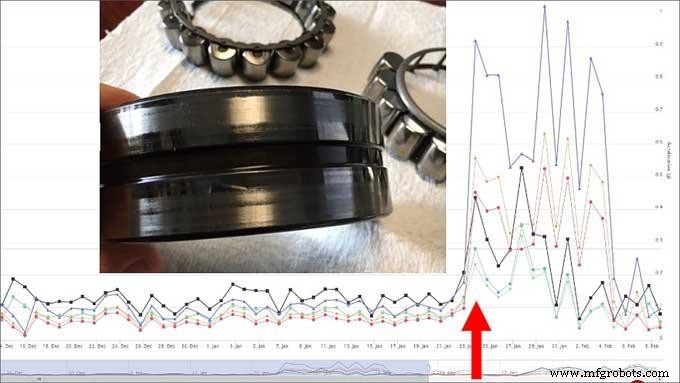
If you run a quarterly or monthly route‑based vibration inspection and still see unexpected failures, the root cause is often the limited snapshot nature of the method. Many bearing and motor defects can evolve rapidly—sometimes within days—without leaving a clear warning in a single on‑site check.
Take a bearing cage defect, for instance. It can progress from first symptoms to catastrophic failure in as little as a week. A purely route‑based schedule might miss that critical window. Switching entirely to continuous monitoring is one option, but it can be costly and sometimes unnecessary for lower‑risk equipment. A more balanced solution is to adopt a hybrid monitoring strategy that blends continuous data streams with scheduled inspections, applying the right tool to each asset type.
In this model, high‑value, safety‑critical, or process‑bottleneck assets—such as rooftop blowers, cooling fans, or conveyors that drive the entire line—receive continuous vibration monitoring (see Figure 1). Lower‑risk or low‑speed machines are efficiently monitored on a route‑based cadence. This approach delivers measurable uptime gains without the overhead of a full‑time, system‑wide continuous setup.
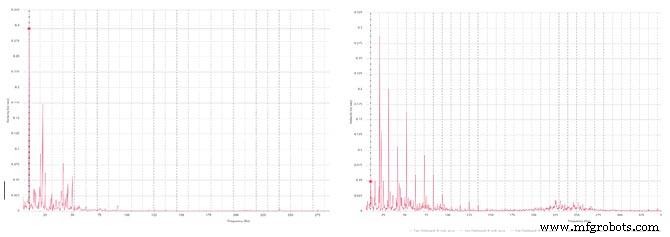
Figure 1: Baseline vibration spectrum of a bearing (left) taken by Dynapar OnSite™ Online Condition Monitoring System shows the highest amplitude at the fundamental frequency of rotation (red dot). In the spectrum taken after a defect emerges (right), the fundamental amplitude has dropped (red dot) while 2X and 3X harmonics rise; higher‑order harmonics correlate with bearing looseness.
Balancing Pros and Cons
In engineering, there is rarely a single perfect solution—there is always the best fit for the specific problem at hand. Designing a hybrid program begins with a clear understanding of each method’s strengths and limitations.
Route‑based monitoring captures manual readings at intervals defined by the asset’s history or a preventive maintenance schedule. It scales well to many points but requires significant upfront investment in equipment and trained technicians, whether in‑house or external. Data is usually stored locally, leading to growing storage demands, and interpretation demands skilled analysts—costs that can be mitigated only through training or outsourcing.
Continuous online vibration analysis deploys networked sensors that send data in real time to a local server or the cloud. The high sampling rate makes it exceptionally good at catching fast‑developing defects. While historically expensive, recent cloud‑based condition‑monitoring platforms bring the technology within reach for a wider range of assets.
Trade‑offs exist on both sides. Even at discrete intervals, continuous monitoring can generate massive data volumes that, in most cases, are stored in the cloud. User‑friendly analytics platforms can automatically run pre‑configured algorithms, reducing the need for deep expertise to turn raw sensor output into actionable insights.
Choosing the Right Tool for Each Asset
The ideal monitoring method balances cost against the likelihood that the chosen frequency will detect problems early enough to prevent unscheduled downtime. When selecting a modality, assess the risk of failure—including probability, duration, and impact on human safety, the environment, and overall production—as well as how accessible the asset is for manual readings and repairs.
Once you’ve tabulated these factors, match each application to the most suitable monitoring approach.
Assets Suited to Route‑Based Monitoring
Stable assets: Equipment with a mean time between failures (MTBF) of a year or more is effectively monitored with monthly or quarterly route‑based checks. Continuous monitoring for such assets offers marginal uptime gains at disproportionate cost.
Low‑risk assets: If an asset has a standby unit, spare inventory, or minimal impact on overall productivity when offline, route‑based monitoring is adequate.
Low‑speed assets: Most continuous monitoring systems exhibit roll‑off below about 600 RPM. Route‑based checks are thus preferable for slow‑rotating machinery, such as the 25 RPM conveyors in industrial ovens that handle heavy loads.
Example: The motors powering conveyor belts in food‑processing ovens often run at low speeds. Route‑based vibration checks, combined with other process‑variable monitoring, provide comprehensive insight into asset health.
Assets Best Tracked with Continuous Online Monitoring
Frequent failures despite route‑based checks: If an asset fails more than twice a year despite regular inspections, continuous monitoring offers a cost‑effective solution that captures fast‑developing defects.
Critical bottlenecks: Conveyors or equipment that serve as single points of failure for an entire line should be monitored continuously. For instance, a single rooftop blower servicing a 100,000 sq‑ft production floor can cause a shutdown worth over $1 million if it fails unexpectedly. Continuous monitoring provided early warning and allowed scheduled repair, saving significant downtime costs.
Difficult‑to‑access assets: Continuous monitoring is ideal for equipment that cannot be safely inspected while running, such as paper‑machine winder rolls. Cloud‑based analytics that scale vibration data with encoder speed enabled a safe, run‑time monitoring solution, extending the line’s operation until a bearing replacement was feasible.
Safety‑critical assets: Equipment whose failure could cause immediate injury or create hazardous environments—like dust collectors in wood‑product mills—must be monitored continuously. Hourly data collection revealed lubrication issues that, once addressed, reduced failure rates dramatically.
Troubled assets: When a route‑based check flags a developing defect, maintenance must decide whether to repair immediately or delay while monitoring. Weekly or daily checks become cost‑inefficient, whereas continuous monitoring provides the short‑interval data necessary for rapid response and automated alerts.
Variable‑speed assets: Machines that constantly accelerate and decelerate—such as wind/unwind rolls—experience premature bearing wear. Continuous monitoring captures these dynamic stresses better than sporadic checks.
A single condition‑monitoring solution cannot cover every scenario. By auditing the facility and categorizing assets, you can build a hybrid program that optimizes uptime, safety, and profitability.
About the Author
Derek Lammel, Reliability Specialist at Dynapar Corporation, is a Category III Vibration Analyst with extensive experience in predictive maintenance across vibration analysis, thermography, oil analysis, and ultrasound. A former U.S. Navy aviation maintenance officer, Derek brings 9 years of overseas service in Patrol Wing Reconnaissance Squadron 45 to his work. Since joining Dynapar in 2019, he has led the development of vibration‑analysis strategies for a broad range of industries—including pulp & paper, steel, food & beverage, and mining—helping customers achieve higher uptime and lower costs.
Equipment Maintenance and Repair
- Proactive IoT Strategies for Monitoring and Enhancing Public Spaces
- Reliability‑Centered Maintenance Reimagined: A Holistic, Business‑Focused Approach
- Wireless Condition Monitoring: Boost Production & Cut Downtime
- Wireless Technology Transforms Condition Monitoring for Industrial Reliability
- Understanding Machinery Vibration: Causes, Symptoms, and Rapid Diagnosis with the Fluke 810
- New A6630 Temperature Module Enhances CSI 6500 Machinery Health Monitor with Vibration & Temperature Insights
- Introducing Rotating Assets: Streamlined Asset Lifecycle Management
- Vibration Analysis Fundamentals: A Practical Guide for Predictive Maintenance
- Eliminating Fan Vibration: A Practical On‑Site Balancing Solution
- Mastering Vibration Analysis: A Data‑Driven Strategy to Eliminate Machining Chatter