



Choosing the Right IoT Platform: A Practical Guide for Businesses
What is an IoT platform?
An IoT platform is the software backbone that connects edge devices, access points, and data networks to the end‑user applications that deliver value. These platforms handle device management, data routing, and visualization, enabling organizations to automate and derive insights from sensor data. In practice, they act as the middleware that translates raw edge data into actionable information for SaaS or mobile apps.
IoT or M2M solutions are typically composed of several layers from different vendors:
- Sensors or controllers
- A gateway that aggregates and forwards data
- A communications network that transports the data
- Analytics and data‑translation software
- The end‑user application that creates value
These layers together form the IoT value chain. When we talk about an IoT platform, we’re usually referring to layers 3 through 5.
Considerations In IoT Platform Selection
Because IoT environments are inherently complex, the market is crowded with vendors promising automation at scale. Choosing the right platform requires a clear understanding of your specific needs—whether you need particular hardware, protocols, real‑time access, custom reporting, or other capabilities.
The Internet of Things is an inherently complex networking environment, and thus, the need to automate data tasks at scale has thrust a number of IoT platform players into the market.

Before you pick a solution, assess:
1. Budget, in‑house expertise, and capacity
- Platform pricing can be deceptive. Introductory rates often only cover the base model, and the cost can increase tenfold once you enable the features you actually need.
- Being transparent about your budget with the vendor helps prevent upselling on unnecessary features.
- Licensing fees are only the beginning. Integration, development, and consulting costs can quickly add up, so factor these into your total cost of ownership.
2. Your business model and the value you create
To monetize an IoT offering, you must add value beyond the underlying hardware. Identify where you add the most value in the value chain, and choose a platform that supports that focus. For example:
- If your core asset is a hardware device, an upfront license fee can be embedded in the device cost.
- If you run a subscription model, consider bundling the platform cost into recurring fees.
Also, understand the platform’s pricing model—whether it charges by data volume, users, nodes, or another metric—as this will influence your own cost structure.
3. Time versus money
Decide whether you need to cut development time or reduce long‑term expenses. Some platforms, like AWS IoT, are inexpensive and modular but require significant custom development. Others, such as PTC ThingWorx, offer extensive out‑of‑the‑box functionality at a higher upfront cost but can shorten time to market.
Successful platforms often pair closely with hardware distributors that provide both the connectivity hardware and a complementary software stack.
3 Types Of IoT & M2M Platforms
Platforms can be grouped by sophistication, from highly integrated solutions to more basic device‑centric offerings.
- Application enablement & development: These platforms provide templates, modules, and widget‑based frameworks that accelerate the creation of end‑user applications. Leading players include Oracle, Wot.io, and ThingWorx.
- Network, data, and subscriber management: In the cellular and MVNO space, these platforms simplify connecting M2M traffic without building custom data infrastructure. Cisco, Aeris, Jasper, and Wyless are prominent examples.
- Device management: Focused on provisioning, monitoring, and troubleshooting endpoints, these platforms are common among hardware vendors. Digi and Intel offer pure device‑cloud solutions.
This chart from First Analysis shows the various functions, features, and components by platform type:
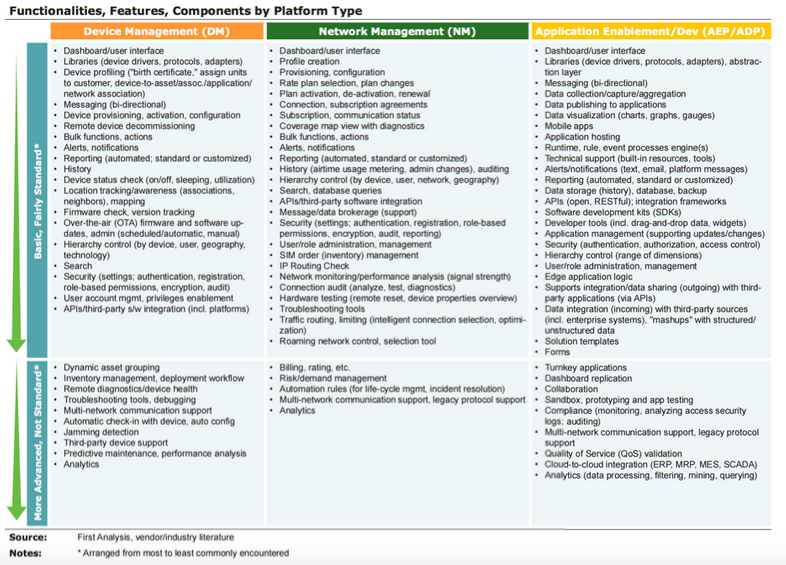
IoT Platform Type Convergence
Many platforms today combine features from all three categories. While this breadth can accelerate development, it also introduces integration challenges when you need a deep, specialized capability. A platform with a slick UI but limited device‑management may force you to rely on a less‑user‑friendly system for critical tasks, which can be a deal‑breaker.
When starting from scratch, a platform that covers device, network, and application layers can get you up and running faster. But if you already have components in place, overlapping functionality can create complexity. Carefully map out your future system at scale, prioritize the features you need, and then choose the platform that best aligns with those priorities.
Many companies build custom in‑house platforms. Depending on your go‑to‑market strategy, a pre‑built solution may save you time and money. Evaluate the trade‑offs before committing.
A Final Note
Many organizations still develop their own platforms, but leveraging a proven third‑party solution can be a smart choice when rapid deployment and cost efficiency matter.
Internet of Things Technology
- Plate Clamps: Design, Function, and Benefits for Heavy‑Duty Lifting
- Thrust Bearings Explained: Types, Functionality, and Selection Guide
- Flat Springs Explained: Design, Function, and Selection Guide
- Adjustable Glides: What They Are, How They Work, and Their Benefits
- Locking Washers Explained: Types, Functions, and Why They Matter
- Choosing the Right IoT Platform: Insights from a 2,000‑User Survey
- Apple AirTags in the IoT Landscape: What Businesses Need to Know
- Designing and Managing an Effective Maintenance Shop: A Practical Guide
- Choosing the Right IoT Platform: A Practical Guide
- How IoT Fuels Industry 4.0: Unlocking Key Benefits