



LoRa Localization: Why Native Geolocation Is More Complex Than It Appears
At Link Labs, we’ve noticed a growing interest in native LoRa geolocation. The concept is simple: use three or more gateways to calculate a time‑difference‑of‑arrival (TDOA) and derive a device’s position. It sounds straightforward, but the physics behind it make it far more complex.
Update: Semtech has just announced that this capability is “now available.” See the press release for details.
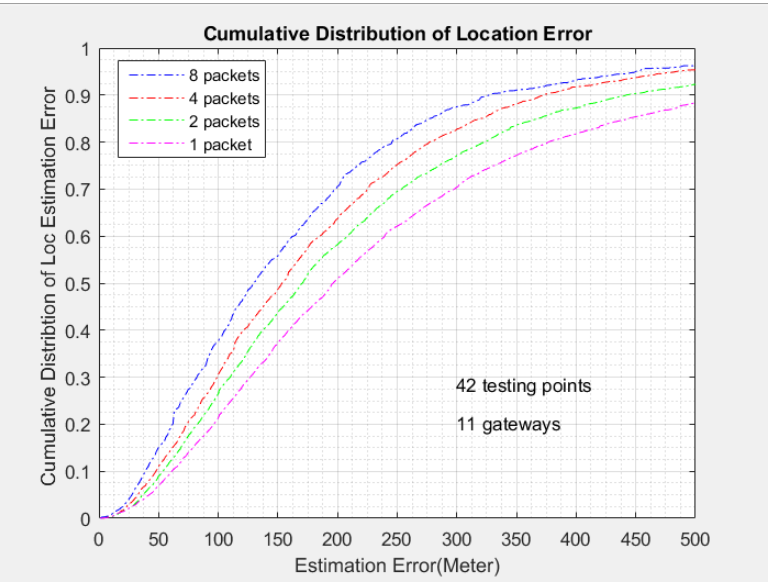
Update #2: According to Semtech’s own localization study, a single packet routed through 11 gateways in an urban setting yields a 10 % error rate of just over 500 m. When plotted as a 90 % confidence circle, the diameter expands to more than 1 km. The full report explains why.
Accurately determining position with low‑power, narrowband RF such as LoRa (or Sigfox) is one of the most challenging problems in wireless engineering. While many companies are excited about native LoRa localization, our experience in time‑domain positioning systems tells us that achieving a truly usable solution is extremely difficult, if not impossible.

Below we outline the key technical hurdles. For a deeper dive, see the reading list at the end.
1. Direct‑Path Energy
To calculate distance accurately, you must capture the direct line‑of‑sight (LOS) path, not a reflected one. LoRa excels at penetrating multipath environments, but its low transmit power limits the energy available on the LOS path. For example, a LoRa gateway on the 4th floor communicating with a node on the 44th floor often receives the signal after it has bounced off the building and re‑entered the room—doubling the path length and reducing the received power dramatically.
Detecting the LOS component depends on the product of time on air, bandwidth, and transmit power. LoRa offers a respectable bandwidth and airtime, but regulatory constraints keep power low. Consequently, unless a near‑LOS link exists, the direct path energy falls below the correlation noise floor.
Conclusion: In non‑LOS conditions, the direct path cannot be isolated, making precise TDOA impossible.
2. Multipath Correlation Resolution
Even if the direct path is detectable, distinguishing it from reflected paths requires sufficient bandwidth. The fundamental resolution limit is given by c / B, where c is the speed of light and B is bandwidth.
For LoRa’s 125 kHz bandwidth: c / B = 2,398 m. This means that any two paths differing by less than ~2.4 km will merge in the correlation, introducing significant range error.
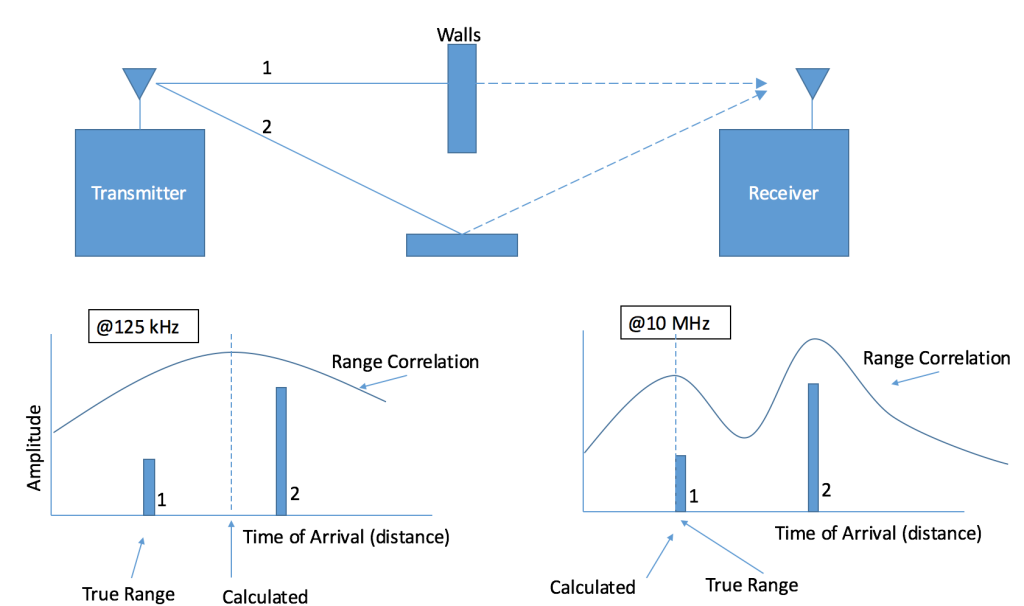
In contrast, a 10 MHz signal provides a 30 m resolution, allowing the receiver to separate paths that differ by more than 30 m. LoRa’s narrow bandwidth thus severely limits multipath discrimination.
Because of these physics limits, the 3GPP’s decades‑long attempt to implement GSM TDOA failed for similar reasons: limited power and bandwidth were insufficient to overcome multipath.
Averaging and More Gateways
Averaging many packets can only help if the transmitter remains phase‑locked between bursts—a condition that LoRa’s low‑cost oscillators do not satisfy. Adding more gateways increases the likelihood of a strong LOS link, but the cost of deploying dozens of gateways quickly erodes any advantage.
Why Link Labs Shares This
As an engineering‑first company, we believe in honest, transparent communication about what technology can realistically achieve. By setting realistic expectations, we help our customers avoid costly pitfalls.
LoRa Geolocation Still Matters
While native LoRa TDOA is fraught with challenges, LoRa remains a powerful enabler for location‑centric applications when combined with other techniques:
- GPS + LoRa – Ship GPS coordinates over LoRa. Power‑intensive and limited to outdoors.
- Proximity/RSSI Beaconing – Endpoints broadcast to fixed LoRa readers, which return RSSI and timing data. See AirFinder.
- Signal‑of‑Opportunity / PHY Reporting – LoRa nodes report nearby Wi‑Fi SSIDs and RSSI to a cloud service (e.g., Skyhook) for hybrid positioning.
These methods, and others we’re developing, can deliver reliable indoor and outdoor asset tracking. Contact us to explore a tailored solution for your use case.
Reading List
• “TDOA in GSM Networks” – A foundational paper on the challenges of GSM TDOA.
• “Time‑Domain Localization: A Comprehensive Survey” – Covers the entire spectrum of positioning technologies.
• “Ultra‑Wideband Localization” – Provides the mathematical background that underpins modern high‑precision positioning.

Internet of Things Technology
- Signal Coupling: Understanding AC Noise in Telephone Cables
- Combination Tubes: Merging Multiple Functions into a Single Glass Envelope
- Voltage Signal Systems: Accurate Measurement of Water Tank Levels
- Current Signal Systems: The 4‑20 mA Loop Explained
- Traffic Signals: Engineering, History, and Future Innovations
- What Is LoRaWAN? A Technical Deep Dive
- LoRa Explained: Technical Foundations & Practical Applications
- NB‑IoT vs. LoRa vs. Sigfox: Selecting the Ideal LPWAN for Your IoT Deployment
- LoRa FAQ: 14 Expert Answers to Your Most Common Questions
- Ensuring Signal Integrity in High-Speed PCB Design