Industrial manufacturing
Sensor

MEMS sensors have been around for a long time, but requests from the market for new applications are driving upgrades in the technology. Because of their small size, their accuracy, and reliability, MEMS sensors are a good fit for wearable devices. Barometric pressure sensors, for example, are ideal
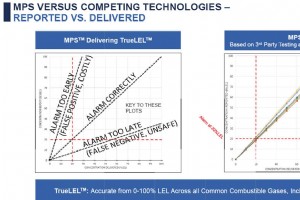
Sensing of gases is a critical function but the technology hasn’t changed in decades. So, when I heard about a brand-new type of sensor from NevadaNano (Sparks, NV), I decided to interview Ben Rogers, their Director of Engineering. Molecular Property Spectrometer They call their sensor, a MEMS-based
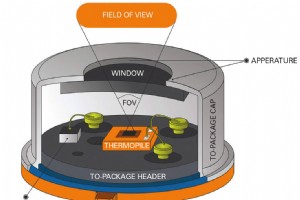
Over the last 75 years, sensors have played an increasingly significant part in the advancement of medicine. Medical sensors for monitoring people’s vital signs, including temperature, blood pressure, heart rate, and respiration rate have become increasingly sophisticated. But sensors are also usefu
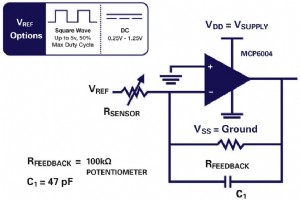
From electronic devices to high-efficiency vehicles, consumer demand continues to grow for more compact, lightweight, quick-charging battery technologies with higher energy densities. At the same time, batteries should also be safe, even in catastrophic events. Lithium-ion (Li-ion) has become a favo
We are in the age of an AI (artificial intelligence) explosion. Everything — from your refrigerator to your dog’s bowl — will become part of the AI neuron network. Worldwide revenues for the AI market, including software, hardware, and services, are forecast to grow 16.4 percent year over year in 20
To find out what’s ahead for MEMS automobile navigation systems, I interviewed Yang Zhao, CEO, and Teoman Ustun, VP of Marketing and Business Development, ACEINNA, Inc. (Boston, MA). Tech Briefs: Why do you call ACEINNA IMUs next generation? Yang Zhao: In ideal conditions, you can navigate a car wit
In the circuit board industry, an increasing number of parts and boards are proving to be difficult to inspect with automated optical inspection (AOI) because the solder is invisible. Furthermore, high-quality requirements such as bonding strength of the automobile industry and full surface inspecti
In many motion control applications, it is necessary to know the position, speed, and perhaps even acceleration of a motor’s rotor or its load. Depending on the application and design specifics, the motor controller might need to know these parameters precisely, approximately, or perhaps not at all.
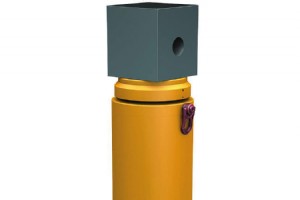
In oil and gas subsea production systems, a subsea “Christmas tree” is mounted on the wellheads. Each tree controls the oil and gas production of its respective well via multiple process valves. Each process valve is actuated by a subsea valve actuator (SVA) that must be able to safely close the val

The Intelligent Structural Monitoring and Response Testing (iSMaRT) Lab at the University of Pittsburgh Swanson School of Engineering has designed a new class of self-aware materials. The self-powering metamaterial system is, in effect, its own sensor, recording and relaying important informat
Lost something on the beach? A Digger Finger from MIT digs through sand and gravel to detect a buried object. Equipped with tactile sensing, the slender, digit-like device could someday be mounted on a robotic arm and used to spot underground cables or even explosives. The research from the MIT team
North Carolina State University engineers continue to improve the efficiency of a flexible device worn on the wrist that harvests heat energy from the human body to monitor health. The researchers report significant enhancements in preventing heat leakage in the flexible body heat harvester they fir
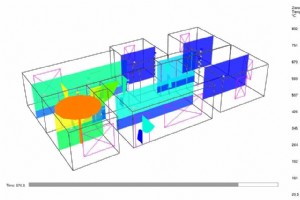
A deadly phenomenon known as flashover occurs when flammable materials in a room ignite almost simultaneously. A blind spot for firefighters, the event produces a blaze limited only by the amount of available oxygen. A new tool — called P-Flash — estimates when flashover is imminent. The technology,
Physicists from the University of Sussex have developed an extremely thin, large-area semiconductor surface source of terahertz, composed of just a few atomic layers and compatible with existing electronic platforms. Terahertz sources emit brief light pulses oscillating at trillion of times per seco
Atomically thin materials are a promising alternative to silicon-based transistors; now researchers can connect them more efficiently to other chip elements. Moore’s Law, the famous prediction that the number of transistors that can be packed onto a microchip will double every couple of years, has b
After the optical frequency comb made its debut as a ruler for light, spinoffs followed, including the “astrocomb” to measure starlight and a radar-like comb system to detect natural gas leaks. Now, researchers have unveiled the “agricomb” to measure “cow burps.” The agricomb could help optimize agr
Engineers at the University of California San Diego have developed a soft, stretchy skin patch that can be worn on the neck to continuously track blood pressure and heart rate while measuring the wearer’s levels of glucose as well as lactate, alcohol, or caffeine. It is the first wearable device tha
Typically, non-destructive evaluation of composites — by ultrasound or other means — is conducted either before or after the cure process but many defects vanish and form during cure. NASA Langley Research Center, in collaboration with Analytical Mechanics Associates, developed an automated ultrason
Even small changes in a soldier’s surroundings could indicate danger. Now, a robot can detect those changes and a warning could immediately alert the soldier through a display in her eyeglasses. Researchers demonstrated in a real-world environment the first human-robot team in which the robot detect
While real-time positioning computed by standard GPS service is adequate for some onboard applications, inherent position discontinuities are not acceptable for high-precision instrument applications, such as view-period prediction and maneuver planning, both of which are computations that require a
Sensor