



Open‑Die vs Closed‑Die Forging: Techniques, Applications, and Key Differences
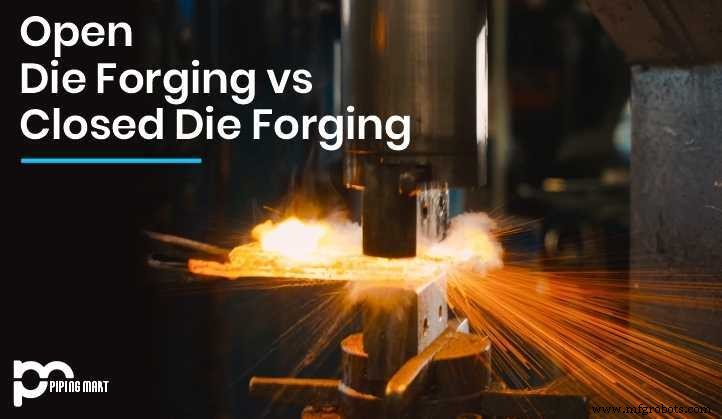
Open‑Die Forging
Open‑die forging, also known as free‑form forging, shapes heated metal between a swinging hammer or anvil and a loose die. The metal is held in a bucket‑type die that does not fully encase the workpiece, allowing the hammer to strike from all sides. Typical forging temperatures range from 500 °F to 2,400 °F (260 °C to 1,310 °C), depending on the alloy and desired mechanical properties.
Because the die is open, the operator can adjust dimensions by repeated hammer blows, gradually refining the part before it reaches final tolerances. This flexibility makes open‑die forging ideal for large, complex shapes such as shafts, gears, and structural components that may not fit into a closed die.
Closed‑Die (Impression) Forging
Closed‑die forging uses a pair of matched dies that fully encase the billet. The metal is compressed between the upper and lower dies until it fills the impression, producing a part that already meets precise dimensions. The process typically involves one or two forging passes followed by minimal machining, as the final shape is largely determined by the die geometry.
Closed‑die forging is preferred when high dimensional accuracy, surface finish, and repeatability are required. It is commonly used for items such as bolts, crankshafts, and precision structural parts that must meet stringent tolerances.
Key Differences
- Die configuration: Open die leaves the billet partially exposed; closed die fully encapsulates it.
- Process flexibility: Open die allows on‑the‑fly adjustments; closed die relies on pre‑designed die geometry.
- Typical applications: Open die for large, complex shapes; closed die for small, high‑precision parts.
- Machining requirement: Open die parts often need more post‑forging machining; closed die parts usually require minimal finishing.
- Tooling cost: Closed‑die tooling is expensive and time‑consuming; open‑die tooling is cheaper and quicker to set up.
Choosing the right forging method depends on part size, required tolerances, production volume, and cost constraints. By understanding these fundamental differences, manufacturers can optimize their forging processes for both performance and efficiency.
Metal
- Titanium Alloy Forging: Advanced Techniques for Aerospace & Power Generation
- Neon: A Dynamic Open/Closed Makerspace Sign Powered by Raspberry Pi 2 – El Paso, TX
- Build a Speech-Driven Computer Vision Robot on Windows 10 IoT Core
- Forging Carbon Steel: How Heat and Pressure Transform Strength and Toughness
- Understanding the Flange Forging Process: Benefits, Techniques, and Applications
- Mastering Control Loops: Open vs. Closed Systems Explained
- Forging, Stamping & Casting: Understanding Their Key Differences
- Die Casting Explained: Precision, Efficiency, and Production Benefits
- Die Stock Explained: Essential for Precise Threading on Screws, Bolts, and Pipes
- Open vs. Closed 3D Printing Systems: Choosing the Right Solution