



Batesville Casket: Excellence in Reliability and Continuous Improvement
In manufacturing, a reliable maintenance department is the silent partner that keeps production flowing smoothly—much like a seasoned football referee who manages the game without drawing attention.
“If we do our jobs right, nobody knows that we even exist,” says George Doll, the maintenance manager at Batesville Casket Company’s assembly plant in Batesville, Ind. This quiet excellence is crucial for a company that delivers personalized caskets to grieving families on strict timelines.
Customers expect each custom‑made casket—often featuring specific colors, etchings, handles and interior fabrics—to arrive at the funeral home defect‑free and on schedule, even when orders are placed the day before. With 75 % of products customized, Batesville uses a single production line that produces a unique casket each minute, completing orders in just 24 hours.
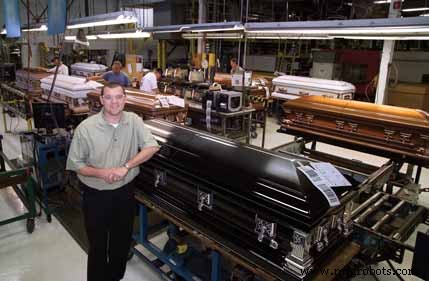
Assembly superintendent Joe Dwenger believes in the power of maintenance.
“Customers expect more out of us,” says plant manager Todd Dennis. “As demands rise, so does the pressure on our systems.” When equipment fails, downtime can push delivery dates back, leading to quality issues that compromise the customer experience. A failure that slips to the funeral home is a direct reflection on the plant, much like a referee’s controversial call under public scrutiny.
“If you don’t fulfill your responsibilities, you are digging a deep hole for yourself,” warns lean sensei Mike Wroblewski.
With nearly 1,000 primary production assets, Doll’s team of multi‑craft professionals maintains exceptional uptime across the 300,000‑square‑foot plant floor. High reliability translates to first‑pass yield and low returns, ensuring that the final product meets every family’s expectations.
“Did the customer get what he or she wanted at the end of the day?” asks maintenance superintendent Butch Flaspohler. “That is the final judgment.”
The maintenance organization remains invisible to the customer, yet its impact is felt across the plant and the 123‑year‑old corporation. Their contributions to reliability, product flow, continuous improvement, and lean operations underpin a glowing industry reputation.
Batesville’s commitment to maintenance excellence earned an IndustryWeek Best Plants award in 2006 and a regional Association for Manufacturing Excellence title in 2007.
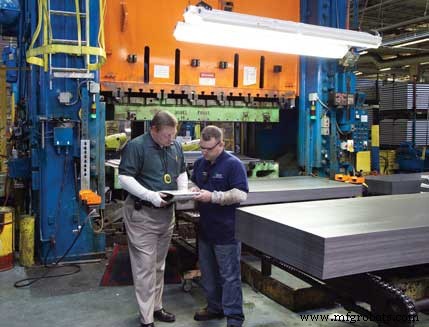
Mike Wroblewski (left), Batesville Casket Company’s lean sensei, pores over some production data with an operator on the stamping line.
DNA AND DISSECTION
Batesville is the leading casket manufacturer in America, reporting $659 million in sales in 2006. Its success stems from a culture of continuous improvement that has been ingrained for 123 years.
“Change has been a part of Batesville’s culture for 123 years. It’s in our DNA,” says Dennis. “We have a burning desire to make things better.” Whether it’s equipment, processes, products or logistics, the plant never stops tinkering.
“We’ll look at something and say, ‘Overall, it’s working well. But what isn’t working well?’ We’ll peel back the onion and look at the non‑value‑added components,” explains Dennis. “Many companies would say, ‘That’s working well. Why break it?’ We don’t approach it that way. We want to get better every year.”
The philosophy is simple: be proactive, seize opportunities in change, and control plant assets before they control you.
Lean manufacturing and reliability enhancement initiatives formalized nearly two decades ago continue to strengthen this bond year after year.
“Lean and reliability go hand in hand,” says Doll. “To be lean, you have to run your production line in a flowing nature. If you have unplanned downtime or breakdowns, it interrupts the flow and impacts quality and productivity.”
“You can’t have lean without reliability,” adds Dennis. “Without a reliable system, you’re constantly fixing equipment and processes. Lean is built on stability.”
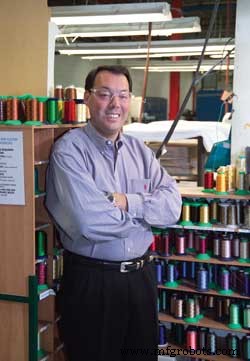
Plant manager Todd Dennis says, “Change has been a part of Batesville’s culture for 123 years. It’s in our DNA.”
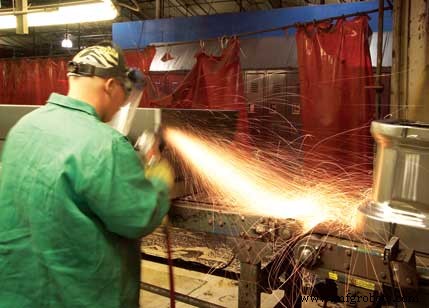
The facility in Indiana manufactures bronze, copper, stainless steel and steel caskets. Photos by Bill Krider, Krider Photography.
Other metrics of reliability and lean enablement include:
Uptime: Critical areas of the plant achieve 99 % uptime; less critical areas average 96 %.
Lost cycles: The assembly line’s takt time is 56.5 seconds. Missing a cycle means a delay. “Losing 56 seconds of production is catastrophic here,” says Dwenger. “Our goal is 100 % efficiency—no allowance for lost time.” The plant’s lost‑cycle rate is less than 1 %.
Proactive vs. reactive work: Proactive maintenance accounts for 75 % of work in mission‑critical areas and 50/50 elsewhere. Previously, reactive work made up 75 % of all maintenance activities.
Quality: “Quality prevents us from having good flow,” says Dennis. “I have as many quality‑related lost cycles as I do equipment downtime.” Interruptions from breakdowns damage the product or force operators out of their normal workflow, compromising quality.
CONTINUOUS IMPROVEMENT TALE OF THE TAPE: DITCA VERSUS DITKA
- Name: DITCA (Daily Improvement Target Countermeasure Analysis)
- Nickname: The form
- Claim to fame: Since the late 1990s, Batesville has submitted 500‑750 DITCA forms annually, saving over $1 million each year from 2002‑2006.
- Quotable: “Every single day, a team leader or a backup team leader should come up with an improvement,” says Dwenger. “It doesn’t have to be a game‑changer; it can be a simple idea captured on the DITCA form.”
- Name: Ditka (Mike Ditka)
- Nickname: Da Coach
- Claim to fame: Ditka is one of only two men to win a Super Bowl as a player, assistant coach, and head coach. He was inducted into the Pro Football Hall of Fame in 1988.
- Quotable: “Those who live in the past are cowards and losers.”
FIVE‑WHYS AND RCA
The maintenance organization employs five‑why analysis and root‑cause analysis (RCA) to solve problems quickly and sustainably. The approach encourages critical and creative thinking, producing fact‑based answers and innovative solutions.
Example: A finish system failure caused 70 lost cycles. The five‑why chain identified an unmaintained filter as the root cause, leading to a permanent fix rather than a temporary repair.
When an issue results in five or more lost cycles—or indicates a potential recurrence—team leaders initiate a full RCA to create lasting solutions.
DEEP ANALYSIS
Maintenance leaders conduct criticality analyses to prioritize equipment and processes by physical and financial impact. Lost cycles can cost up to $125 each in assembly, while fabrication costs only $15.
By maintaining spreadsheets that link equipment, lost cycles, and dollar impact, the team targets resources where they yield the greatest benefit. Proactive maintenance (preventive or predictive) is preferred over reactive “run‑to‑failure” for high‑impact assets.
MANPOWER CRITICALITY
With limited daily man‑hours, the plant analyzes workforce allocation to distinguish value‑added work from non‑value‑added activities. This insight has led to better planning, scheduling, and reduced overtime.
Preventive maintenance schedules are also refined; many machines that once received PMs every six weeks now operate on 12‑week intervals, increasing lean efficiency without compromising reliability.
CREATIVE THINKING
The maintenance team regularly devises low‑cost, durable solutions to daily operational challenges. Examples include a poke‑yoke gauge to prevent mis‑insertion of components, a Plexiglas window to monitor dust buildup, a vibration‑damping support system, a sand‑bag pulley to hold casket lids, and a fillable bench to reduce operator strain.
Collaborators such as toolmakers, CAD technicians, and engineering services provide critical resources, fostering innovation and simplicity.
Each improvement is documented on a DITCA sheet, which captures the problem, root cause, countermeasures, and team contributors. Weekly meetings showcase completed DITCAs, and personnel receive recognition for their contributions.
Environmental benefits also result from these initiatives—sealing compressed‑air leaks, conserving water, reducing electrical consumption, and replacing mercury lamps with high‑tech fluorescent bulbs.
THE CLOCK IS TICKING
The plant’s quick‑response pit‑crew mentality ensures that downtime is minimized. When a failure occurs, a team of three to five technicians converges on the spot, diagnoses the issue, and resolves it—often within minutes. Centralized troubleshooting and real‑time support further accelerate recovery.
Proactive measures, such as predictive maintenance (PdM) using infrared thermography, vibration analysis, laser alignment, and oil analysis, complement the reactive approach. PdM allows technicians to target the exact component needing replacement, reducing unnecessary downtime.
PROACTIVE HIRING
With many seasoned workers approaching retirement, the maintenance department has implemented a proactive hiring program. New hires start in lower grades and progress to full‑time maintenance roles over three to five years, gaining safety, book‑based knowledge, and hands‑on experience. Currently, 30 % of the team is in this “young, up‑and‑coming” category.
Standardized work orders, complete with safety instructions, lubricant specifications, and belt types, ensure consistency across technicians of all experience levels.
GROUNDED Doll takes pride in the maintenance team’s contributions to reliability and continuous improvement. While the plant remains a quiet, invisible force, its impact is felt throughout the organization.
“In terms of delivering reliability to the plant and the company, I think we’re an 8 to a 9 on a scale of 1 to 10,” says Doll. “I would like to think we’re a 10, but there are always opportunities for improvement.”
Future plans include:
- Greater use of design‑for‑maintainability and reliability principles when purchasing new equipment.
- Standardizing parts to reduce tool crib inventory.
- Reducing “deadly waste” by making critical systems more robust—currently 250 workers can be idle when the line is down.
- Hiring more problem‑solvers to sustain the plant’s momentum.
Leadership emphasizes accountability. “The simplest and best way is to lead by example,” says Wroblewski. “Actions speak louder than words.”
With a strong track record of industry awards, the plant remains committed to continuous improvement—recognizing that the pursuit of excellence is an ongoing journey.
THE DIRT ON BATESVILLE
Plant: Batesville Casket Company plant in Batesville, Ind.
Plant size: The assembly plant encompasses 300,000 square feet.
Plant employment: Approximately 600 associates, including 34 in the maintenance department. The maintenance total includes 29 hourly associates and five salary associates. The facilities group has an additional three workers. The plant is an open union shop. Employees can opt, if they choose, to be members of a union.
Products: The facility manufactures bronze, copper, stainless steel, steel and hardwood caskets.
Production: The plant completes one casket every minute of a production shift.
FYI: Batesville Casket Company is an operating unit of Hillenbrand Industries, which is also based in Batesville, Ind. The Indiana assembly plant won an IndustryWeek Best Plants award in 2006 and was the Great Lakes Region winner of the Association for Manufacturing Excellence’s Award for Manufacturing Excellence in 2007. Batesville’s sister plant in Manchester, Tenn., was the national winner of AME’s Award for Manufacturing Excellence in 2006.
Equipment Maintenance and Repair
- Eli Lilly BHI Plant: A Reliability Success Story
- Six Real-World Case Studies: How Predictive Analytics Boosts Power Plant Performance
- Case Study: Honda Lincoln Plant – Engineering Excellence & Reliability
- Rebuilding Reliability at Century Aluminum’s Ravenswood Smelter
- High-Performance Maintenance at CCM Tecate: A Proven TPM Success Story
- Predictive Maintenance Case Study: Real-World Vibration, Infrared, Oil, and Motor Current Analysis
- Why Standing Work Orders Streamline Maintenance Management
- Repair vs. Replace: A 10‑Year‑Old Grinder Case Study
- Diagnosing a Persistent Gearbox Noise: Lessons from a Refurbished Unit
- Understanding Verilog Case Statements: Efficient Multiplexer Implementation