



Impact of Threading Dislocation Density on the Refractive Index of AlN: Nanoscale Strain Field Effects
Abstract
The refractive index of aluminum nitride (AlN) critically influences the performance of AlGaN‑based deep‑ultraviolet (DUV) optoelectronic devices, including the external quantum efficiency (EQE) of LEDs. High‑density threading dislocations (TDDs) are a common defect in AlN, yet their quantitative effect on refractive index remains poorly understood. In this study, we systematically varied TDDs from 4.24 × 10⁸ to 3.48 × 109 cm−2 by post‑growth annealing and measured the corresponding refractive index using spectroscopic ellipsometry (SE). The refractive index decreased from 2.2508 to 2.2102 at 280 nm as TDD increased, confirming that dislocations reduce the optical density of AlN. Theoretical modeling of the nanoscale strain field surrounding screw and edge dislocations demonstrates how local elastic deformation perturbs the photoelastic response, leading to spatially varying refractive index and enhanced light scattering. These findings provide a critical design parameter for optimizing DUV LEDs, laser diodes, and DBR structures built on AlN substrates.
Introduction
AlN and its alloys are the workhorses of DUV optoelectronics, offering a direct bandgap tunable from 3.4 to 6.2 eV. The refractive index of AlN directly determines light‑extract efficiency (LEE) through the total internal reflection angle and also governs the reflectivity of distributed Bragg reflectors (DBRs). Consequently, any factor that shifts the refractive index can limit device output power or spectral performance. While temperature, pressure, and bandgap have been shown to affect AlN’s optical constants, the role of threading dislocations—prevalent in epitaxial AlN layers—has not been quantified. Given typical TDDs ranging from 108 to 109 cm−2, it is imperative to establish their influence on refractive index to guide growth optimization and device engineering.
Methods
High‑quality AlN templates were grown on c‑sapphire by metal‑organic chemical vapor deposition (MOCVD) using trimethylaluminum and ammonia precursors under 40 mbar hydrogen flow. A 1.1 µm AlN film was fabricated through a two‑step growth: a 955 °C nucleation layer followed by 1280 °C high‑temperature growth, interleaved with a 1050 °C AlN interlayer. Post‑growth annealing at 1500, 1600, 1700, and 1750 °C for one hour produced samples with progressively lower TDDs. X‑ray diffraction (XRD) rocking curves (XRCs) measured (0002) and (10–12) planes to extract screw and edge dislocation densities via the modified Hall–Petch equations. Spectroscopic ellipsometry (SE) provided the complex refractive index across 200–1000 nm. Raman spectroscopy assessed residual stress by tracking the AlN E2(h) peak shift.
Results and Discussion
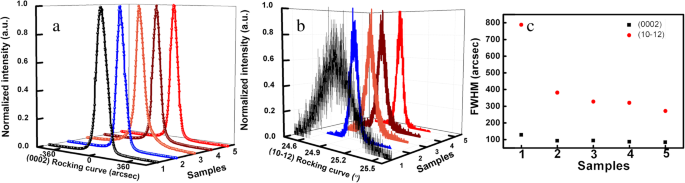
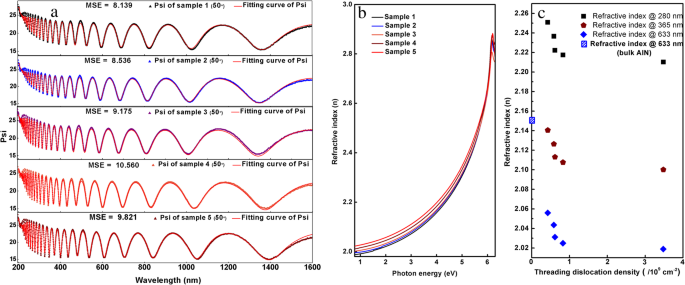
Figure 1 illustrates the (0002) and (10–12) XRCs for the five samples. The full width at half maximum (FWHM) of the (10–12) plane decreased markedly from sample 1 to sample 5, yielding TDDs that span 4.24 × 10⁸ to 3.48 × 109 cm−2. SE fitting, performed with CompleteEASE using a direct‑bandgap semiconductor model, achieved mean‑squared errors below 11, confirming reliable optical constants.
Refractive index curves (Figure 2b) show the expected dispersion: an increase with photon energy below the 6.2 eV bandgap, followed by a decrease beyond. At 633 nm, the index rises from 2.019 to 2.056 as TDD falls, approaching the bulk value of 2.15 [27]. Crucially, at 280 nm, the index drops from 2.2508 to 2.2102 as TDD increases, illustrating a clear inverse relationship (Figure 2c).
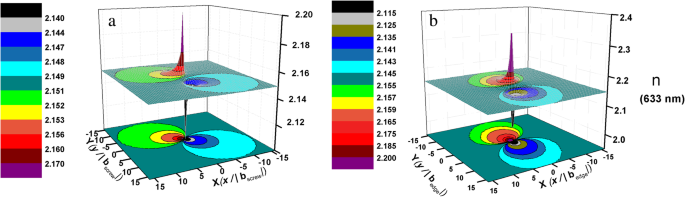
To rationalize this behavior, we modeled the strain field of a single screw or edge dislocation using cylindrical symmetry. The strain tensor components (Eqs. 5–6) were mapped into the photoelastic tensor (Eq. 3), yielding the perturbation Δ(1/n²). Calculations reveal that both screw and edge dislocations locally depress the refractive index in concentric shells around the core (Figure 4), creating an inhomogeneous optical medium. When light traverses these perturbed regions, scattering and interference redistribute the optical field, effectively reducing the measured refractive index.
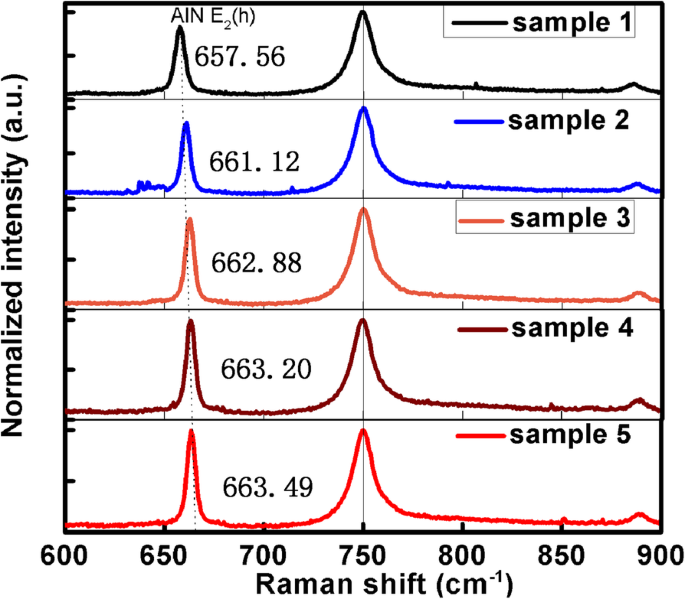
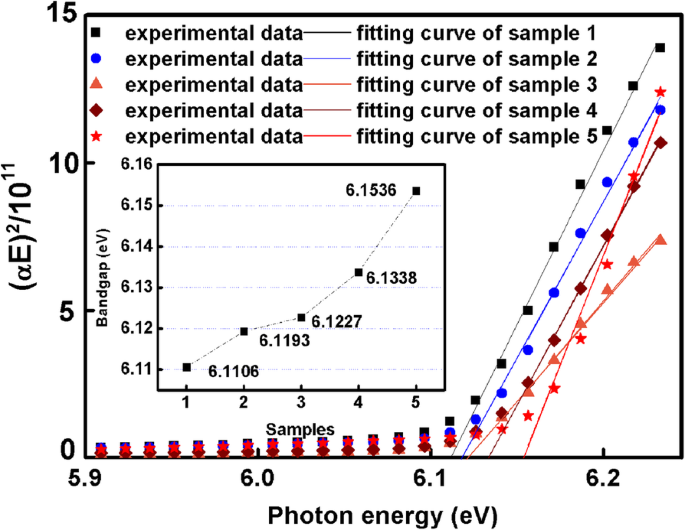
Potential confounding factors—temperature, residual stress, and bandgap—were systematically excluded. All measurements were at room temperature. Raman spectra (Figure 5) show a modest blue shift of the AlN E2(h) peak with decreasing TDD, indicating compressive strain from the sapphire substrate; however, this strain has negligible impact on the refractive index compared to dislocation density. Bandgap determinations from the (αE)2 vs. E plot (Figure 6) reveal a slight increase from 6.1106 to 6.1536 eV across the samples, but the expected inverse correlation with refractive index (Eq. 12) is not observed, reinforcing that TDD dominates the optical response.
Conclusions
Threading dislocation density is a decisive parameter governing the refractive index of AlN. By reducing TDD through high‑temperature annealing, the refractive index can be tuned upward, approaching bulk values and potentially enhancing LEE and DBR reflectivity in DUV devices. The nanoscale strain field around dislocations induces local refractive index variations that aggregate into a measurable macroscopic effect. These insights provide a clear pathway for optimizing AlN growth and device architecture to achieve higher performance in DUV optoelectronics.
Availability of Data and Materials
All raw data and fitting parameters are available upon reasonable request.
Abbreviations
- DBR
- Distributed Bragg reflector
- DUV
- Deep ultraviolet
- EQE
- External quantum efficiency
- FWHM
- Full width at half maximum
- LEDs
- Light‑emitting diodes
- LEE
- Light extract efficiency
- MOCVD
- Metal‑organic chemical vapor deposition
- MSE
- Mean‑squared error
- SE
- Spectroscopic ellipsometry
- TDDs
- Threading dislocation densities
- XRC
- X‑ray diffraction rocking curve
- XRD
- X‑ray diffraction
Figures
Nanomaterials
- How Molybdenum Boosts Stainless Steel Performance
- Molybdenum in Medicine: Advanced Applications in Breast Imaging and Bone Repair
- Tungsten in Alloy Design: Applications in Steel, Carbide, and Heavy Materials
- Diamond's Exceptional Role in Modern Medicine: From Surgical Instruments to Nanomedicine
- IBM Engineers Develop Nanoscopic Thermometer, Enabling Precise Temperature Mapping of Quantum Devices
- Unlocking Hidden Oil Reserves: How Nanoscale Science is Driving a New Boom
- Augmented Reality: Transforming Connected Field Service
- How Substrate Properties Influence LSP Coupling Wavelengths and Intensities in Nanoparticle Systems
- Tailoring Electronic and Optical Properties of WSSe Bilayer via Strain Engineering
- Revolutionizing Cuisine: How 3D Printing Transforms Food Production