



Interview with Timm Kragl: Why Additive Manufacturing Execution Systems (MES) Drive Success in 3D Printing
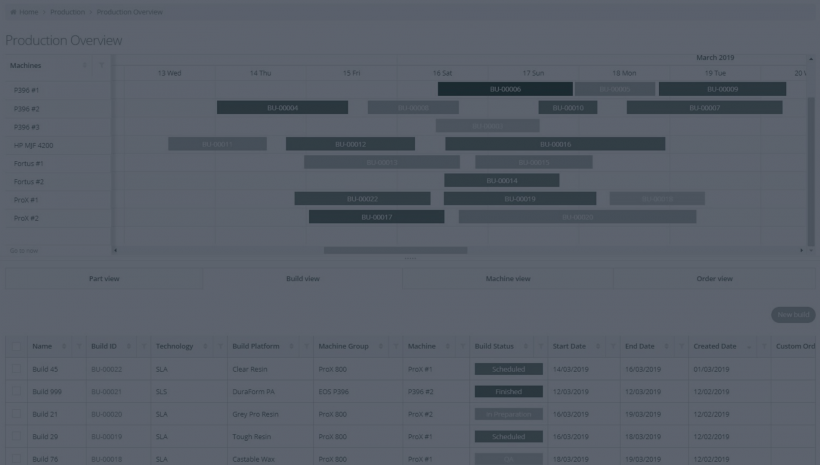
AMFG’s Production Scheduling System [Image credit: AMFG]
As additive manufacturing pushes into mainstream industrial production, Additive Manufacturing Execution Systems (MES) are emerging as essential tools for managing complex AM workflows.
Additive MES software bridges the gap between fragmented, manual processes by integrating data, hardware, and software to provide end‑to‑end visibility across the entire production chain.

We spoke with Timm Kragl, Senior Consultant at Phanos GmbH, an independent AM consultancy headquartered in Munich, to explore the current state of Additive MES solutions and share practical guidance for selecting and implementing them.
In this interview, Timm covers when to consider an Additive MES, how to evaluate vendors, and the key criteria that distinguish the best solutions.
How would you describe the current landscape of Additive MES solutions?
The market is expanding rapidly, bringing a mix of established manufacturers, opportunistic software firms, and niche specialists into the mix. This diversity can overwhelm buyers who lack deep MES experience.
We can broadly categorize the landscape into three groups:
- Legacy MES vendors: Companies that have built traditional MES platforms for conventional manufacturing. While robust, these solutions often miss the unique requirements of 3D printing.
- Cross‑industry players: Software firms that recognize AM’s potential and are extending their portfolios to include additive capabilities, offering hybrid functionality.
- Dedicated additive MES providers: Small, focused players whose sole expertise lies in additive manufacturing. Their workflows and feature sets are highly tailored to AM processes.
With such a broad spectrum, it is vital for organizations to clarify their priorities and functional needs before engaging with any vendor.
At what point should a company start to consider an Additive MES solution?
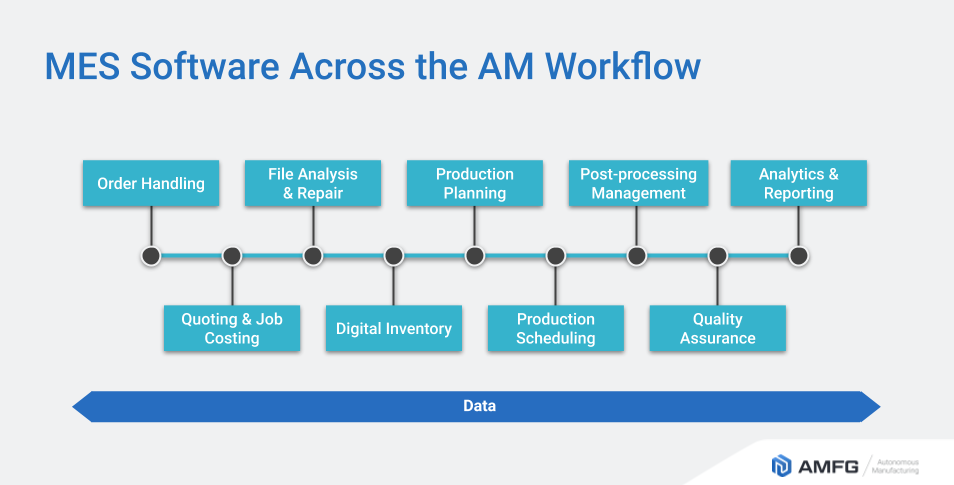
Key decision drivers include:
- Multi‑site operations or compliance‑heavy industries that require stringent documentation and audit trails.
- Company size and the scope of AM activities—larger firms or those expanding into additive production typically benefit from scalable MES platforms.
- The need for real‑time visibility, such as instant order status updates or enterprise‑wide dashboards.
- Automation ambitions—to reduce manual intervention, a customer‑facing front end can streamline order intake and monitoring.
When traceability, transparency, and efficiency become non‑negotiable, an Additive MES is the logical next step.
Why are more companies looking into Additive MES solutions?
Customization is becoming a competitive differentiator. Manufacturers aiming for a customer‑centric product strategy must streamline interactions and internal processes.
Comprehensive data visibility is critical—knowing what was ordered, by whom, and when, as well as production steps, scheduling, and quality checkpoints.
Such data‑driven insight spans production, customer demand, and internal workflow requirements, making an MES indispensable for achieving the necessary transparency and efficiency.
How would you advise a company that is just beginning their search for an Additive MES solution, but doesn’t have a solid process in place?
Start with a dual lens: process mapping and customer experience.
Identify gaps in your current workflow, then ask how software could bridge them. Anticipate edge cases—e.g., a failed print—and define the required response.
Group scenarios into thematic buckets such as “quality assurance” and “process stability.” This framework will sharpen your evaluation criteria and enable you to ask targeted questions during vendor demos.
From your experience, what do companies need to successfully make the transition to production with AM?
While specifics vary, traceability remains the foundation—every event must be recorded so root causes can be identified swiftly.
Collected data should feed continuous improvement cycles, elevating both product quality and operational efficiency.
In additive manufacturing, traceability covers the entire chain: from 3D data acquisition and part fabrication to post‑processing and final inspection.
Ultimately, the finished product, customer satisfaction, and production efficiency are the true success metrics.

3D printing
- How MES Workflow Software Accelerates Growth for 3D Printing Service Bureaus
- How MES Software Can Revolutionize Production Planning for Your 3D Printing Service
- Expert Interview: Simon Fried, Co‑Founder of Nano Dimension, on 3D Printing’s Future in Electronics
- AMendate’s CEO Thomas Reiher on Revolutionizing 3D Printing with Automated Topology Optimization
- Interview with Oerlikon's Additive Manufacturing Lead Matthew Donovan on 3D Printing in Aerospace
- Why Post‑Processing Is the Key to Scalable 3D Printing – Insights from AMT CEO Joseph Crabtree
- Altair’s Ravi Kunju Discusses Simulation-Driven Design & the New Inspire Print3D for 3D Printing
- How 3D Printing and Software Drive Digital Transformation in Manufacturing
- ZBrush for 3D Printing: Unlocking Design Potential
- Choosing the Right 3D Printing Software: A Comprehensive Guide