



Elevating Quality Control: 3D‑Printed Tooling Enhances Manufacturing Precision
Well‑designed jigs and fixtures drive lean, efficient production, yet the engineering effort required can bottleneck smaller operations. Markforged demonstrates how its Mark Two printers can transform quality control by creating high‑performance tooling in 3D‑printed form.
Every Markforged printer is backed by a rigorous quality‑control process that verifies each subsystem meets our precision engineering standards. While this thorough testing guarantees reliability, it also adds time to the manufacturing cycle, limiting our ability to respond swiftly to changing demand. As a fast‑growing company, agility is essential. We therefore adopt a balanced approach: validate subsystems efficiently and invest engineering effort only where it delivers the greatest payoff. 3D printing our jigs and fixtures lets us prototype, test, and deploy improvements at a fraction of the cost and time of traditional machining.
A prime example is our nylon extruder preload calibration jig. The extruder is a core component of Fused Filament Fabrication (FFF) 3D printing. For a concise overview of extruder mechanics, see the RepRap Squad’s detailed guide.
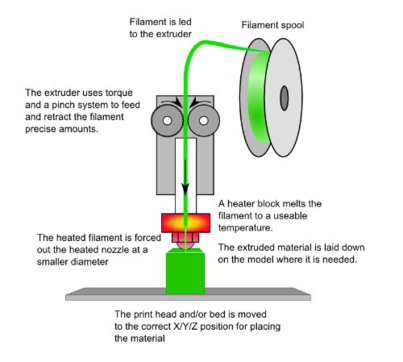
Consistent print quality hinges on each extruder’s “pinch system” applying a force within our tolerance. That force comes from a pair of springs whose preload can be tuned. Initially, we calibrated extruders late in assembly using a jig designed by Phillip, a mechanical engineer who specializes in machine instrumentation. The jig, built from water‑jet‑cut and machined parts, had a two‑week lead time, required on‑site modifications, and often needed re‑work on our in‑house CNC mill. Moreover, most extruders from our supplier needed adjustment, and measuring them in situ on the assembled printer was cumbersome and slowed production. We decided to create a fixture that could rapidly test a batch of as‑received extruders while still keeping adjustment screws accessible.
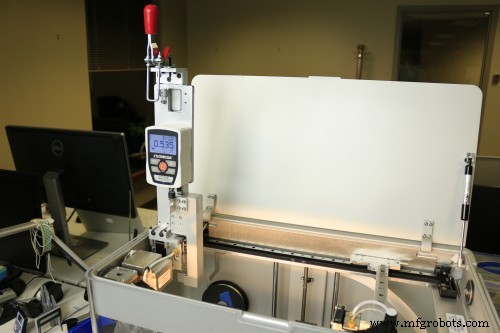
Key design goals were: 1) a quick ex‑situ validation tool that lets operators calibrate entire batches; 2) a poka‑yoke mechanism so the extruder fits in only one orientation, preventing miscalibration; 3) a compact 12"×12" footprint suitable for our manufacturing floor.
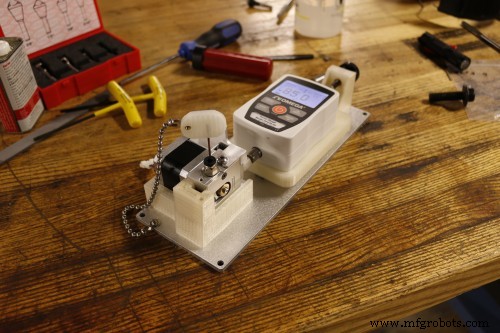
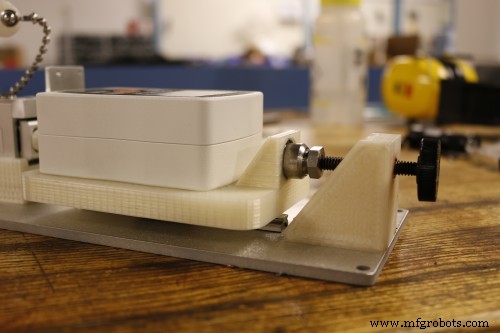
Bennett, another of our mechanical engineers, delivered the final jig. The system centers around an Omega DFG35 force gauge. The extruder slides into a receptacle; a floating spring‑driven idler wheel directs force onto the gauge’s probe. The gauge is mounted on a linear rail, allowing it to move freely along the idler’s axis. A thumb screw with a floating head, threaded through a melt‑in brass insert, presses the gauge into the idler without introducing torque.
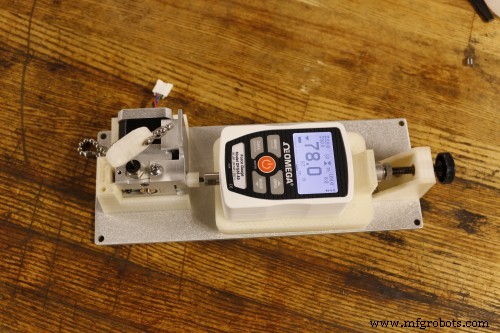
Bennett incorporated several 3D‑printing‑specific features. Using our “fiber striping” technique, he added fiber reinforcement every 20–40 layers, yielding a part that is both exceptionally strong and material‑efficient. The extruder receptacle was produced as a single part—a geometry that would have required multiple costly CNC setups.
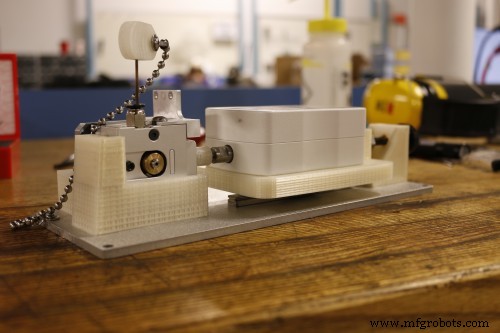
Today, the jig sits in our manufacturing facility, enabling a streamlined quality‑control workflow that saves technician time and allows us to deliver more Mark Two printers to customers.
3D printing
- Coloring 3D‑Printed Parts with Wax Crayons: A Novel Post‑Processing Technique
- Designing Functional 3D‑Printed Bicycle Pannier Adapters with Kevlar CFF
- Reimagining the Go‑Kart: 3D‑Printed Carbon‑Fiber Parts for Unmatched Performance
- Webinar: Build Stronger 3D Parts with Eiger Software
- Optimizing 3D Printed Part Strength with Efficient Fiber Routing – Part 1
- Björn Lindwall’s 3D‑Printed Gear Powers His Everest Ascent
- GÖPEL Enhances Automotive Quality Control with Universal Robots’ UR10e Cobot
- Mastering Quality Control: Strategies for Consistent Excellence
- Enhancing Quality Control: The Power of Sampling Plans for Small Metal Parts
- Professional Guide: Dyeing 3D Printed Polyamide Parts for Vibrant Color and Durability