



Engineering a Fully 3‑D Printed Shock Absorber with Industrial‑Strength Onyx
Each Friday, we showcase innovative projects from our team. Following the launch of our new Onyx filament—a robust, industrial‑strength material—our applications team has pushed its limits. In this edition, we highlight a fully 3‑D printed shock absorber that demonstrates the filament’s surprising versatility.
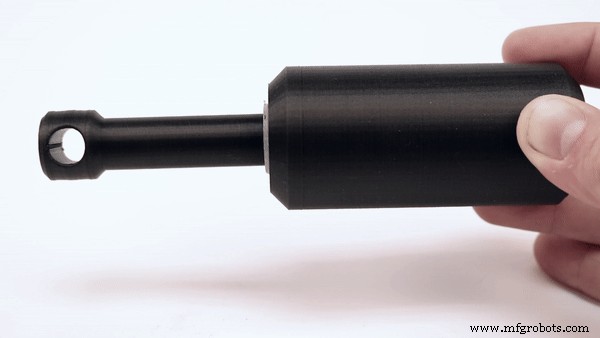
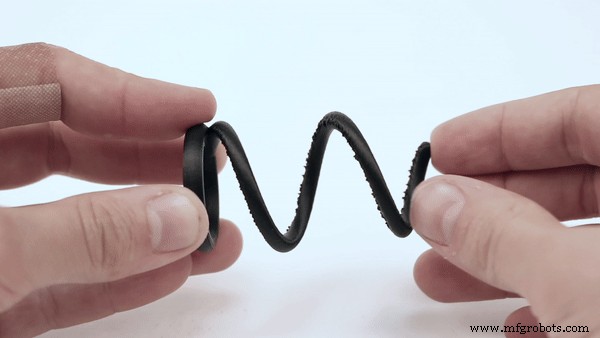
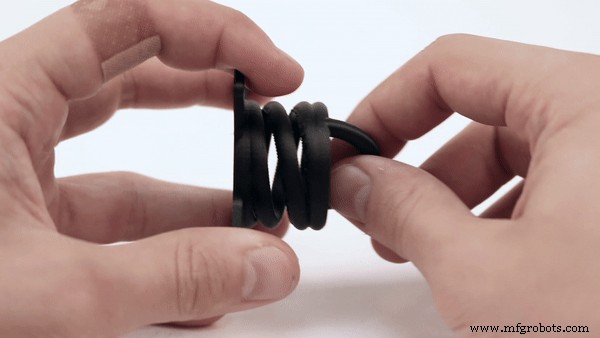
The journey began with a straightforward overhang test designed to assess dimensional stability. While Onyx is stiffer than our Tough Nylon line, it still exhibits a degree of flexibility when printed without reinforcement. The printed test part not only survived challenging overhangs but also behaved like a spring, revealing Onyx’s capacity for both extension and compression springs.
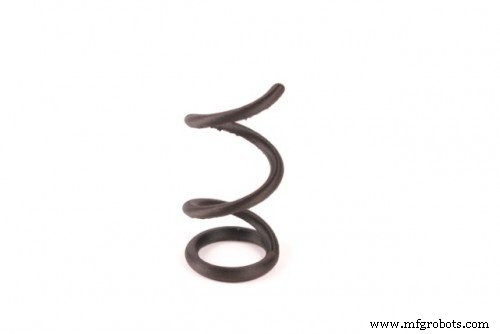
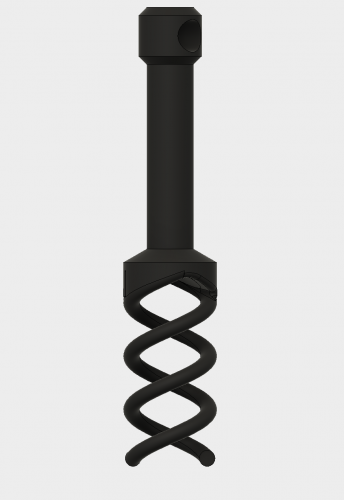
By adjusting parameters such as wall thickness, coil diameter, and pitch, the spring constant can be tuned—a concept we explored with a single‑coil compression spring and a dual‑coil extension spring (two coils in parallel). Both variants were printed without support material, relying on the filament’s inherent strength to maintain structural integrity.
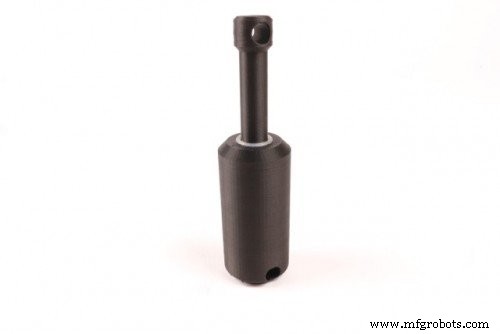
Building on this insight, we designed a compact shock absorber that encloses the spring within a rigid cylinder, incorporates a shaft, and features mounting holes—all printed as a single piece in Onyx. To mitigate friction—especially where the spring contacts the inner cylinder wall and where the shaft slides through the top—two nylon components were added: a sleeve that slides into the cylinder and a bushing that mates with the top hole. Tough Nylon’s smoother surface makes it an ideal material for these moving parts.
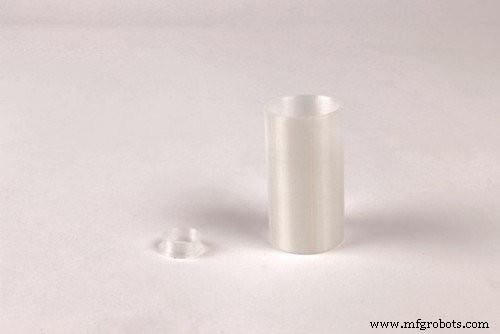
The design ensures every angle remains below 60° to avoid support requirements, and the spring pitch was calculated to fall within the printer’s overhang tolerance. The final assembly consists of three parts: the main body (Onyx), the nylon sleeve, and the nylon bushing.
Printing strategy was critical. We first printed the nylon sleeve and bushing on a Mark Two printer. The shock absorber was then printed on a Mark Two Enterprise printer in Onyx, with two deliberate pauses: the first immediately after the sleeve was completed, allowing us to slide the sleeve into place; the second after the cylinder’s top was finished, enabling the bushing to be inserted. After the print finished, a small amount of superglue secured the bushing in position.
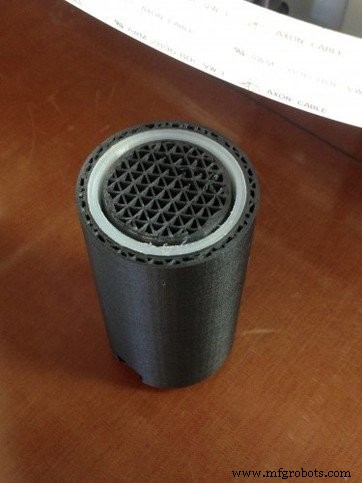
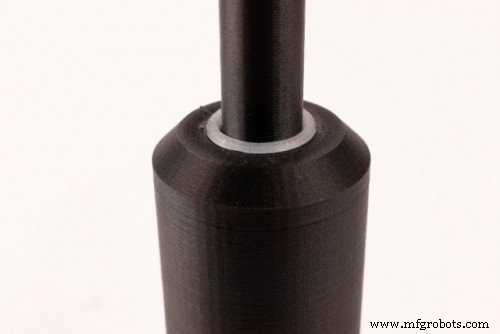
We now have a fully enclosed, 3‑D printed shock absorber. While it performs impressively in static tests, we plan to conduct cycle testing to determine its durability over time. If you have ideas for creative applications of Onyx’s spring‑like properties, we’d love to hear them.
Share your own 3‑D printed innovations with us on Twitter or Instagram!
Available files for download:
- Shock Body: STL, MFP (no supports required; pauses at layers 758 & 880)
- Nylon Sleeve: STL
- Nylon Bushing: STL
- Sleeve & Bushing MFP files available upon request.
3D printing
- Weekly 3D‑Printed Highlight: Kevlar‑Reinforced Pliers
- Carl Calabria’s Magnetic Featherboard: A 3D‑Printed Innovation for Woodworking Precision
- Ethan Steele’s Guzzleine Antifrost Device: A 3D‑Printed Solution to Winter Fuel Pump Hassles
- Engineering Highlight: Samrat's Reinforced Quadcopter Wins 'Part of the Week'
- Carl Calabria’s Caddytown: 3‑D Printed Nylon Caddies for Power Bits and Wera Sockets
- Introducing the Composite Cable Clamp by MechEngineerMike: A Durable, Kevlar‑Reinforced Solution
- How to Color Nylon 3D‑Printed Parts Quickly and Safely
- High-Performance 3D-Printed Tripod with Continuous Carbon Fiber Reinforced Legs – STL Files & Build Guide
- How Much Do Shock Absorbers Cost? A Complete Pricing Guide
- How Shock Absorbers Work: Enhancing Vehicle Balance and Comfort