



Full-Wave Bridge Rectifier: Design, Benefits, and Practical Implementation
Parts and Materials
- Low‑voltage AC supply (6 V RMS)
- Four 1N4001 rectifier diodes (Radio Shack catalog #276‑1101)
- Small permanent‑magnet hobby motor (Radio Shack catalog #273‑223 or equivalent)
Cross‑References
Lessons In Electric Circuits, Volume 3, Chapter 3: “Diodes and Rectifiers”
Learning Objectives
- Design a full‑wave bridge rectifier circuit
- Compare the bridge rectifier’s advantages and disadvantages with the center‑tap (split‑phase) configuration
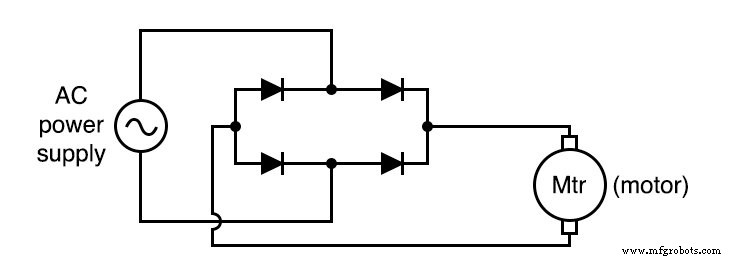
Schematic Diagram
Illustration
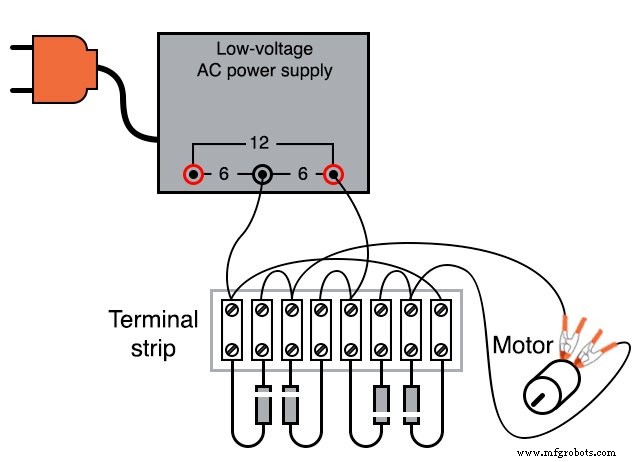
Instructions
This configuration delivers full‑wave rectification without a center‑tapped transformer, making it ideal when a split‑phase source is unavailable. Compared to a center‑tap bridge, the full‑wave design uses four diodes and introduces an additional voltage drop—each half‑cycle requires current to pass through two diodes instead of one—resulting in a slightly lower DC output. With a 6 V RMS supply, this drop is noticeable; compare the DC voltage across the motor terminals here with the voltage measured in the previous center‑tap experiment using the same supply and motor.
Computer Simulation
SPICE schematic (node numbers shown):

Netlist (copy the following into a text file and run in your SPICE tool):
Fullwave bridge rectifier v1 1 0 sin(0 8.485 60 0 0) rload 2 3 10k d1 3 1 mod1 d2 1 2 mod1 d3 3 0 mod1 d4 0 2 mod1 .model mod1 d .tran .5m 25m .plot tran v(1,0) v(2,3) .end
Related Worksheets
- Full‑Wave Bridge Rectifier Worksheet
- Rectifier Circuits Worksheet
Industrial Technology
- Half‑Wave Rectifier Experiment: Build, Measure, and Simulate a Simple AC‑to‑DC Motor Circuit
- Full‑Wave Center‑Tap Rectifier: Design, Measurement, and Simulation
- Constructing a Reliable Low‑Voltage AC/DC Power Supply: Bridge Rectifier & Capacitive Filter
- Rectifier Circuits: From Half‑Wave to Polyphase Full‑Wave Designs
- Bridge Circuits: Wheatstone, Kelvin, and Their Role in Precise Electrical Measurements
- AC Bridge Circuits: Precise Impedance Measurement with Balanced Ratios
- Draw Bridges: Engineering, History, and Modern Innovations
- Suspension Bridges: Design, History, and Engineering Excellence
- Understanding Pedestrian Bridges: Purpose, Design, and Safety
- Bridge Plugs Explained: Safely Sealing Wells in Oil Drilling