



Full‑Wave Center‑Tap Rectifier: Design, Measurement, and Simulation
Parts and Materials
PARTS AND MATERIALS
- Low‑voltage AC power supply (6‑volt output)
- Two 1N4001 rectifying diodes (Radio Shack catalog # 276‑1101)
- Small “hobby” motor, permanent‑magnet type (Radio Shack catalog # 273‑223 or equivalent)
- Audio detector with headphones
- 0.1 µF capacitor
- One toggle switch, SPST (“Single‑Pole, Single‑Throw”)
It is essential for this experiment that the low‑voltage AC power supply is equipped with a center tap. A transformer with a non‑tapped secondary winding simply will not work for this circuit.
The diodes need not be exact model 1N4001 units. Any of the “1N400X” series of rectifying diodes are suitable for the task, and they are quite easy to obtain.
Cross‑References
Lessons In Electric Circuits, Volume 3, chapter 3: “Diodes and Rectifiers”.
Learning Objectives
- Design a center‑tap rectifier circuit
- Measure “ripple” voltage with a voltmeter
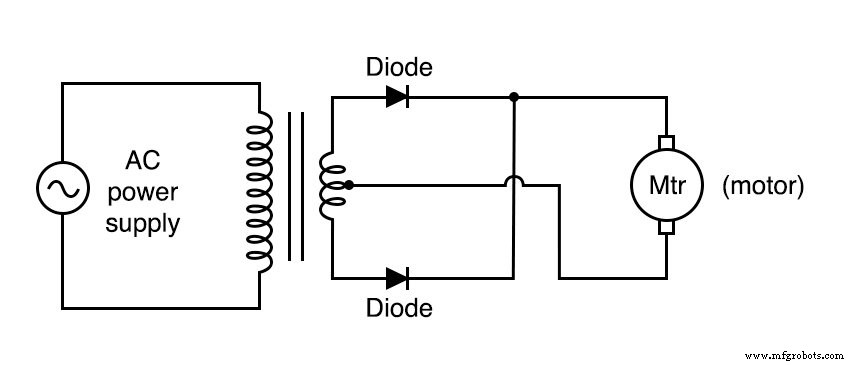
Schematic Diagram
Illustration
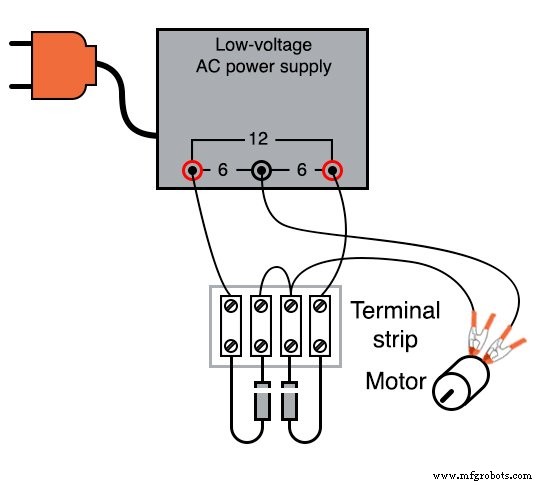
Instructions
This rectifier circuit is called full‑wave because it makes use of the entire waveform, both positive and negative half‑cycles, of the AC source voltage in powering the DC load. As a result, there is less “ripple” voltage seen at the load.
The RMS (Root‑Mean‑Square) value of the rectifier’s output is also greater for this circuit than for the half‑wave rectifier. Use a voltmeter to measure both the DC and AC voltage delivered to the motor.
You should notice the advantages of the full‑wave rectifier immediately by the greater DC and lower AC indications as compared to the last experiment. An experimental advantage of this circuit is the ease of which it may be “de‑converted” to a half‑wave rectifier: simply disconnect the short jumper wire connecting the two diodes’ cathode ends together on the terminal strip.
Better yet, for a quick comparison between half and full‑wave rectification, you may add a switch in the circuit to open and close this connection at will:
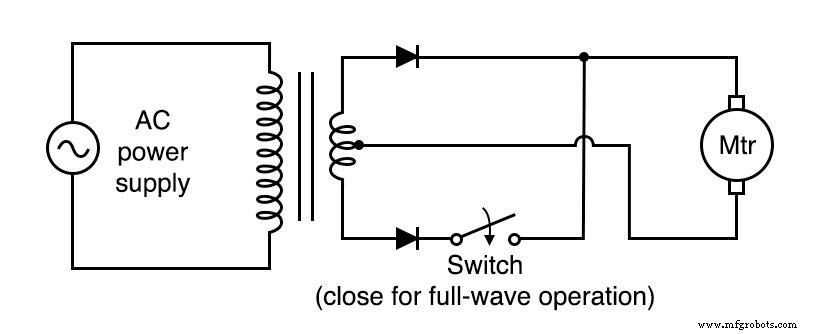
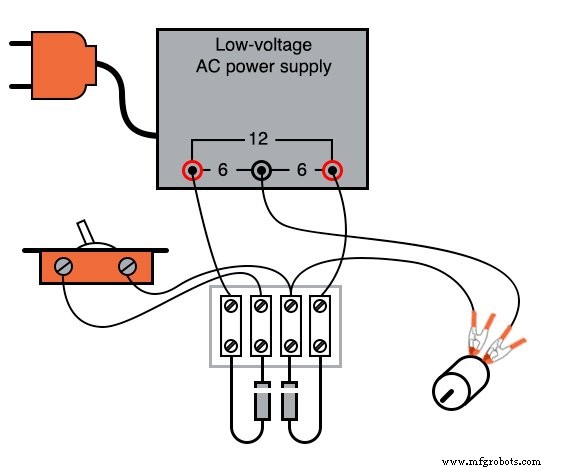
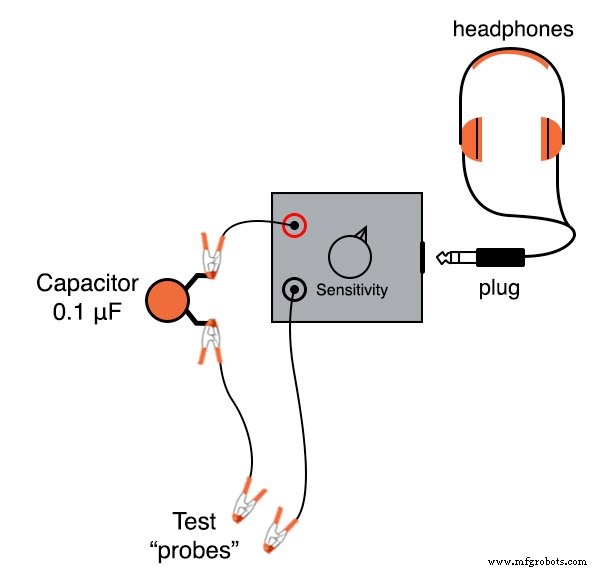
With the ability to quickly switch between half‑ and full‑wave rectification, you may easily perform qualitative comparisons between the two different operating modes. Use the audio signal detector to “listen” to the ripple voltage present between the motor terminals for half‑wave and full‑wave rectification modes, noting both the intensity and the quality of the tone.
Remember to use a coupling capacitor in series with the detector so that it only receives the AC “ripple” voltage and not DC voltage:
Computer Simulation
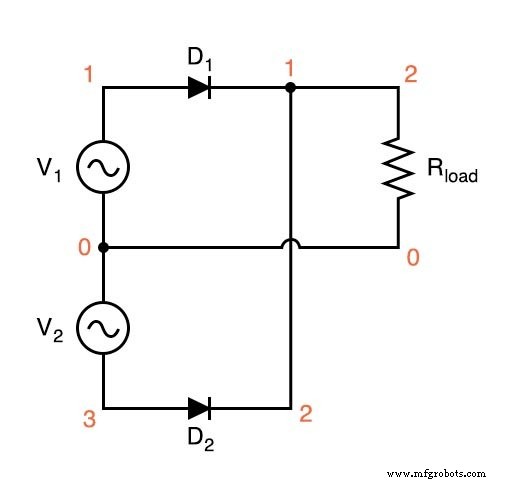
Schematic with SPICE node numbers:
Netlist (make a text file containing the following text, verbatim):
Fullwave center‑tap rectifier v1 1 0 sin(0 8.485 60 0 0) v2 0 3 sin(0 8.485 60 0 0) rload 2 0 10k d1 1 2 mod1 d2 3 2 mod1 .model mod1 d .tran .5m 25m .plot tran v(1,0) v(2,0) .end
Related Worksheet
- Rectifier Circuits Worksheet
Industrial Technology
- Electronics: A Hands‑On Science for All
- Setting Up a Home Electronics Lab: Tools, Work Area, and Supplies
- Half‑Wave Rectifier Experiment: Build, Measure, and Simulate a Simple AC‑to‑DC Motor Circuit
- Full-Wave Bridge Rectifier: Design, Benefits, and Practical Implementation
- Constructing a Reliable Low‑Voltage AC/DC Power Supply: Bridge Rectifier & Capacitive Filter
- Rectifier Circuits: From Half‑Wave to Polyphase Full‑Wave Designs
- Silicon‑Controlled Rectifiers (SCRs): Design, Operation, and Practical Applications
- Master Silicon Controlled Rectifiers (SCR) – A Complete Guide
- Step-by-Step Guide to Building a Reliable Rectifier for Power Systems
- Rectifier Circuits: Fundamentals, Operation, and Design Guidelines