



Agilent GPC/SEC: Precise Molecular Weight Profiling of Biodegradable Polymers
There are numerous products and subassemblies in the industry where polymers are used. The properties, performance and longevity play a vital role in the composition and structure of these materials which are synthesized. Their lifetime is limited and it depends on various factors which includes the environment, the additives that are used, the stabilizers and the usage extent of the polymers.
Agilent GPC/SEC system is a reliable way of studying Molecular Weight Distribution of biodegradable polymers. Request quote
Agilent can be a great choice for your organization when you are looking for accuracy and reliability. The process where the quality and chemical composition of plastics of the plastics is measured is undoubtedly one of the most dependable solutions in the industry. We have a wide range of powerful instruments depending on your needs of testing the chemical composition of polymers. Our GPC/SEC, FTIR mobile, Polymer Grade GC Analyzers, and bench and microscopy systems are some of the most trusted instruments around the world. The need to screen products for banned or restricted phthalates is critical. Our FTIR analyzer, the 4500 Polymer ID Package, has proven to be effective in analyzing polymers and providing their chemical composition within span of seconds.
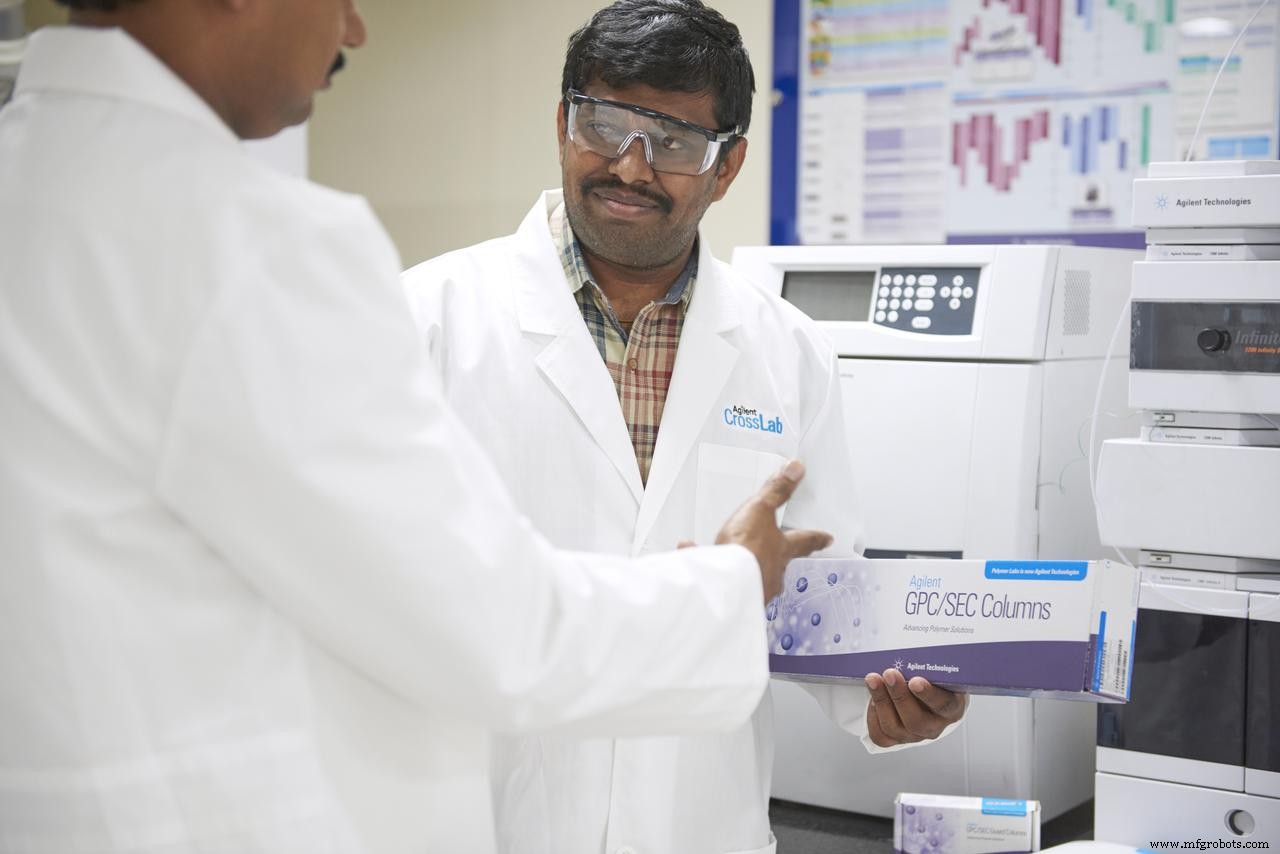
Agilent Technologies’ is widely recognized for its extensive range of instruments standards and most importantly the GPC/SEC columns. All of them are the best choice for studying biodegradable polymers. The columns produced by Agilent are used for organic and aqueous eluents, solvent mixtures and high polarity organic eluents. The columns are stable and suited for all biodegradable materials. The best part of Agilent’s columns is that there are a wide-range of particle and pore size options available. This makes it easy for any company to choose a particular column based on molecular weight of the material which needs to be studied. The best quality output is available through the GPC/SEC study.
The polydispersity standards act as the calibration standards for the GPC/SEC study. Since the standards are designed with highly characterized molecular weights the outcome is precise. The instrumentation systems available range from the ambient to 220 degree Celsius. This is one of the biggest distinguishing factors of Agilent’s GPC/SEC product.
The 1260 Infinity II GPC/SEC System is a unique system that can address the challenges that polymer analysts come across. It comprises an Agilent 1260 Infinity II Vialsampler, for higher unattended sample throughput. Our system offers:
- Accuracy - repeatable, consistent molecular weight distributions
- High performance - rapid system stability considerably increases sample throughput
- Versatility - perform both GPC/SEC and LC on the same system
- Simplified data analysis - control the instrument, collect the data, analyze the polymer in three easy steps
- Add sophisticated detectors - get more information about polymer size and configuration by adding light scattering and viscometry detection at any time
- Reduce solvent costs - automated recycling when the polymer peak is not eluting
- Unattended operation - let the 1260 Infinity II Vialsampler fully automate your workflow
- Even higher precision - system stability makes peak integration easier and extremely reproducible
Agilent provides solutions for Synthetic polymers:
- Poly(lactide-co-glycolide)
- Polycaprolactam
- Polyvinyl alcohol
- Polyethylene glycol (PEG)
Agilent also provides solutions for naturally occurring polymers:
- Natural rubber
- Polyacrylic acid
- Chitosan
- Cellulosic polymer
- Hydroxyethyl cellulose
- Methyl cellulose
- Cellulose acetate analysis
- Pectins
© Worldofchemicals
Industrial Technology
- Advanced Waveform Analysis with Winscope: From Time‑Domain to Frequency Domain
- AC Analysis Configuration: Curves, Points, and Frequency Sweep Settings
- Component Failure Analysis: Troubleshooting Techniques for Series and Parallel Circuits
- Advanced Component Failure Analysis: Qualitative Techniques for Troubleshooting Complex Circuits
- Network Analysis Explained: Advanced Techniques for Complex Electrical Circuits
- Advanced Spectrum Analysis: Interpreting Waveforms and Harmonics
- Photoluminescence of Low‑Molecular‑Weight Poly(3‑hexylthiophene) Polymorphs: Insights into Interchain Interactions
- Mapping Bismuth Distribution in GaAsBi/GaAs Heterostructures Using Aberration-Corrected HAADF‑STEM
- Agilent 8890 GC System – Precise Sulfur Analysis for Diesel & Residual Fuel Oils
- Understanding Reactive Power: Key Insights for Power System Reliability