Industrial manufacturing
Industrial Technology


In an earlier post, I outlined the background leading to China’s monopoly over the rare earth element (REE) market, and why the prevailing belief in the U.S. that private investment and the opening of new domestic mines will solve the nation’s resource problem is not realistic.In this ar
With traditional business models being turned upside down, brands like Pepsi are capitalizing on the e-commerce trend with a direct-to-consumer offer — and now restaurant chains are increasingly following suit with home delivery. This illustrates how it’s more critical than ev
The COVID-19 crisis has changed so much about daily life. That’s as true in logistics as anywhere else, which, because of the virus, has experienced the loss of a very specific industry mainstay: the late excuse.Think of the following scenario, which would have been normal as recently as Febru
The global pandemic has exposed the utter dependence of the U.S. and the world on China for critical equipment and raw materials. That’s especially the case with the supply of rare earth elements (REEs), which are required in numerous commercial products and defense systems. The risks of China
As the COVID-19 pandemic continues to disrupt business around the world, many contemplate how it will affect the future of supply chains — and how to survive during uncertainty and build new capabilities to deliver continued value to customers, partners and shareholders.The most significant im
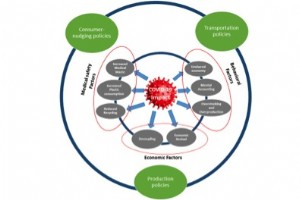
Since the Paris climate change agreement in 2015, supply chains around the world have committed to work toward slowing the rise in global temperature. Conservation of resources; investments in green technologies; adoption of reduce, reuse and recycle principles, and development of low-carbon pr
Over the past few months, the pandemic has exposed supply-chain weaknesses across virtually all industries, sectors and companies. Many companies have struggled to adapt to recent large-scale changes in consumer demand and consumption as stay-at-home orders have led to an increase in e-commerce. As
We've all had it happen: You buy a product from a shop and get it home, only to realize that something is wrong when you open the packaging. The item could be broken or have parts missing, or might even have been tampered with in a deliberate act of vandalism. Regardless of what has happened, it
Modern manufacturing plants are going wireless at an unprecedented pace. In a revolution that some call “Industry 4.0,” factories are implementing industrial internet-of-things (IIOT) technologies that allow for real-time, data-driven methods and strategies. And on the factory floor, wir
The COVID-19 pandemic has exposed the acute vulnerability of hitherto reliable business practices to profound economic shocks.For industries across the world, the awkward truth is that approaches such as just-in-time and build-to-order have been found wanting.While these methodologies traditionally
Supply-chain companies have a unique set of requirements when it comes to wireless connectivity. These organizations are operating 24 hours a day, seven days a week. They also rely heavily on wireless connectivity both indoors and outdoors, two environments that present separate challenges for diffe
Professionally managed pallet programs yield cost savings, transparency and optimization now, while positioning pallet users for the future.Such programs increase the value of every dollar spent in multiple ways. While each is tailored to the customer’s individual needs and operating environme
Does the vision of a “new normal” on the factory floor exclude the presence of people at all?Without question, manufacturers in recent few decades have been inching steadily toward automation, resulting in fewer and fewer warm bodies on the production line. Tedious, repetitive tasks &mda
The unprecedented disruptions to global supply chains caused by COVID-19 have forever changed the way businesses operate.Overall, the crisis could cost the global economy $2 trillion this year. As MIT Professor Yossi Sheffi noted in a recent webcast, disruptions caused by the virus won’t look
Today’s supply chains are complex, global networks of networks. Thanks to the increasing sophistication of everyday products and services, from cell phones to automobiles, supply chains often rely on four or more tiers of suppliers to deliver finished goods.That volume of suppliers, the global
In today’s world, there are very few reasons why freight shipments are delayed. With high-tech tracking and transportation-management systems, following a shipment is something that anyone can do.Consider how the average consumer can track a package ordered online. If a single package can be t
You might say the coronavirus pandemic is bringing about a seismic shift in attitudes toward supply-chain risk.To minimize future disruptions, many companies are revamping their business plans to include extensive risk-mapping capabilities. This involves a sensing mechanism that includes mapping, de
The COVID-19 pandemic has shown the world that the healthcare supply chain is broken. As a result, a lack of critical supplies put patients and staff at risk and caused unnecessary deaths; businesses were ruined and trillions of dollars were wasted because we had to shut down our country so tha
Our deeds define who we are, especially in times of crises, and the coronavirus pandemic is no exception. It’s forcing companies to evolve rapidly regardless of size, industry or location. As we fear job loss and lament the dislocation from our work, we have to stay focused on improving our wo
As the COVID-19 pandemic begins to recede in some countries and global businesses take steps toward recovery, what will reemerging supply chains look like? Will they become more geographically dispersed in an effort to mitigate risk? Will they become less so to accommodate a reshoring of manufacturi
Industrial Technology