



Cheese Curls: History, Production, and Quality Control of America’s Classic Snack
Background
Cheese curls—also known as corn curls or cheese puffs—have been a staple American snack since the 1950s. These crispy treats are made from cornmeal, water, oil, and a range of flavor coatings. The snack is produced by extrusion: a heated, pressurized mixture is forced through a die that shapes it before the product is baked or fried. The die’s design determines the final shape—ball‑shaped, curly, straight, or irregular—and the flavorings added afterward give each brand its signature taste. Cheese curls are particularly popular with children and are often chosen for school lunches because they are easy to package and distribute.
History
The first cheese curl emerged accidentally in the 1930s when the Flakall Company, which made livestock feed from corn, developed a flaking machine to reduce grain dust and hulls. Edward Wilson, a flake operator, noticed that moistened corn kernels poured into the machine produced puffy ribbons when the machine ran continuously. He collected the ribbons, added oil and flavor, and created the first cheese curls. By 1950 the Adams Corporation began mass‑producing the product, and a wave of small snack companies followed suit, each experimenting with unique dies to create distinctive shapes. Frito‑Lay entered the market in 1980 and today offers a wide variety of shapes and flavors, including a cayenne pepper option. Despite limited nutritional value—high in calories and fat with little fiber or protein—cheese curls remain beloved; it is estimated that 82% of U.S. families have tried them.
Raw Materials
Extrusion primarily uses cornmeal and water. After extrusion and drying, the product is coated with oils—soybean, cottonseed, or coconut—and seasoned with cheddar powder, acid whey, artificial cheese flavor, salt, and spices. The coating is applied in a way that ensures even coverage and flavor retention.
The Manufacturing Process
This section outlines the steps for baked cheese curls. The image below illustrates the extrusion line.
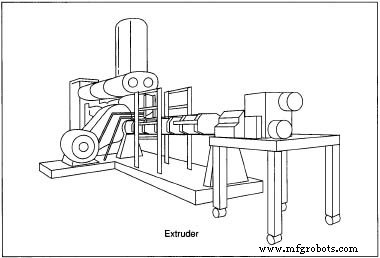
The core step is extrusion: a tapered screw forces the cornmeal mixture against the inner wall of a heated chamber, creating a shearing effect. Steam jackets cook the dough as it moves toward the die, where the mixture expands and puffs as pressure drops. The resulting product, known as a collette, is cut to length by a rotating knife.
Mixing
- Fine cornmeal with 6–10% moisture is chosen for its smooth texture and crispness. The meal is sprayed with a fine mist of water during mixing to avoid gluten formation and clumping. The mixture must be extruded immediately; any delay can lead to excess moisture absorption. If waiting is unavoidable, it must be stored in an airtight container.
Extruding the Collettes
- The slurry is fed into the extruder, where heat, moisture, and pressure gelatinize the starch. The mixture is forced through a die that determines the shape. As the dough exits, it expands into a puffed form. The die’s geometry is crucial for product consistency.
Drying the Collettes
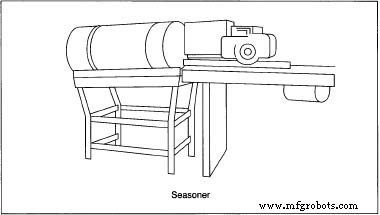
- Collettes retain 6–10% moisture post‑extrusion and are conveyed to a dryer set at about 140°F (60°C). The drying cycle lasts roughly five minutes, reducing moisture to 1–2%. A flavor reel then applies oils, spices, and color while the curls tumble in a barrel. Once seasoned, the curls are fully dried before packaging.
Separating the Fines
- During drying, small particles—fines—are generated. These absorb oil and flavorings poorly, so they are removed via a cross conveyor. Modern dryers often have self‑cleaning mechanisms that deposit fines for easy removal.
Flavoring the Collettes
- Two common methods are used: 1) spraying the curls with vegetable oil and then dusting with dry seasonings; 2) mixing oil, flavor, spices, and color in a tank and spraying the mixture onto the tumbled curls. Oil is essential for adhesion and flavor retention.
Packaging the Cheese Curls
- Flaked curls are conveyed to a vibrating belt that guides them into a weigher. The weigher precisely measures the amount destined for each bag, which are typically made of moisture‑resistant polypropylene. Bags are formed, filled, heat‑sealed, and then packed into cartons for shipment.
Quality Control
Quality begins with cornmeal selection. Grain must be finely ground; larger particles create an undesirable texture. Grit size is assessed by sieving a 1.75 oz (50 g) sample and comparing the retained portion to supplier specifications. Moisture content is critical: a 2–3 g sample is weighed, exposed to 60 seconds at 210°C, reweighed, and the loss is calculated. Moisture loss exceeding 0.2% indicates a too‑wet batch.
Throughout production, equipment is calibrated to maintain specific feed rates, extruder revolutions per minute, temperature, pressure (in atmospheres), and knife speed. Operators monitor the die for blockages and verify moisture levels at both the inlet and outlet of the extruder. Precise timing of each process step ensures product consistency.
The Future
In the past two decades, the puffed corn snack market has expanded with new flavors, including spicy coatings that have gained popularity. Manufacturers are exploring novel die designs and collaborating with equipment suppliers to develop unique products. Beyond corn, extrusion of wheat, rye, and other grains is being investigated, potentially broadening the snack landscape.
Manufacturing process
- What is VMC Machining? An Expert Overview of Vertical Machining Centers
- Expert Guide to Aluminum Laser Marking: Precision, Durability, and Industry Applications
- MIG vs. TIG Welding: Selecting the Right Arc Welding Technique for Your Project
- Cheese Curls: History, Production, and Quality Control of America’s Classic Snack
- The Art and Science of Cheese: From History to Modern Production
- Stratasys Insight: Proven Strategies to Minimize Part Curl in FDM Printing
- CMM Group Unveils Expert Guide to Infrared Cheese Melters
- Implementing Secure SFTP Uploads in IEC 61131-3 Using Curl
- Revolutionizing Cheese Production: The Fully Automated Brine System
- Efficient Heater Failure Solutions for Wisconsin Food Production