



The Art and Industry of Coffin Production
Background
Coffins, or funeral caskets, are the final resting containers for the deceased. Burial customs have evolved across cultures and epochs, yet the basic function remains: to provide a dignified enclosure for the body. Ancient Egyptians favored ornate stone sarcophagi; medieval Europe employed wooden and later iron coffins; in modern times, lead, steel, and even eco‑friendly cardboard boxes have become common. Historically, wealth determined the level of craftsmanship—affluent families could afford elaborate designs, while the poorer were often interred in plain wooden boxes or, at times, without any coffin at all.
In some regions, coffin making is a specialized craft. Italy once boasted a vanishing tradition of hand‑built burial caskets, while Ghana’s master artisans continue to create whimsical shapes—from birds to cars to corn—crafted from wood. In the United States, the practice evolved from custom carpentry to large, automated factories, a shift mirrored in Canada and the United Kingdom. Recent years have seen small‑scale producers reclaim the market through direct sales, showrooms, mail order, and online platforms. Alternatives such as willow‑wicker baskets in England and the Swiss “Peace Box”—a cardboard coffin made of recycled materials—illustrate the industry's diversification.
Raw Materials
Materials vary widely depending on style and purpose. The Peace Box uses cardboard, whereas a head‑of‑state coffin might be forged from solid bronze. Wooden coffins can be constructed from pine or high‑grade hardwoods like cherry or mahogany. In the U.S., steel is the most common choice for the shell, and fiberglass is also used for lightweight models. Most coffins include an inner lining of taffeta or velvet, often backed with polyester batting and cardboard. Accessories such as hinges, handles, and decorative corners are typically made of steel or other metals; rubber gaskets and paint finish the exterior.
The Manufacturing Process
A wooden coffin can be built in a conventional woodshop using cabinet‑making tools, but most producers today assemble pre‑manufactured shells with custom linings. The core components are the shell, lining, and hardware. Below is a typical sequence for a steel coffin.
1. Assembling the Shell
- Steel coils—usually 18‑ or 20‑gauge—arrive in sizes ranging from 1,000 lb (454 kg) to 20,000 lb (9,080 kg). The coil is levelled, then cut into blanks by a blanking machine.
- Blanks are fed into a die stamper that shapes the shell panels.
- Panels are welded together automatically; any un‑welded areas are finished by hand.
2. Painting
- Shells pass to a spray‑gun area where primer and specialty paint are applied in a continuous, hose‑fed system.
- After painting, the coffins are baked to cure the finish.
3. Accessorizing
- Hinges and handles—usually steel—are screwed or hand‑welded onto the lid.
- Decorative corner plates and other hardware are installed in the same manner.
4. Making the Lining
- Upholstery is sourced in precise dimensions or produced on‑site. Seamstresses use multi‑needle shirring machines to create a quilted taffeta lining, then cut it to fit.
- Polyester batting backs the taffeta; cardboard provides structural support.
- The three‑layer upholstery is attached—by stapling, gluing, or snapping—inside the shell.
5. Packaging
- After final inspection, coffins are wrapped in heavy paper and padded at the corners.
- They are then enclosed in clear plastic, shrink‑wrapped, and wrapped in a mover’s blanket before trucking to warehouses.
Quality Control
Inspection occurs at every stage: steel gauge and quality upon arrival, shell shape after stamping, finish after painting, and final checks on lining and hardware. This multi‑tiered approach ensures each coffin meets industry standards for durability and appearance.
The Future
As cremation rates rise in the United States, coffin demand is plateauing. Industry growth may hinge more on marketing than on technological breakthroughs. Direct‑to‑consumer sales and funeral‑insurance products—covering a full burial package—offer new revenue streams. While the manufacturing process remains largely unchanged, small producers are increasingly leveraging digital platforms to reach customers and differentiate their offerings.
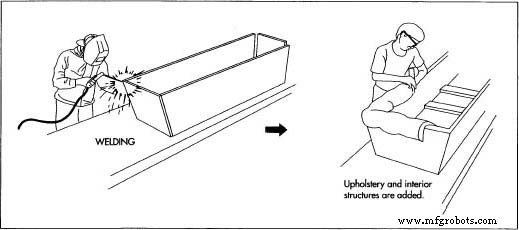
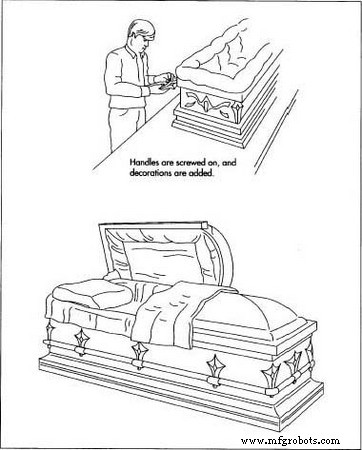 Decoration and handles are added to the outside of the coffin.
Manufacturing process
- What is VMC Machining? An Expert Overview of Vertical Machining Centers
- Expert Guide to Aluminum Laser Marking: Precision, Durability, and Industry Applications
- MIG vs. TIG Welding: Selecting the Right Arc Welding Technique for Your Project
- Comprehensive Guide to Laser Marking: Types, Benefits, and Applications
- Key Considerations for High‑Volume Swiss Machining
- CNC Prototyping Guide: Precision, Speed, and Cost‑Effective Production
- Expert Shaft Manufacturing: Precision Processes & Custom Solutions
- Fiber Laser Marking: Precision, Speed, and Versatility for Modern Industries
- The Art and Industry of Coffin Production
- Arduino Coffin Dance Melody Project – Build & Play the Viral Tune