



The Magnetic Compass: From Ancient Navigation to Modern Applications
Background
A compass is a precision instrument that determines cardinal direction on Earth's surface.
The most familiar variant is the magnetic compass, which takes advantage of a magnet’s tendency to align with the planet’s magnetic field.
Other directional tools—solar, stellar, or gyroscopic compasses—use the Sun’s position, stellar coordinates, or the inertia of a spinning mass to find orientation.
The core of a magnetic compass consists of a slender magnetic needle, a dial bearing the four cardinal points, and a housing that keeps the components stable. Basic models, often sold as toys, may lack additional features, whereas professional compasses incorporate protective cases, optical sights, and a transparent baseplate that can be placed directly on a map.
Many modern compasses feature automatic declination adjustment. Declination, or magnetic variance, is the angular difference between magnetic North and true North, which varies worldwide. When the local declination is known, the device can display true direction without the user having to manually correct the reading.
History
By 500 B.C., the ancient world had discovered that lodestone—a naturally magnetized iron‑oxide mineral—attracted iron. The first documented use of a freely moving lodestone aligning north–south dates back to the Chinese, who employed magnetic compasses by 1100 A.D. Western Europe and the Arab world adopted the technology by 1200 A.D., and Scandinavians by 1300 A.D.
Early instruments were simple: a lodestone piece on a wooden, cork, or reed rod floated in a water bowl. Subsequent iterations replaced the stone with a needle pivoted on a pin beneath a bowl, and by the thirteenth century a directional card was affixed. The sixteenth century introduced gimbals, allowing the compass to remain level aboard rolling vessels.
In 1745, English inventor Gowin Knight pioneered a method for permanently magnetizing steel, enabling steel needles to replace lodestone. The rise of iron and steel in shipbuilding during the early nineteenth century disrupted compass accuracy, prompting the British Admiralty’s 1837 commission to investigate. The 1840 breakthrough—a four‑needle design—overcame magnetic interference and was rapidly adopted by navies worldwide.
Before the mid‑nineteenth century, navigators used both dry‑card and liquid compasses. Dry‑card models were susceptible to shocks, while liquid versions leaked and were hard to repair. Advances in 1862 made liquid compasses superior, rendering dry‑card designs obsolete for naval use. By World War I, the British Army deployed liquid compasses on land, and these remain the benchmark for handheld magnetic instruments.
Raw Materials
The needle must be fabricated from a metal that retains magnetism over long periods. Steel—a blend of iron and trace carbon—is the standard choice. Its raw ingredients are iron ore and coke (carbon derived from coal), with additional elements such as cobalt sometimes added to enhance magnetic endurance.
The housing often employs acrylic plastics like polymethyl methacrylate (PMMA), produced from methyl methacrylate monomers polymerized into Lucite or Plexiglas. PMMA is prized for its strength and optical clarity.
The Manufacturing
Process
Making the needle
- 1. Iron ore, coke, and limestone are heated in a blast furnace under pressurized air. Coke furnishes heat, melting the ore, while carbon monoxide reacts with iron oxides to release molten iron. Limestone removes impurities such as sulfur, forming slag that floats to the surface and is discarded. The resulting pig iron contains ~90% iron, 3–5% carbon, and various impurities.
- 2. Oxygen is blasted into the molten pig iron to oxidize remaining carbon and impurities. The cleaned steel is poured into molds and cooled into massive ingots.
- 3. The ingots are reheated to about 2,200 °F (1,200 °C) and rolled between grooved rollers to form slabs. Repeated cutting, reheating, and rolling produce thin sheets suitable for needle manufacturing. A sharp die stamps each needle shape from the sheet, allowing many needles to be produced from a single strip.
- 4. At the compass factory, needles are hand‑inserted into holders on an automated turntable. While rotating, the “North” tip receives a red paint spray, the “South” tip a white spray, and the entire needle is exposed to a strong magnetic field generated by an electronic magnetizer.
- 5. Once magnetized, needles are dried—sometimes with an oven—to ensure paint adhesion. They are then stored until assembly.
Making the housing
- 6. Polymethyl methacrylate is synthesized by polymerizing methyl methacrylate under light, heat, or chemical catalysts. The resulting PMMA is melted and injected into molds to form housing components. After cooling, the solid parts are removed, shipped to the compass manufacturer, and stored until needed.
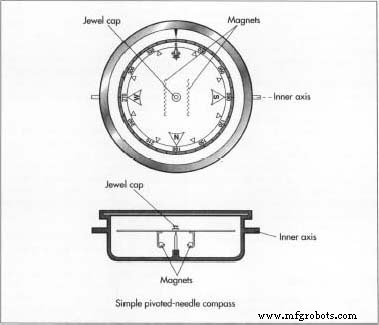 A frontal and sideview of a simple pivoted-needle compass.
Assembling the compass
- 7. Upon receiving an order, the plant manager releases the required parts to workers along the assembly line. Plastic components snap together, and some pass through printers that stamp logos or map scales.
- 8. The vial that holds the needle is critical. The needle balances on a pivot for free movement. While inexpensive models use steel pivots, high‑end compasses employ jeweled pivots—made from hard alloys like osmium‑iridium capped with artificial sapphire—to resist wear.
- 9. Vials are filled with a transparent dampening liquid, typically a mixture of ethyl alcohol and water, which ensures the needle settles quickly after disturbance.
- 10. Sealing the vial uses sonic welding, which melts the plastic locally with ultrasonic waves, avoiding heat that could alter magnetism. The sealed vial is then snapped onto the baseplate.
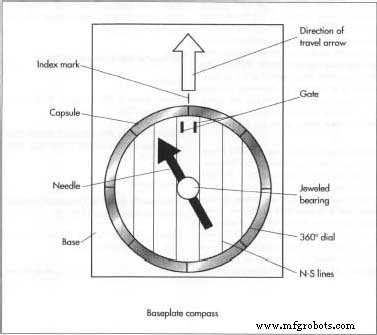 A baseplate compass.
- 11. Finished compasses are packaged—commonly in clam or blister packaging—to protect against theft and damage, then boxed and shipped to wholesalers.
Quality Control
Every manufacturing stage includes visual inspection to eliminate defects such as printing errors or bubbles in the dampening liquid. The magnetic needle is rarely defective; when a needle fails, it is typically due to exposure to strong magnetic or electric fields, which can be remedied by remagnetization.
Ultimately, the user’s competence is paramount. Compasses are reliable only when operated correctly. Proper declination adjustment is essential; overlooking it can introduce errors of several degrees, potentially diverting a navigator miles off course. Orienteering—competitive map and compass navigation—offers an engaging way to master these skills.
The Future
In the 1970s, the U.S. Navy launched the Global Positioning System (GPS), a constellation of 24 satellites equipped with atomic clocks. Completed in 1993, GPS delivers positional accuracy within roughly 30 m (100 ft) for handheld devices.
While GPS can appear to supersede the magnetic compass, it actually complements it. GPS provides position but not direction, so many manufacturers recommend pairing GPS receivers with a compass. Unlike GPS, a magnetic compass requires no power and remains functional under heavy tree cover or in buildings that block satellite signals. Thus, even as navigation technology advances, the magnetic compass retains its indispensable role.
Manufacturing process
- What is VMC Machining? An Expert Overview of Vertical Machining Centers
- Expert Guide to Aluminum Laser Marking: Precision, Durability, and Industry Applications
- MIG vs. TIG Welding: Selecting the Right Arc Welding Technique for Your Project
- Comprehensive Guide to Laser Marking: Types, Benefits, and Applications
- The Magnetic Compass: From Ancient Navigation to Modern Applications
- Compass Sensors: From Ancient Navigation to Modern Devices
- Car HUD: Real‑Time Windshield Speed & Compass Display
- Build Your Own Flight Instruments: Horizon & Compass with Arduino & MPU-6050
- Build a Real‑Time Digital Compass with Arduino & Processing
- Compass Saw: How It Works and Why It's Essential for Precise Curved Cuts