



Trampoline: Evolution, Construction, and Future Innovations
Background
A trampoline is a spring‑laden, webbed platform encased in a metal frame, designed to provide a controlled bounce for athletic and recreational use. Its elastic suspension allows athletes to perform mid‑air acrobatics and is a staple training aid for gymnasts, divers, and pole vaulters.
History
The desire to defy gravity dates back centuries. Early devices such as the springboard and the medieval “leaps” enabled performers to achieve modest height and execute basic stunts. The modern trampoline traces its roots to French circus performer du Trampoline, who adapted trapeze nets and spring suspensions into a portable rebound apparatus.
American gymnast George Nissen refined the design in 1936, establishing the framework that underpins today’s competitive trampolining. During World War II, the U.S. military adopted the trampoline for pilot training, improving body awareness in simulated flight conditions. Post‑war, educators introduced it into schools and YMCAs, recognizing its benefits for strength, coordination, and cardiovascular fitness.
Competitive trampolining gained formal structure with the 1947 unofficial contests, official U.S. competitions in 1954, and international events starting in 1964. The International Trampoline Association now governs worldwide standards. A routine consists of a compulsory and an optional routine, each limited to eight touches, scored on difficulty, execution, and form.
Despite concerns raised by the American Academy of Pediatrics in 1977—highlighting risks of broken bones and severe injuries—trampolines remain popular for home exercise. Modern mini‑trampolines, known as rebounders, have become effective cardiovascular tools since their 1975 debut.
Raw Materials
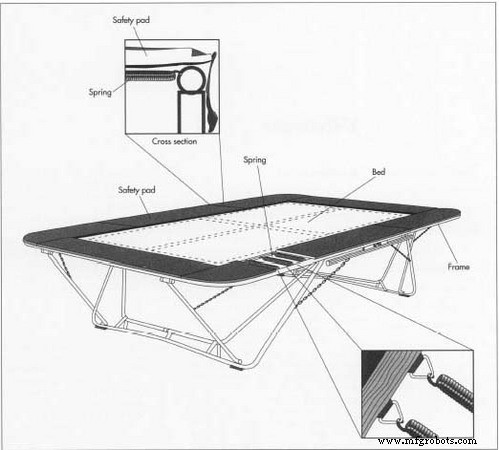
Four core components constitute a trampoline: frame tubing, springs, jumping mat, and safety pads.
- Frame Tubing – Typically galvanized steel to resist corrosion, fabricated into a sturdy circular frame.
- Springs – Custom‑made by specialized suppliers, engineered to deliver optimal bounce and durability.
- Jumping Mat – Woven from high‑strength synthetic fibers (polyethylene or nylon), often water‑resistant to preserve color outdoors.
- Safety Pads – Foam cores covered with vinyl and secured by pie straps, cushioning the springs and frame.
The Manufacturing Process
Home‑use trampolines are typically shipped disassembled, requiring customer assembly. Below is an overview of component fabrication:
- The frame tubing is bent on a jig, holes punched for springs, and welded to form the U‑shaped legs.
- Springs are delivered pre‑manufactured; no additional processing is needed at the trampoline plant.
- Jumping mat fabric is cut, sewn with reinforced webbing and D‑rings, then edged by industrial sewing machines.
- Safety pads receive a vinyl cover and pie straps through precision stitching.
- All components are packaged together for shipment.
A single production shift of 80 workers can assemble 500–600 trampolines.
Quality Control
ASTM International provides rigorous safety and quality benchmarks. Inspections cover:
- Frame integrity—bend, gauge, and galvanization thickness.
- Mat weaving—flaw detection and thread tension testing.
- Spring condition—defect screening before packaging.
- Final assembly—verification of safety pad placement and overall build.
The Future
Innovations such as the “frameless” trampoline by Inwood Ryan Company aim to reduce injury risk by eliminating exposed metal frames, potentially redefining safety standards for children. Whether this design becomes mainstream remains to be seen, but it reflects ongoing efforts to enhance both performance and user safety.
Manufacturing process
- Titanium: Key Properties, Applications, and Industrial Uses
- Castanets: History, Craftsmanship, and Performance
- The History, Production, and Future of Glue: From Ancient Adhesives to Modern Innovations
- Thread: Types, History, Production, and Quality Control
- Acetylene: Production, Uses, and Handling – A Comprehensive Overview
- Comprehensive Overview of Asbestos: From Ancient Uses to Modern Health Risks
- The History, Design, and Manufacturing of Dice: From Ancient Tools to Modern Gaming
- Plywood: History, Production, and the Path Ahead
- Tin: From Bronze Age to Modern Industry – Uses, Production, and Future
- Silver: History, Properties, and Modern Applications