



Applications & Characteristics of DC Motors: Performance, Efficiency, and Versatility
Have you ever wonder how air conditioners, the sweet creature that always keeps our room at a suitable temperature, makes the magic happen? Well, the permanent magnet brushless DC motor, with its excellent speed regulation and all, will do it. What more can a DC motor do? Let’s move on and find out.
DC motor features
- Power: DC power
- Operating speeds: from 1,000 to 5,000 rpm
- Efficiency: 60 to 75%
- High starting torque
- Low no-load speed
Advantages and disadvantages
Advantages
- Low-cost speed adjustment controller
- A good choice for low-cost motors
- Pair with reducer easily
Disadvantages
- Low brush life and high maintenance rate (up to 2,000 hours in continuous operation)
- Cogging acceleration at speeds below 300 rpm
- Full-wave rectified voltage significantly reduces power loss
- High starting torque can damage the reducer.
Performance curve
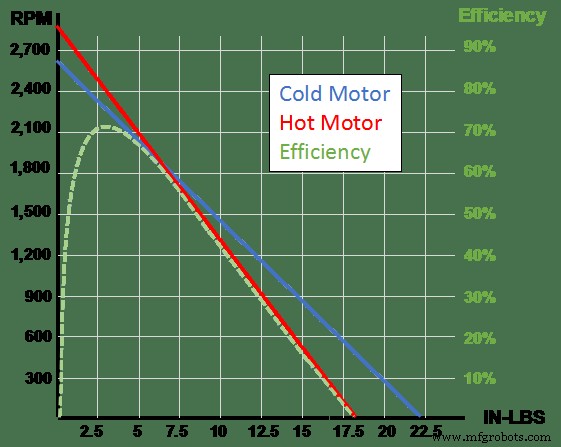
From the picture above, we can see an interesting phenomenon. As the motor temperature increases, the no-load speed also increases. This is the effect of heat on the magnet. When the motor cools, the speed will return to normal. The concept applies to the other end of the curve, where the stall torque of the “hot” motor decreases.
Applications
In transportation
DC motor, with fast starting and high starting torque, is the power of large-scale ship propulsion and locomotive. In addition, the maglev trains and metros, of high speed, comfort, safety and no pollution, is also driven by DC motor. In the future, DC motor will play greater role in emerging transportation vehicles.

In industry
DC motor has unique advantages in DC transmission and material transportation, such as sorting conveyor lines, lifts and so on. So they can also be widely used in various industrial machine tools, as the replacements for rotary motors due to their high gas velocity and high precision. For example, it can drive punching machine, die casting machine, electric spark molding machine, etc.
In daily life
DC motors are used in recorders, razors, electric toys, etc. Generally speaking, many appliances we use in daily life has been driven by AC motor, such as washing machines, refrigerators, air conditioners, hood, electric fans and so on.
However, with the improvement of our living standard, we ask more from appliances. It’s now a trend to switch to DC motors in refrigerators, washing machines, dust collectors, fans, etc.
In all, DC motors have their own unique characteristics, but also shortcomings. We should weigh the pros and cons to apply it in the occasion that can give full play to its advantages. The application of DC motor help us promote the progress of technology in various fields.
Interested in knowing more? Feel free to contact us or leave a comment. We’d be glad to hear from you.
Manufacturing process
- Titanium: Key Properties and Real‑World Applications
- Tantalum Capacitors: Key Characteristics & Applications
- Stepper Motors: Types, Characteristics, and Practical Applications
- Understanding AC Commutator Motors: Design, Types, and Applications
- Silicon Photomultipliers (SiPMs): Structure, Performance, and Key Applications
- Fiberglass Adhesive Tape: High‑Temperature Resistance & Versatile Applications
- Master DC & Servo Motor Control with Arduino – Step-by-Step Tutorial
- Industrial Motors: Types, Functions, and Applications
- Understanding BLDC Motors: A Professional Guide
- Understanding Brushed vs. Brushless DC Motors: Fundamentals & Applications