



Understanding Brushed vs. Brushless DC Motors: Fundamentals & Applications
Have you ever wondered how your car is moving? What the magic behind it? Just between the two of us, the magic is from the motor. So what is motor? What power does motor has to make things like your car move around? You’ll find the answers here in this post.
Motor is an electromagnetic device that converts electric energy into mechanical energy. It’s indicated by the letter M (old standard D) in the circuit. Its main function is to generate drive torque, as a power source for various electrical appliances or machines such as electric locomotives, bus trams, tape recorders, razors, electric toys, etc.
Motors can be divided into DC motor and AC motor by the power type
DC motor is a motor that converts direct current electrical energy into mechanical energy. The car we just mentioned uses a DC motor.
AC motor is a motor that converts alternating current electrical energy into mechanical energy. They are widely used in washing machines, refrigerators, air conditioners, lampblack pumps, fans and other electrical appliances.
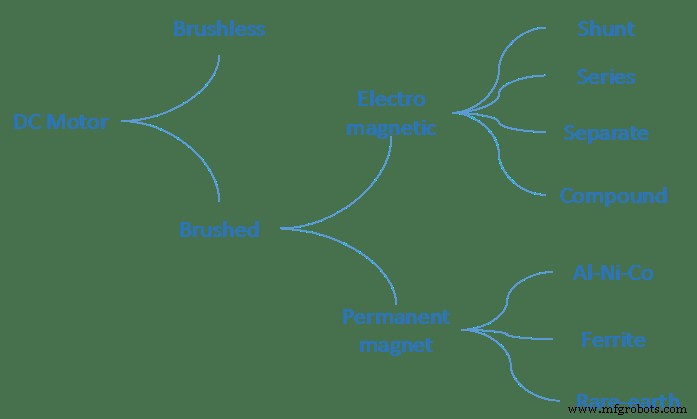
DC motors can be divided into brushless ones and brushed ones by structure and working principle. And there are deeper levels of categorizations under the brushed motors, just as you can see from the “family tree of DC motors” below:
Brushless DC motor
The brushless DC motor swaps the stator and rotor of a conventional DC motor. The rotor is permanent magnet, which produces air gap flux. The stator is armature and consists of multiphase winding. In structure, it’s similar to permanent magnet synchronous motor.
Brushless DC motors are mainly used in computer peripherals and electronic products such as printers, fax machines, copiers, hard drives, floppy disk drives, movie cameras, tape recorders, etc.
Brushed DC motor
Two brushes (copper or carbon brushes) of brush motor directly connect the positive and negative electrodes with rotor’s commutator by fixing the brushes on the back cover of the motor using insulating seat. The commutator connects the coils on the rotor. The polarity of the three coils is constantly alternating, forming a force with the two fixed magnets, and thus the device is turning.
Brushed DC motors can be divided into electromagnetic DC motors and permanent magnet DC motors.
Electromagnetic DC motor
The electromagnetic DC motor includes series ones, shunt ones, separate ones and compound ones.
- For series motor, the excitation winding is connected in series with armature winding, then connected to DC power supply. It can be applied in electric tools and kitchen utensils.
- For shunt motor, the excitation winding is connected in parallel with the armature winding. Here, the excitation winding and armature share the same power supply. And the performance is the same as that of separate motors. It’s commonly used in large lathes, planers.
- For separate motor, the excitation winding is not connected with the armature winding, but powered by other DC power supplies. Permanent magnet DC motors can be regarded as separate DC motors. Just like shunt motor, it’s often used in large lathes and planers.
- For compound motor, there are two excitation windings, shunt and series excitation. If the flux potential generated by series winding is in the same direction as that generated by shunt winding, it’s called cumulative compound excitation. If the two directions are opposite, it’s called differential compound excitation. It can be used in ships, trolley buses, and lifting and mining equipment.
Permanent magnet DC motor
Permanent magnet DC motors includes rare-earth ones, ferrite ones and Al-Ni-Co ones. Its application is extremely wide, covering almost all areas of aerospace, defense, industrial and agricultural production and our daily life.
In the air conditioning industry, permanent magnet brushless DC motors have become one of the main indicators for measuring air conditioning technology.
- The earliest motor prototype was a permanent magnet motor. However, because of the poor performance of the permanent magnet material, its application was quite limited.
- Al-Ni-Co permanent magnet drove the development of permanent magnet motor to next level. But because of its high price, this type of motor is also not widely used.
- Since the emergence of cheap ferrite, the application of permanent magnet motor has greatly expended, ranging from toy motors, audio-visual motors, automotive micro-motors to industrial low-power drive and servo drive. Statistics show that permanent magnet motors account for more than 92% of DC motors below 500W, the majority of which are ferrite permanent magnet motors.
- However, ferrite magnetism is poor and unsuitable for the needs of high-performance motors. In the 1960s, rare-earth samarium cobalt permanent magnets appeared. It makes high performance servomotor possible. However, its price is so high that it’s replaced by NdFeB permanent magnets found in the 1980s.
- NdFeB permanent magnet has better performance in nearly all aspects except for working temperature and magnetic temperature coefficient. Moreover, it’s much cheaper. It’s expected that all kinds of servo motors, whether DC or AC, or stepper motors, will eventually be replaced by permanent magnet motors.
Do you want to know more? Feel free to contact us or leave a comment. We’d be glad to hear from you.
Manufacturing process
- Stepper Motors: Types, Characteristics, and Practical Applications
- Brushless DC Motors: Design, Construction, and Advanced Applications
- Understanding AC Commutator Motors: Design, Types, and Applications
- Nanotec CL4‑E: Compact, High‑Performance Motor Controller for BLDC & Stepper Motors
- Master DC & Servo Motor Control with Arduino – Step-by-Step Tutorial
- How Brushless DC Motors and ESCs Operate – A Technical Overview
- Advanced BLDC Motors & Automation Solutions
- Understanding BLDC Motors: A Professional Guide
- Applications & Characteristics of DC Motors: Performance, Efficiency, and Versatility
- Brushed vs Brushless DC Motors: Key Differences Explained