



Understanding .NET Framework: Architecture, Components, and Design Principles
What is .NET Framework?
.NET Framework is Microsoft’s flagship development platform that brings together a rich set of languages, libraries, and tooling to build dependable Windows desktop, web, and cloud‑native applications. From its first release in 2002 (v1.0) to the current 4.7.2, the framework has evolved into a mature ecosystem that supports Form‑based, web‑based, and service‑oriented solutions.
Key benefits include unified language support (C#, VB.NET, F#, etc.), reusable class libraries, and seamless integration with Windows services such as IIS. This chapter provides a concise overview of the framework’s architecture, core components, and guiding design principles.
- .NET Framework Architecture
- .NET Components
- .NET Design Principles
.NET Framework Architecture
The architecture is a layered programming model that delivers a consistent execution environment across languages. It comprises a managed runtime, extensive class libraries, and a set of tooling components that simplify development, deployment, and maintenance.
The foundational structure is illustrated below.
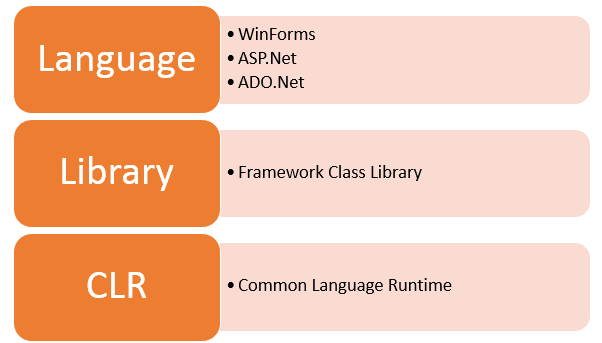
.NET Components
Three core pillars underpin the framework’s functionality:
1. Common Language Runtime (CLR)
The CLR is the execution engine that manages code compiled from any .NET language. Its responsibilities include:
- Exception Handling – Provides a unified mechanism for detecting, propagating, and recovering from runtime errors.
- Garbage Collection – Automatically reclaims memory and other resources that are no longer referenced, ensuring efficient use of system resources.
- Security – Enforces code access security and validates assemblies before execution.
- Interoperability – Allows managed code to call native APIs and vice versa through P/Invoke and COM interop.
The CLR sits beneath the language compilers and above the operating system, acting as the final layer that translates compiled IL (Intermediate Language) into machine code.
2. Class Library
The framework’s class libraries are organized into namespaces such as System and Microsoft. They provide pre‑built, battle‑tested functionality for common tasks:
- File I/O, networking, and cryptography
- Collections, data binding, and serialization
- Database connectivity via ADO.NET
- UI components for WinForms and ASP.NET
Developers can consume these libraries directly, enabling rapid development and reducing code duplication.
3. Languages
While the CLR is language‑agnostic, developers typically choose from:
- WinForms – For desktop applications that run directly on a user’s machine.
- ASP.NET – For web applications delivered through Internet Information Services (IIS) and rendered in modern browsers.
- ADO.NET – For data‑centric applications that interact with relational databases.
Each language has its own compiler that produces IL, which the CLR then executes.
.NET Framework Design Principles
Microsoft’s design philosophy has guided the framework’s evolution, yielding the following core principles:
- Interoperability – Applications built on earlier framework versions (e.g., 2.0) run unmodified on newer releases (e.g., 3.5, 4.7.2), thanks to backward compatibility layers.
- Portability – While traditionally Windows‑centric, .NET is now cross‑platform via .NET Core and .NET 5/6, enabling deployment on Linux, macOS, and mobile OSes.
- Security – The CLR enforces assembly permissions, code signing, and role‑based access control to protect both the host system and the application.
- Memory Management – Automatic garbage collection and deterministic disposal patterns (e.g.,
usingstatements) relieve developers from manual memory handling. - Simplified Deployment – Click‑Once, Click‑Once, and MSIX packages streamline installation, updating, and rollback of .NET applications.
Summary
- The .NET Framework is a Microsoft platform designed for building reliable Windows applications, including desktop, web, and services.
- It offers a versatile ecosystem of languages (C#, VB.NET, F#) and a vast class library set.
- Key components—CLR, class libraries, and language compilers—work together to deliver performance, security, and ease of development.
C Language
- Control Unit Explained: Components & Design in CPUs
- Operating System Fundamentals: Key Components and Functions
- Chatbots 101: Design Process, Architecture, and Practical Insights
- Comprehensive .NET and C# Version History Guide
- Spring Framework 2026: Comprehensive Overview, Features, Architecture, MVC, AOP, and Installation Guide
- Net Metering Explained: How Solar Homeowners Earn Credit on the Grid
- 5 Essential Elements of a Robust Asset Management Framework
- Hybrid Cloud Explained: Key Benefits & How It Enhances IT Flexibility
- Understanding Architecture Design: Principles, Practices, and Impact
- Understanding Microelectronics: The Science of Tiny Electronics