



Master C++ Conditional Statements: if, if...else, and Nested if...else Explained
C++ if, if...else and Nested if...else
In this tutorial, we will learn about the if...else statement to create decision making programs with the help of examples.
In computer programming, we use the if...else statement to run one block of code under certain conditions and another block of code under different conditions.
For example, assigning grades (A, B, C) based on marks obtained by a student.
- if the percentage is above 90, assign grade A
- if the percentage is above 75, assign grade B
- if the percentage is above 65, assign grade C
There are three forms of if...else statements in C++.
ifstatementif...elsestatementif...else if...elsestatement
C++ if Statement
The syntax of the if statement is:
if (condition) {
  // body of if statement
}
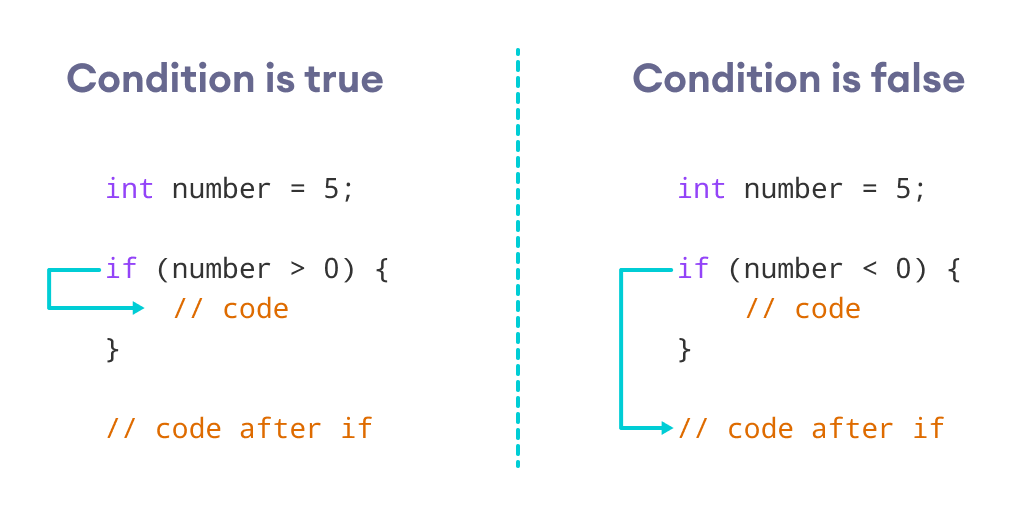
The if statement evaluates the condition inside the parentheses ( ).
- If the
conditionevaluates totrue, the code inside the body ofifis executed. - If the
conditionevaluates tofalse, the code inside the body ofifis skipped.
Note: The code inside { } is the body of the if statement.
Example 1: C++ if Statement
// Program to print positive number entered by the user
// If the user enters a negative number, it is skipped

#include <iostream>
using namespace std;

int main() {

  int number;

  cout << "Enter an integer: ";
  cin >> number;

  // checks if the number is positive
  if (number > 0) {
    cout << "You entered a positive integer: " << number << endl;
  }

  cout << "This statement is always executed.";

  return 0;
}
Output 1
Enter an integer: 5
You entered a positive number: 5
This statement is always executed.
When the user enters 5, the condition number > 0 is evaluated to true and the statement inside the body of if is executed.
Output 2
Enter a number: -5
This statement is always executed.
When the user enters -5, the condition number > 0 is evaluated to false and the statement inside the body of if is not executed.
C++ if...else
The if statement can have an optional else clause. Its syntax is:
if (condition) {
  // block of code if condition is true
}
else {
  // block of code if condition is false
}
The if..else statement evaluates the condition inside the parenthesis.
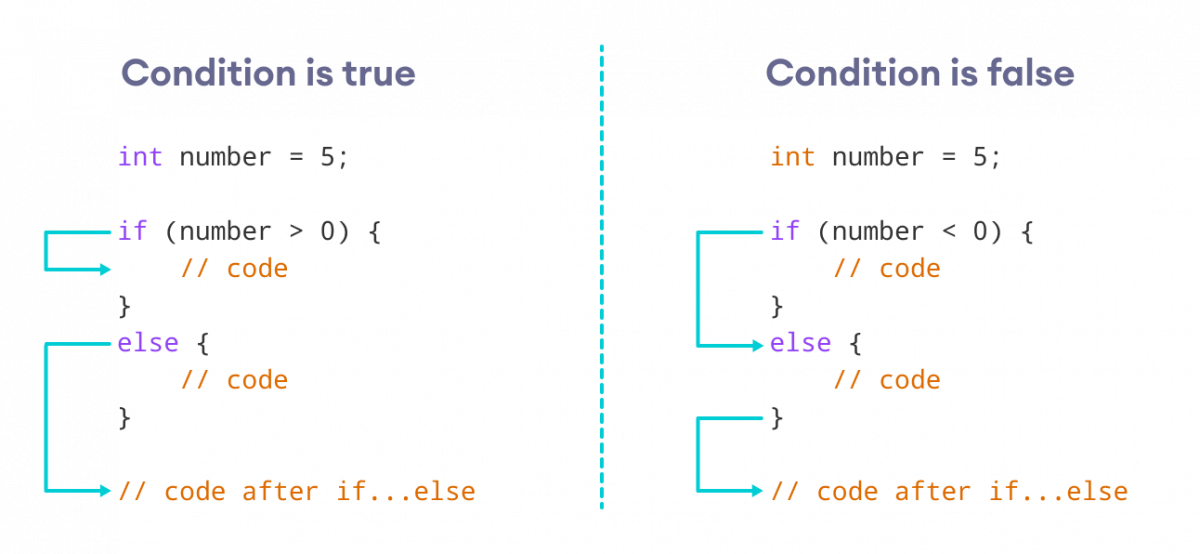
If the condition evaluates true,
- the code inside the body of
ifis executed - the code inside the body of
elseis skipped from execution
If the condition evaluates false,
- the code inside the body of
elseis executed - the code inside the body of
ifis skipped from execution
Example 2: C++ if...else Statement
// Program to check whether an integer is positive or negative
// This program considers 0 as a positive number

#include <iostream>
using namespace std;

int main() {

  int number;

  cout << "Enter an integer: ";
  cin >> number;

  if (number >= 0) {
    cout << "You entered a positive integer: " << number << endl;
  }
  else {
    cout << "You entered a negative integer: " << number << endl;
  }

  cout << "This line is always printed.";

  return 0;
}
Output 1
Enter an integer: 4
You entered a positive integer: 4.
This line is always printed.
In the above program, we have the condition number >= 0. If we enter the number greater or equal to 0, then the condition evaluates true.
Here, we enter 4. So, the condition is true. Hence, the statement inside the body of if is executed.
Output 2
Enter an integer: -4
You entered a negative integer: -4.
This line is always printed.
Here, we enter -4. So, the condition is false. Hence, the statement inside the body of else is executed.
C++ if...else...else if statement
The if...else statement is used to execute a block of code among two alternatives. However, if we need to make a choice between more than two alternatives, we use the if...else if...else statement.
The syntax of the if...else if...else statement is:
if (condition1) {
  // code block 1
}
else if (condition2){
  // code block 2
}
else {
  // code block 3
}
Here,
- If
condition1evaluates totrue, thecode block 1is executed. - If
condition1evaluates tofalse, thencondition2is evaluated. - If
condition2istrue, thecode block 2is executed. - If
condition2isfalse, thecode block 3is executed.
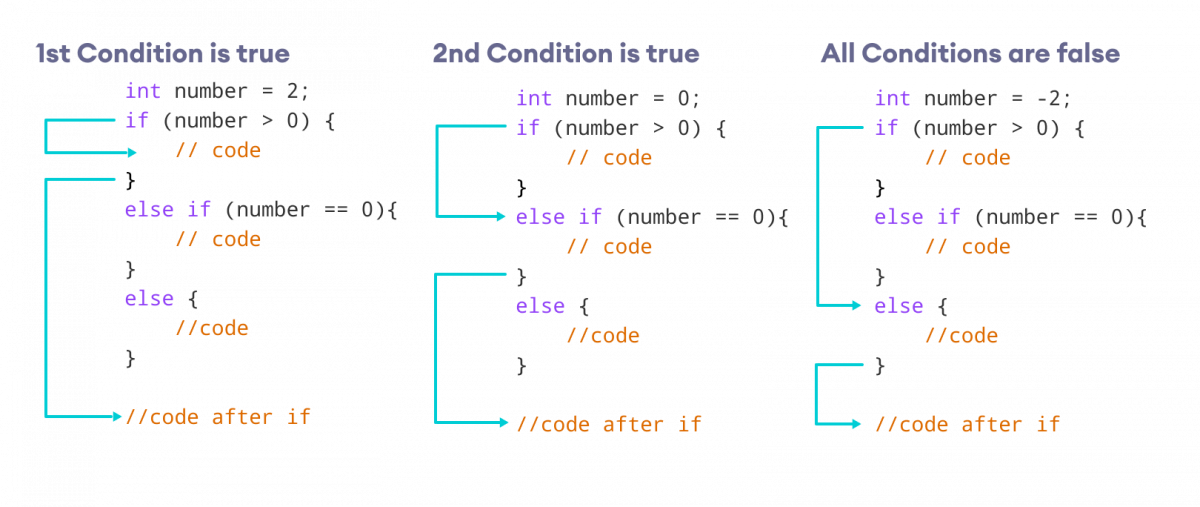
Note: There can be more than one else if statement but only one if and else statements.
Example 3: C++ if...else...else if
// Program to check whether an integer is positive, negative or zero

#include <iostream>
using namespace std;

int main() {

  int number;

  cout << "Enter an integer: ";
  cin >> number;

  if (number > 0) {
    cout << "You entered a positive integer: " << number << endl;
  }
  else if (number < 0) {
    cout << "You entered a negative integer: " << number << endl;
  }
  else {
    cout << "You entered 0." << endl;
  }

  cout << "This line is always printed.";

  return 0;
}
Output 1
Enter an integer: 1
You entered a positive integer: 1.
This line is always printed.
Output 2
Enter an integer: -2
You entered a negative integer: -2.
This line is always printed.
Output 3
Enter an integer: 0
You entered 0.
This line is always printed.
In this program, we take a number from the user. We then use the if...else if...else ladder to check whether the number is positive, negative, or zero.
If the number is greater than 0, the code inside the if block is executed. If the number is less than 0, the code inside the else if block is executed. Otherwise, the code inside the else block is executed.
C++ Nested if...else
Sometimes, we need to use an if statement inside another if statement. This is known as nested if statement.
Think of it as multiple layers of if statements. There is a first, outer if statement, and inside it is another, inner if statement. Its syntax is:
// outer if statement
if (condition1) {

  // statements

  // inner if statement
  if (condition2) {
    // statements
  }
}
Notes:
- We can add
elseandelse ifstatements to the innerifstatement as required. - The inner
ifstatement can also be inserted inside the outerelseorelse ifstatements (if they exist). - We can nest multiple layers of
ifstatements.
Example 4: C++ Nested if
// C++ program to find if an integer is positive, negative or zero
// using nested if statements

#include <iostream>
using namespace std;

int main() {

  int num;

  cout << "Enter an integer: ";
   cin >> num;

  // outer if condition
  if (num != 0) {

    // inner if condition
    if (num > 0) {
      cout << "The number is positive." << endl;
    }
    // inner else condition
    else {
      cout << "The number is negative." << endl;
    }
  }
  // outer else condition
  else {
    cout << "The number is 0 and it is neither positive nor negative." << endl;
  }

  cout << "This line is always printed." << endl;

  return 0;
}
Output 1
Enter an integer: 35
The number is positive.
This line is always printed.
Output 2
Enter an integer: -35
The number is negative.
This line is always printed.
Output 3
Enter an integer: 0
The number is 0 and it is neither positive nor negative.
This line is always printed.
In the above example,
- We take an integer as an input from the user and store it in the variable num.
- We then use an
if...elsestatement to check whether num is not equal to0.- If
true, then the innerif...elsestatement is executed. - If
false, the code inside the outerelsecondition is executed, which prints"The number is 0 and it is neither positive nor negative."
- If
- The inner
if...elsestatement checks whether the input number is positive i.e. if num is greater than 0.- If
true, then we print a statement saying that the number is positive. - If
false, we print that the number is negative.
- If
Note: As you can see, nested if...else makes your logic complicated. If possible, you should always try to avoid nested if...else.
Body of if...else With Only One Statement
If the body of if...else has only one statement, you can omit { } in the program. For example, you can replace
int number = 5;

if (number > 0) {
  cout << "The number is positive." << endl;
}
else {
  cout << "The number is negative." << endl;
}
with
int number = 5;

if (number > 0)
  cout << "The number is positive." << endl;
else
  cout << "The number is negative." << endl;
The output of both programs will be the same.
Note: Although it's not necessary to use { } if the body of if...else has only one statement, using { } makes your code more readable.
More on Decision Making
In certain situations, a ternary operator can replace an if...else statement. To learn more, visit C++ Ternary Operator.
If we need to make a choice between more than one alternatives based on a given test condition, the switch statement can be used. To learn more, visit C++ switch.
Check out these examples to learn more:
C++ Program to Check Whether Number is Even or Odd
C++ Program to Check Whether a character is Vowel or Consonant.
C++ Program to Find Largest Number Among Three Numbers
C Language
- Mastering Conditional Logic in C#: If, If‑Else, If‑ElseIf, and Nested If Statements
- C++ While and Do‑While Loops – Mastering Repetition in Your Code
- Mastering the C++ break Statement
- Mastering C++ Continue Statement: Practical Examples & Loop Control
- Mastering C Conditional Statements: If, Else, and More
- Mastering the C Goto Statement: Syntax, Practical Use, and Best Practices
- Mastering Java if…else: Control Flow Explained
- Mastering C Conditional Statements: IF, IF-ELSE, and Nested IF-ELSE Explained
- Understanding C++ Loop Types: For, While, Do-While Explained
- Comprehensive Guide to Date and Time in C++