



Mastering Java Loop Control: Efficient Repetition Techniques
There may be a situation when you need to execute a block of code several number of times. In general, statements are executed sequentially: The first statement in a function is executed first, followed by the second, and so on.
Programming languages provide various control structures that allow for more complicated execution paths.
A loop statement allows us to execute a statement or group of statements multiple times and following is the general form of a loop statement in most of the programming languages −
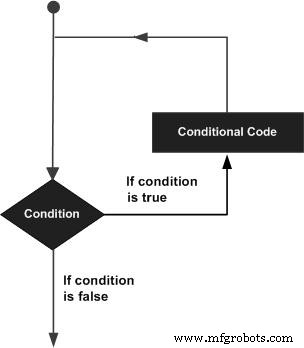
Java programming language provides the following types of loop to handle looping requirements. Click the following links to check their detail.
| Sr.No. | Loop & Description |
|---|---|
| 1 | while loop
Repeats a statement or group of statements while a given condition is true. It tests the condition before executing the loop body. |
| 2 | for loop
Execute a sequence of statements multiple times and abbreviates the code that manages the loop variable. |
| 3 | do...while loop
Like a while statement, except that it tests the condition at the end of the loop body. |
Loop Control Statements
Loop control statements change execution from its normal sequence. When execution leaves a scope, all automatic objects that were created in that scope are destroyed.
Java supports the following control statements. Click the following links to check their detail.
| Sr.No. | Control Statement & Description |
|---|---|
| 1 | break statement
Terminates the loop or switch statement and transfers execution to the statement immediately following the loop or switch. |
| 2 | continue statement
Causes the loop to skip the remainder of its body and immediately retest its condition prior to reiterating. |
Enhanced for loop in Java
As of Java 5, the enhanced for loop was introduced. This is mainly used to traverse collection of elements including arrays.
Syntax
Following is the syntax of enhanced for loop −
for(declaration : expression) {
   // Statements
}
Declaration − The newly declared block variable, is of a type compatible with the elements of the array you are accessing. The variable will be available within the for block and its value would be the same as the current array element.
Expression − This evaluates to the array you need to loop through. The expression can be an array variable or method call that returns an array.
Example
Live Demo
public class Test {

   public static void main(String args[]) {
      int [] numbers = {10, 20, 30, 40, 50};

      for(int x : numbers ) {
         System.out.print( x );
         System.out.print(",");
      }
      System.out.print("\n");
      String [] names = {"James", "Larry", "Tom", "Lacy"};

      for( String name : names ) {
         System.out.print( name );
         System.out.print(",");
      }
   }
}
This will produce the following result −
Output
10, 20, 30, 40, 50,
James, Larry, Tom, Lacy,
What is Next?
In the following chapter, we will be learning about decision making statements in Java programming.
Java
- Mastering Java if…else: Control Flow Explained
- Mastering the Java Switch Statement: Syntax, Usage, and Best Practices
- Master Java For Loops: Syntax, Examples, and Best Practices
- Mastering the Java Enhanced For Loop: Syntax, Examples, and Best Practices
- Mastering Java While & Do‑While Loops: Step‑by‑Step Tutorial
- Java Break Statement: How, When, and Labeled Breaks Explained
- Java Continue Statement – Mastering Loop Control with Examples
- Java Decision-Making: Mastering Conditional Statements for Robust Programming
- Mastering C Loops: A Comprehensive Guide to Repetition Control
- Master C# Loops: Efficient Code Repetition Techniques