



Java Collections Framework: Core Interfaces, Implementations, and Practical Usage
Java Collections Framework
Discover the essential interfaces and classes that form Java’s powerful Collections Framework, and learn why it’s a cornerstone of modern Java development.
The Java collections framework supplies a rich set of interfaces and concrete classes that implement common data structures—arrays, linked lists, hash tables, and more—alongside efficient algorithms for searching, sorting, and manipulation.
For instance, the LinkedList class implements a doubly‑linked list, allowing constant‑time insertions and deletions at both ends.
Key Interfaces of the Collections Framework
These interfaces define the contract for collection types and expose a wide array of utility methods for manipulating data.
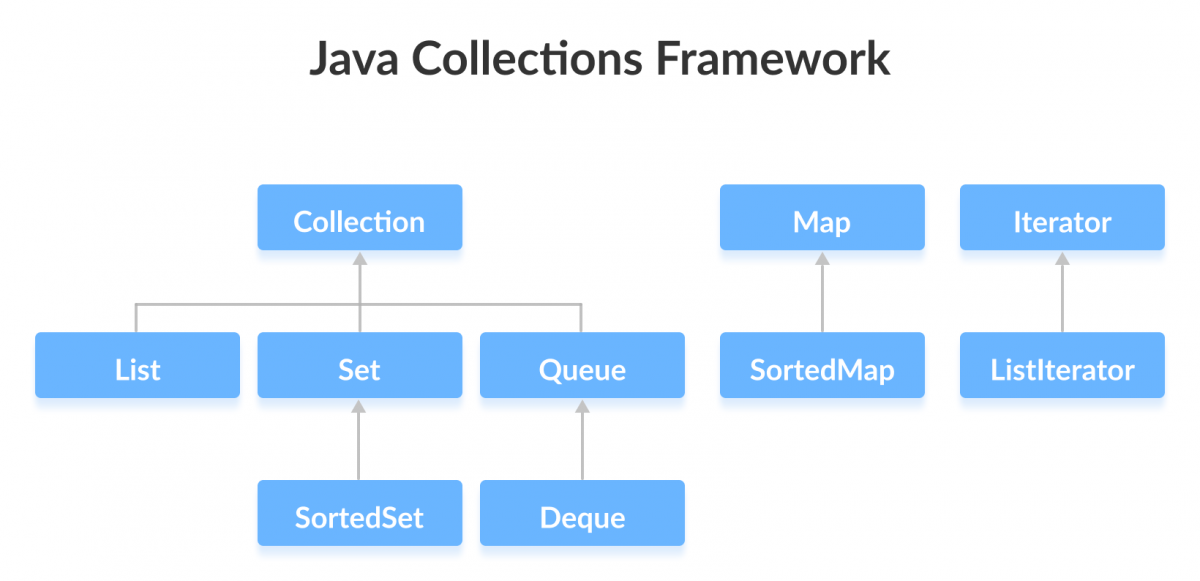
In the following sections we’ll examine each interface, its sub‑interfaces, and the classes that provide concrete implementations.
The Root: Collection Interface
The Collection interface is the top‑level interface in the framework hierarchy. While Java does not provide a direct implementation of Collection, its sub‑interfaces—List, Set, and Queue—are implemented by classes such as ArrayList, HashSet, and LinkedList.
Collections Framework vs. Collection Interface
It’s common to conflate the entire framework with the Collection interface. The framework also includes Map and Iterator interfaces, each with their own sub‑interfaces and implementations.
Sub‑Interfaces of Collection
Each sub‑interface inherits all methods from Collection and adds specialized behavior:
List Interface
The List interface represents an ordered sequence that allows indexed access and duplicate elements. Implementations include ArrayList, LinkedList, and Vector. Learn more about the List interface.
Set Interface
A Set stores unique elements without any guaranteed ordering. Popular implementations are HashSet, LinkedHashSet, and TreeSet. Explore the Set interface.
Queue Interface
The Queue interface defines FIFO (First In, First Out) behavior, ideal for buffering and scheduling. Implementations include LinkedList, PriorityQueue, and ArrayDeque. Discover the Queue interface.
The Map Interface
Unlike the collection interfaces, Map stores data as key/value pairs. Keys are unique, while each key maps to a single value. Implementations such as HashMap, LinkedHashMap, and TreeMap offer varying performance characteristics. Read about the Map interface.
Iterator Support
The Iterator interface provides a standard way to traverse collections sequentially, enabling safe removal of elements during iteration. All collection types expose an iterator() method. Learn about Iterator.
Why Use the Collections Framework?
- No boilerplate code – Built‑in implementations eliminate the need to write custom data structures.
- Performance‑optimized – The framework’s classes are highly tuned for speed and memory efficiency.
- Type safety – Generics provide compile‑time type checking, reducing runtime errors.
- Rich API – A plethora of utility methods (e.g.,
Collections.sort(),Collections.reverse()) simplify common tasks.
Choosing the right interface can streamline your code: use Set for uniqueness, Map for key/value lookups, and ArrayList for indexed access.
Practical Example: Using ArrayList
The ArrayList class provides a resizable array that implements the List interface. It offers fast random access and efficient addition at the end of the list.
// Java Collections framework resides in java.util package
import java.util.ArrayList;

public class Main {
    public static void main(String[] args) {
        ArrayList<String> animals = new ArrayList<>();
        animals.add("Dog");
        animals.add("Cat");
        animals.add("Horse");
        System.out.println("ArrayList: " + animals);
    }
}Output:
ArrayList: [Dog, Cat, Horse]
Future lessons will delve deeper into each interface and class, showcasing advanced patterns and performance tips.
Java
- Mastering Java Interfaces: Concepts, Implementation, and Best Practices
- Java Collection Interface: Core Concepts & Essential Methods
- Mastering Java’s Queue Interface: Methods, Implementations, and Practical Use
- Mastering Java's Deque Interface: Features, Methods, and Practical Examples
- Java Map Interface – Comprehensive Guide to Map, Its Implementations, and Key Methods
- Java SortedMap Interface: Overview, Methods, and TreeMap Implementation
- Mastering Java NavigableMap: Features, Methods, and TreeMap Implementation
- Mastering Java’s ConcurrentMap: Thread‑Safe Maps Explained
- Mastering Java’s Set Interface: Concepts, Methods, and Practical Examples
- Mastering Java Collections: A Comprehensive Guide to Efficient Data Structures