



Mastering Java’s Set Interface: Concepts, Methods, and Practical Examples
Mastering Java’s Set Interface
Discover how Java’s Set interface eliminates duplicates, its key methods, and real‑world usage in HashSet, TreeSet, and more.
The Set interface in the Java Collections Framework models a mathematical set: a collection that never holds duplicate elements. It extends the Collection interface, inheriting all of its standard operations while adding a few set‑specific utilities.
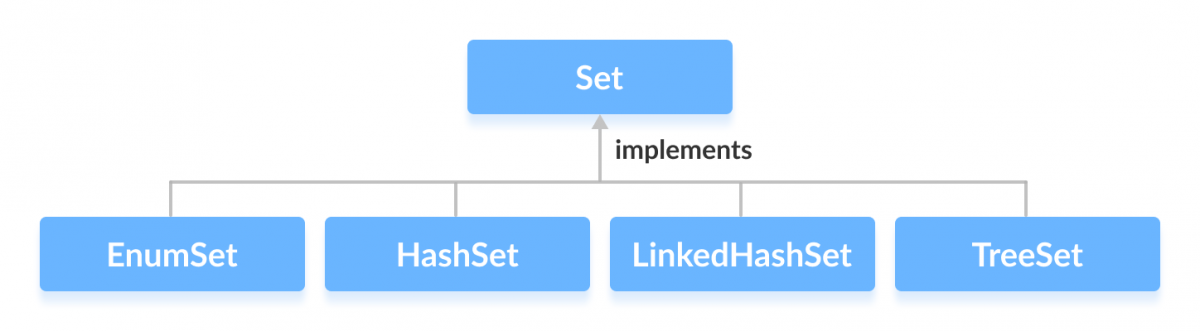
Classes that Implement Set
Because Set is an interface, we instantiate concrete implementations to work with it:
- HashSet – unordered, highly performant, uses hashing.
- LinkedHashSet – preserves insertion order.
- EnumSet – a specialized set for enum types, extremely fast.
- TreeSet – sorted order based on natural ordering or a comparator.
These classes live in the java.util package and all satisfy the Set contract.
Subinterfaces of Set
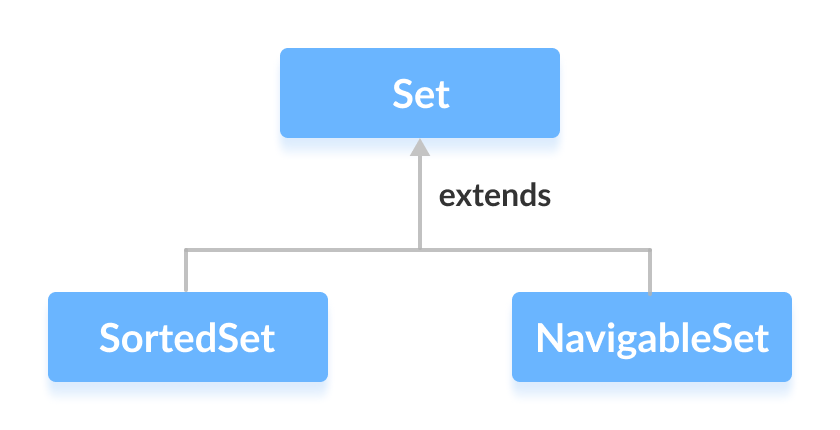
The Set interface is further extended by:
- SortedSet – adds methods for navigating sorted sets.
- NavigableSet – extends SortedSet with higher‑level navigation methods.
Using Set in Code
To use a set, import java.util.Set and choose an implementation:
import java.util.Set;
import java.util.HashSet;

Set<String> animals = new HashSet<>();
Here animals is a Set of strings, backed by a HashSet. The choice of implementation depends on ordering, performance, and use case requirements.
Core Methods of Set
The Set interface inherits all Collection methods and adds the following commonly used ones:
- add(element) – inserts an element if not already present.
- addAll(collection) – bulk‑adds elements from another collection.
- iterator() – provides a sequential iterator.
- remove(element) – removes a specific element.
- removeAll(collection) – removes all elements that appear in the specified collection.
- retainAll(collection) – keeps only the elements also present in the specified collection.
- clear() – empties the set.
- size() – returns the number of elements.
- toArray() – converts the set to an array.
- contains(element) – checks membership.
- containsAll(collection) – verifies that all elements of the given collection are present.
- hashCode() – generates a hash code for the set.
For a complete reference, consult the official Java Set documentation.
Set Operations
Java sets support classic mathematical operations through straightforward methods:
- Union –
x.addAll(y)combines two sets. - Intersection –
x.retainAll(y)keeps only common elements. - Subset –
y.containsAll(x)checks ifxis a subset ofy.
Practical Implementation Examples
1. Using HashSet
import java.util.Set;
import java.util.HashSet;

public class HashSetDemo {
    public static void main(String[] args) {
        Set<Integer> set1 = new HashSet<>();
        set1.add(2);
        set1.add(3);
        System.out.println("Set1: " + set1);

        Set<Integer> set2 = new HashSet<>();
        set2.add(1);
        set2.add(2);
        System.out.println("Set2: " + set2);

        set2.addAll(set1); // Union
        System.out.println("Union is: " + set2);
    }
}
Output
Set1: [2, 3]
Set2: [1, 2]
Union is: [1, 2, 3]
Explore more at Java HashSet.
2. Using TreeSet
import java.util.Set;
import java.util.TreeSet;
import java.util.Iterator;

public class TreeSetDemo {
    public static void main(String[] args) {
        Set<Integer> numbers = new TreeSet<>();
        numbers.add(2);
        numbers.add(3);
        numbers.add(1);
        System.out.println("Set using TreeSet: " + numbers);

        System.out.print("Accessing elements using iterator(): ");
        Iterator<Integer> it = numbers.iterator();
        while (it.hasNext()) {
            System.out.print(it.next() + ", ");
        }
    }
}
Output
Set using TreeSet: [1, 2, 3]
Accessing elements using iterator(): 1, 2, 3,
For deeper insights, visit Java TreeSet.
These examples illustrate how to harness the power of the Set interface in real applications. Next, we’ll explore other implementations such as EnumSet and LinkedHashSet in separate tutorials.
Java
- Mastering Java Interfaces: Concepts, Implementation, and Best Practices
- Java Collections Framework: Core Interfaces, Implementations, and Practical Usage
- Java Collection Interface: Core Concepts & Essential Methods
- Mastering Java’s Queue Interface: Methods, Implementations, and Practical Use
- Mastering Java's Deque Interface: Features, Methods, and Practical Examples
- Java Map Interface – Comprehensive Guide to Map, Its Implementations, and Key Methods
- Java SortedMap Interface: Overview, Methods, and TreeMap Implementation
- Mastering Java NavigableMap: Features, Methods, and TreeMap Implementation
- Mastering Java’s ConcurrentMap: Thread‑Safe Maps Explained
- Mastering Java SortedSet: A Practical Guide to TreeSet and Its Methods