



Java BlockingQueue: Thread‑Safe Queues with Blocking Operations
Java BlockingQueue
This guide explores the Java BlockingQueue interface, its implementations, method categories, and real‑world usage.
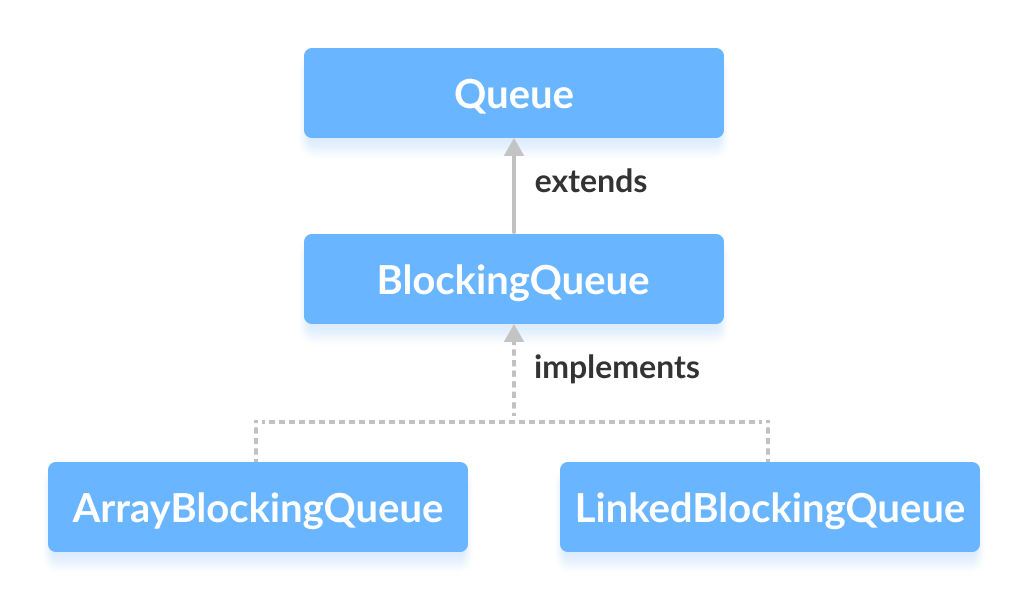
The BlockingQueue interface, part of the Java Collections framework, extends Queue and augments it with blocking behavior. Operations such as insertion and removal will wait automatically until the queue’s state permits the action.
For example, attempting to remove an element from an empty queue will block the calling thread until an item becomes available, ensuring safe coordination between producers and consumers.
Concrete Implementations
Since BlockingQueue is an interface, concrete classes provide the actual functionality:
ArrayBlockingQueue– a bounded, array‑based FIFO queue.LinkedBlockingQueue– an optionally bounded, linked‑list implementation.
Using BlockingQueue
Import the package before creating instances:
import java.util.concurrent.BlockingQueue;
import java.util.concurrent.ArrayBlockingQueue;
import java.util.concurrent.LinkedBlockingQueue;
Example instances:
// Array implementation of BlockingQueue
BlockingQueue<String> animal1 = new ArrayBlockingQueue<>(10);

// LinkedList implementation of BlockingQueue
BlockingQueue<String> animal2 = new LinkedBlockingQueue<>();
Both objects support all methods defined by the BlockingQueue interface.
Method Categories
BlockingQueue methods are grouped by how they react when the queue is full or empty:
Exception‑Throwing Methods
add(E e)– inserts an element; throwsIllegalStateExceptionif full.element()– retrieves, but does not remove, the head; throwsNoSuchElementExceptionif empty.remove()– removes the head; throwsNoSuchElementExceptionif empty.
Return‑Value Methods
offer(E e)– inserts an element; returnsfalseif full.peek()– retrieves the head; returnsnullif empty.poll()– removes the head; returnsnullif empty.
Timed variants
Both offer and poll support timeouts:
boolean success = queue.offer(item, 100, TimeUnit.MILLISECONDS);
In this example, the method attempts to insert item for up to 100 milliseconds, returning false if the operation times out. Supported time units include days, hours, minutes, seconds, milliseconds, microseconds, and nanoseconds.
Blocking Methods
put(E e)– inserts an element, blocking if the queue is full until space becomes available.take()– removes and returns the head, blocking if the queue is empty until an element is inserted.
These methods are essential for producer‑consumer patterns where threads must synchronize without busy‑waiting.
ArrayBlockingQueue Example
import java.util.concurrent.BlockingQueue;
import java.util.concurrent.ArrayBlockingQueue;

public class Main {
    public static void main(String[] args) {
        // Create a bounded blocking queue with capacity 5
        BlockingQueue<Integer> numbers = new ArrayBlockingQueue<>(5);
        try {
            // Insert elements – will block if the queue becomes full
            numbers.put(2);
            numbers.put(1);
            numbers.put(3);
            System.out.println("BlockingQueue: " + numbers);

            // Remove an element – will block if the queue is empty
            int removedNumber = numbers.take();
            System.out.println("Removed Number: " + removedNumber);
        } catch (InterruptedException e) {
            Thread.currentThread().interrupt();
            System.err.println("Operation interrupted: " + e.getMessage());
        }
    }
}
Output
BlockingQueue: [2, 1, 3]
Removed Number: 2
For deeper insights, consult the official Java documentation on ArrayBlockingQueue.
Why Use BlockingQueue?
The core advantage of BlockingQueue is its inherent thread safety. It eliminates the need for explicit synchronization when multiple threads concurrently produce and consume data.
Consider a producer thread that inserts items at a slower pace than a consumer thread that removes them. Without blocking behavior, the consumer could throw exceptions or spin in a busy‑wait loop. A BlockingQueue automatically suspends the consumer until the producer makes new data available, and vice versa.
By leveraging these built‑in blocking mechanisms, developers can build robust, scalable concurrent applications with minimal boilerplate.
---
Java
- Master Java Operators: Types, Syntax, & Practical Examples
- Java Comments: Types, Usage, and Best Practices
- Mastering Java's super Keyword: Advanced Usage & Practical Examples
- Mastering Java Interfaces: Concepts, Implementation, and Best Practices
- Mastering Java Try‑with‑Resources: Automatic Resource Management Explained
- Java Annotations Explained: Types, Placement, and Practical Examples
- Mastering Java’s Queue Interface: Methods, Implementations, and Practical Use
- Java PriorityQueue: Fundamentals, Operations, and Custom Sorting
- Java ArrayBlockingQueue: Advanced Guide to Blocking Queues and Thread‑Safe Operations
- Mastering Java's LinkedBlockingQueue: Comprehensive Guide & Examples