



Western U.S. Coal Plant Cuts Gearbox Wear, Extends Life, and Saves Costs with ISO 460 Synthetic Gear Oil and Advanced Filtration
Western U.S. Coal Plant Cuts Gearbox Wear, Extends Life, and Saves Costs with ISO 460 Synthetic Gear Oil and Advanced Filtration
Authors: Ken Nicholas (Schroeder Industries), Richard Winslow (PacifiCorp Naughton Plant), Ted Naman (ConocoPhillips)
Executive Summary
A western U.S. coal-fired power plant faced premature gearbox failure in its coal pulverizer units. The OEM‑specified AGMA 6EP (ISO 320) gear oil was insufficient due to excessive particulate loading and additive depletion. A comprehensive solution combining a high‑efficiency kidney‑loop filtration system and an ISO 460 synthetic gear oil (AGMA 7) eliminated the wear chain reaction, extended gearbox life, and lowered maintenance costs.
Background: Pulverizer Gearbox Design and Costs
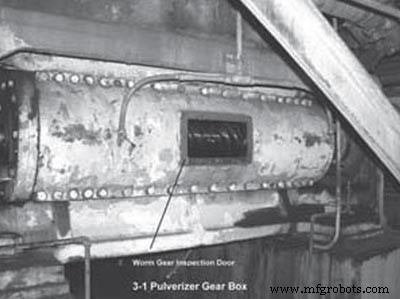
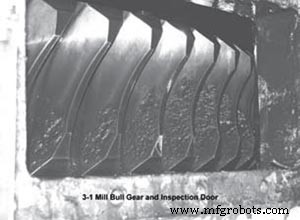
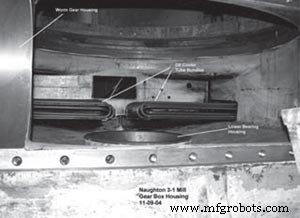
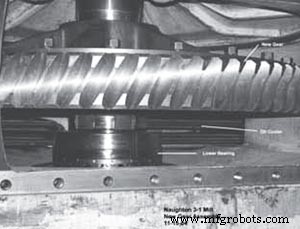
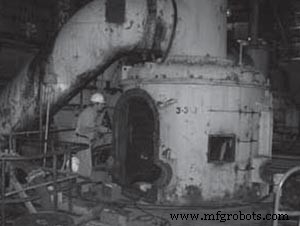
The pulverizer gearbox, built in the early 1960s, employs a steel worm gear driven by an 800 rpm electric motor to turn a bronze bull gear on a grinding table. The 255‑gal sump is water‑cooled, and the OEM recommends unfiltered ISO 320 EP gear oil for bronze‑on‑steel contact.
Maintenance costs were unsustainable:
- Annual oil changes cost $5,000 in materials and labor, plus $20,000–$50,000 in lost production. The plant operated 13 units.
- Every 10 years the bronze bull gear was rotated, requiring a four‑week shutdown and $300,000 per unit.
- Every 20 years a full gearbox rebuild cost $450,000 in parts and labor, with an additional $250,000 in downtime.
Identifying the Wear Chain Reaction
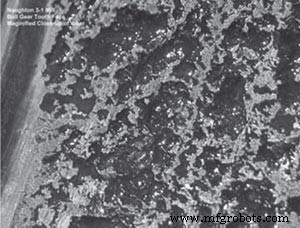
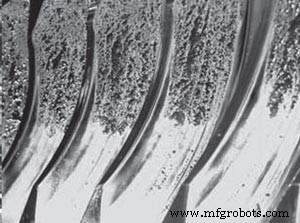
Oil analysis revealed high concentrations of coal dust, dirt, and metallic wear particles, along with a depleted EP additive package. Infrared thermography confirmed excessive sliding of bronze on steel, exacerbating wear. Plant engineers linked the problem to three main factors:
- Particulate ingress from coal dust and dirt.
- Chemical degradation of the EP additive on bronze.
- Catalytic reactions between additives and generated particulates.
Strategic Interventions
The team pursued a three‑pronged approach:
- Improved sealing to block particulate ingress.
- High‑capacity filtration to capture wear and airborne particles.
- Advanced lubricant selection to provide extended intervals without energy penalties.
Controlling Particulate Ingress
Breather desiccant filters were installed on gearbox vents, and grinding table seals were tightened. Aggressive filtration achieved an ISO Cleanliness Code of 23/21/18 (ISO 4406‑1999) after initial trials.
Kidney‑Loop Filtration System
The plant selected a kidney‑loop filtration package that met the following criteria:
- Adequate flow for high‑viscosity gear oil.
- High dirt‑holding capacity.
- Filter changes no more than once per month under normal operation.
- Rapid cleanup within one week of maintenance.
- Target cleanliness of 18/15/11 ISO 4406‑1999.
- Pre‑ and post‑filtration sampling points.
- Skid‑mounted, non‑intrusive installation.
- Safe suction/discharge design to eliminate fire hazards.
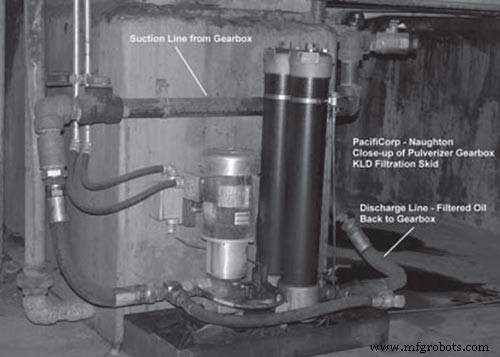
Filtration Specifications
- Two filter housings in series with Beta 25=200 (first stage) and Beta 10=200 (second stage) elements.
- 10 gpm vane pump driving 460 cSt (2,500 SUS) gear oil.
- Operating temperatures: 65 °F idle to 130 °F during run.
- Differential pressure gauges target 25–28 psig for element loading.
Lubricant Upgrade
Oil analysis showed the OEM EP oil was unsuitable due to additive depletion and insufficient film strength for bronze contact. After consultation, AGMA 7 (ISO 460) synthetic gear oil was selected. Key properties (Table 1) include:
| Property | Value |
|---|---|
| Density | 7.34 lb/gal |
| Flash Point | 240 °C (465 °F) |
| Pour Point | –29 °C (–20 °F) |
| Viscosity @ 40 °C | 460 cSt |
| Viscosity @ 100 °C | 37.2 cSt |
| SUS @ 100 °F | 2431 |
| SUS @ 210 °F | 181 |
| Viscosity Index | 123 |
| Acid Number | 0.20 mg KOH/g |
| Foam Test | Pass |
| Four‑Ball EP | 315 kgf |
| Four‑Ball Wear | 0.40 mm |
| Precipitation Number | 0.001 ml |
| Rust Test | Pass |
Benefits include enhanced pumpability at low temperatures, superior oxidation resistance, higher film strength across temperatures, and extended service life when paired with effective filtration.
Implementation and Results
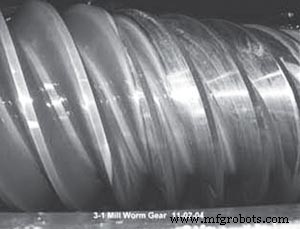
The gearbox was overhauled, all rotating parts replaced except the steel worm gear, and precision alignment performed. The reservoir was flushed with ISO 460 mineral oil and filled with the synthetic gear oil. Baseline cleanliness was 23/21/18.
After three hours of operation, particle counts dropped to 21/19/11. A second set of Beta 5=200 filters reduced the system to the target 18/15/11 within two weeks. Filter service life averaged one year, far exceeding expectations.
Oil analysis over the trial period demonstrated markedly reduced wear metals and maintained cleanliness. Key performance metrics:
- Gear and bearing lubrication significantly improved.
- Wear metals virtually eliminated.
- No increase in motor energy; a 1 % drop in amperage observed.
- Predictive maintenance now based on particle count and ferrography.
- Gear oil life extended, reducing disposal and environmental impact.
- Gearbox life and maintenance intervals extended.
- Downtime due to contamination eliminated.
- Positive ROI justified the shift to synthetic oil and filtration.
- The plant has purchased a second unit and installed the same system.
Acknowledgements
- John Kinion and maintenance personnel, PacifiCorp Naughton Plant, Kemmerer, WY.
- Chris Tully, Project Engineer, Schroeder Industries.
- Ken Knochel, Technical Services, Schroeder Industries.
References
- ISO 4406:1999 – Method for coding contamination by solid particles.
- ISO 16889:1999 – Multipass method for evaluating filter performance.
- I. Sheffield, “Changes in Filtration and Contamination – Switching Directions for the Filtration Industry,” Machinery Lubrication, Jan 2005.
Appendix 1 – Particle Count Data
Equipment Maintenance and Repair
- Extending Coal Pulverizer Gearbox Life with Advanced Filtration and Synthetic Lubrication
- Cut Gearbox Maintenance Costs by 30% to Boost Wind Farm Profitability
- Case Study: How Synchronous Averaging Uncovered a Pinion Failure in a Low‑Speed Gearbox
- Gear System Insights: Backlash, Breathers, Oil Selection & Load Management
- Combatting Corrosion in Mounted Bearings: Innovations & Best Practices
- Diagnosing a Persistent Gearbox Noise: Lessons from a Refurbished Unit
- Prolong Your Undercarriage Life: Expert Maintenance Strategies
- Choosing the Right Gear Reducer Box: A Practical Guide
- Planetary Gearbox Explained: Compact, High-Torque Speed Reduction
- Right Angle Planetary Gearbox: Compact, Efficient Speed Reduction Solutions