



What Is a Mallet? A Comprehensive Guide to Types, Uses, and Selection
A mallet is a type of hammer with a large, soft head which is intended to strike a surface without causing any damage to it. Mallets typically have short handles, making them easier to control. There are a wide range of mallet styles on the market which are designed for a range of applications. Many hardware stores stock basic mallets, and it is also possible to find specialty mallets designed for particular professional trades. Some craftspeople also make their own mallets for specific tasks.
The materials used to make mallets vary. Some common choices are: wood, soft metals, rubber, plastic, and rawhide. As a general rule, mallets are designed so that the materials they are made from will deform before the mallet damages the object it hits. Many mallets are also made from resilient materials which will spring back after they are used; this allows people to use them again and again for projects, as the mallet deforms only temporarily.

Carpenters use mallets as driving tools, to hit other tools like chisels. The broad head of a mallet makes it easy to use when hitting a chisel, requiring less precision on the part of a user. A mallet may also be used to knock pieces of wood into place, or to hammer pegs into furniture and flooring. If a mallet strikes the project being worked on, the soft material simply bounces off, rather than creating a gouge as a hammer might.
Mallets are also used in metalworking and jewelry to flatten metal and drive various tools. In metalworking, mallets are often made from metals which are softer than the metal being worked. These metals can withstand the heat sometimes involved in metalworking without causing damage. Plastic mallets are also sometimes used by jewelers, and various metal mallets are sometimes utilized in machining and electronics as well.
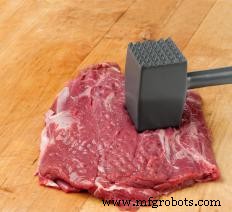
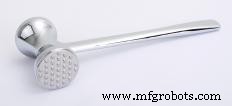
Mallets also pop up in the kitchen. A meat tenderizer is simply a form of mallet, and some people skip the customized tool and stick with a mallet from the toolbox instead. Mallets can also be used in leatherworking, to drive the tools used to tool leather and sometimes to add texture to a leather surface as well.
Because mallets can deform, it is a good idea to hang them up so that they do not come into contact with other tools; even a small amount of pressure can create a distinctive imprint in a mallet. Many mallets have loops on their handles for the purpose of hanging, and a mallet can also be suspended from its head.
Industrial equipment
- Diamond Turning: Precision Machining for Advanced Optics and Beyond
- Ultrasonic Machining Explained: Process, Benefits, and Limitations
- Rotational Molding: The Complete Guide to Creating Hollow Plastic Parts
- Understanding the Oxygen (O2) Sensor: Role, Placement, and Failure Signs
- Understanding AS9100: The Aerospace Quality Management Standard
- What Is A2 Steel? A Versatile, Cost‑Effective Tool‑Steel Grade for Industrial and Woodworking Applications
- Understanding Metal Casting: Process, Benefits, and Applications
- Demystifying 3D Printing: A Clear Guide for Innovators
- What Is a Mallet? A Comprehensive Guide to Types, Uses, and Selection
- Decoding 'N' in Pump Calculations: Its Role and Significance