



Inside NASCAR Engines: Design, Power, and Training
Since its founding in 1948, NASCAR has become synonymous with high‑speed stock‑car racing, showcasing vehicles that are rigorously engineered for peak performance and reliability.
Unlike standard passenger‑car engines, NASCAR powertrains must sustain high output over long races while maintaining flawless durability. This demands precision engineering, balanced components, and rigorous testing protocols.
Students at the NASCAR Technical Institute (NTI) in Mooresville, North Carolina, work with these high‑performance engines in the 15‑week NASCAR Technician Training program. The curriculum covers every aspect of engine design, fabrication, aerodynamics, and pit‑crew strategy.
Read on to understand how NASCAR engines achieve extraordinary horsepower and what it takes to train the next generation of motorsport technicians.
NASCAR vs. Passenger Car Engines
NASCAR engines routinely produce upwards of 750 horsepower, far exceeding the typical 180–200 horsepower range of road‑legal vehicles. This power translates directly to the remarkable speeds seen on the track.
The difference stems from custom‑built components: pistons, valves, and cam profiles are all meticulously sized and balanced. NASCAR camshafts allow intake valves to open earlier and remain open longer, flooding the cylinders with air—especially at high RPMs.
After assembly, engines undergo extensive dyno testing. The first run measures peak power, followed by a two‑hour session where ignition timing is fine‑tuned across a spectrum of power cycles and speeds. Such scrutiny ensures every engine is race‑ready.
Other Critical Components
Beyond the engine, NASCAR vehicles feature specialized parts that enhance safety and performance.
Chassis and Safety
Racing chassis incorporate reinforced frames and roll cages designed to protect drivers during high‑impact incidents.
Exhaust System
Exhaust manifolds, catalytic converters, and mufflers are engineered for minimal backpressure, allowing rapid evacuation of combustion gases. This efficiency supplies fresh air to the engine, boosting horsepower and overall performance.
Transmission
NASCAR race cars use four‑speed manual gearboxes with straight‑cut gears. Although clutch pedals are present, drivers typically rely on rev‑matching to shift, synchronizing engine speed with vehicle speed to preserve torque and reduce wear.
NASCAR Specialized Training
NTI is the sole academic institution in the United States offering NASCAR‑endorsed training. The 15‑week Technician Training program equips students with hands‑on experience in high‑performance engines, fabrication, welding, aerodynamics, and pit‑crew operations.
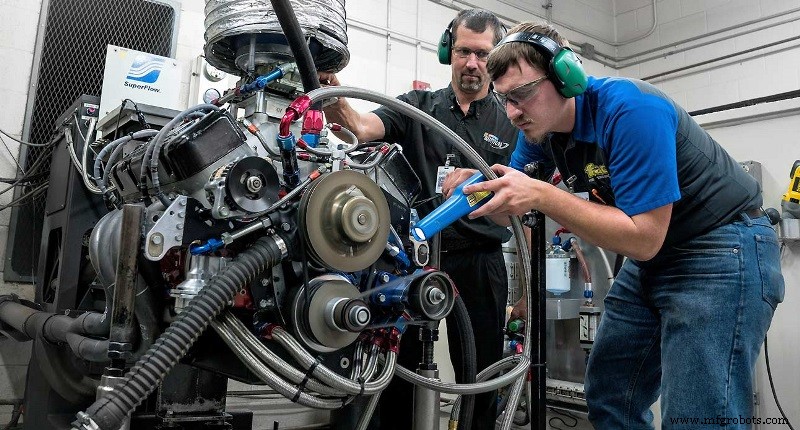
Students may enroll after completing the core automotive program. The curriculum includes:
- NASCAR Engines I
- NASCAR Engines II
- NASCAR Chassis Applications
- NASCAR Pit Crew
- NASCAR Fabrication – Finish Fabrication
- NASCAR Fabrication II – Chassis Fabrication
- NASCAR Fabrication III – Advanced Fabrication & Aerodynamics
How to Qualify
Eligibility requires completion of core automotive courses, with specific exclusions depending on the track:
- Core program training: All Automotive courses except ADTA‑102, ADTA‑103, ADTA‑125, ADTA‑129, ADTA‑135
- Core program training – Technology II: All Automotive courses except AT12‑150, AT12‑151, AT12‑203, AT12‑204
- Core program training – NTI campus only: All Automotive courses except ADTA‑125, ADTA‑135, ADTN‑140, ADTN‑141
Additional admissions requirements are available online, and admissions representatives can answer any questions.
UTI’s Spec Engine Course
Developed by NASCAR, this exclusive program allows a select group of students to build engines that compete in the ARCA Menards Series East. The three‑week course admits only those with a minimum 3.8 GPA and a 98% professionalism and attendance score, ensuring intensive, individualized instruction.
Learn About NASCAR Engines and More at NTI
Hands‑on industry experience in motorsports begins at the NASCAR Technical Institute in Mooresville, North Carolina. NTI remains the only campus in the country offering NASCAR‑endorsed training.
To discover more about the program and admissions, request information here or call 1‑800‑834‑7308.
Industrial equipment
- Understanding Full Mortise Hinges: Function, Installation, and Benefits
- Electrical Grounding Explained: Safeguarding Systems from Arcing and Fires
- How Casters Work: From Early Designs to Omni‑Directional Innovation
- How Gas Springs Store Energy: Mechanics, Function, and Applications
- How a Car Radiator Works: Inside the Cooling System
- How Control Valves Operate: A Technical Overview
- How SCADA Systems Operate: Monitoring and Controlling Industrial Processes
- How Air Dryers Work: Keeping Compressed Air Clean & Efficient
- Understanding Sprag Clutches: Function, Applications, and Benefits
- Understanding Electric Brakes: How They Operate and Why They Matter