



How Casters Work: From Early Designs to Omni‑Directional Innovation
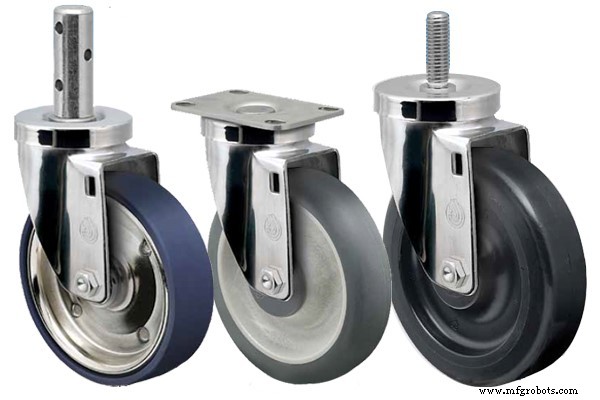
What Are Casters?
Casters are the subtle wheels that grant furniture, carts, and equipment the freedom to glide in any direction. From office chairs to hospital beds, these small yet essential components are used every day without our conscious awareness. While the wheel itself is one of humanity’s oldest inventions, the modern caster was patented in the late 1800s by David Fisher. Today, advances such as the omni‑directional caster keep expanding the possibilities of mobility.
Caster Development
Early casters were simple U‑shaped frames that held a wheel and axle rigidly. The wheel could move only forward or backward, lacking the ability to pivot. The next iteration added a bearing at the top of the frame, allowing the wheel to rotate around a fixed axis. Though this improvement enabled side‑to‑side movement, the wheel still tended to slip without proper alignment, especially on smooth surfaces. Modern casters solve this problem with a self‑steering mechanism: the wheel’s axis is offset from the pivot point, causing the wheel to rotate toward the direction of the applied force. This “self‑centering” feature allows the caster to follow the load with minimal rotation, ensuring smooth, predictable motion.
Fixed & Rotating Casters
Both fixed and rotating casters share a common axle design, with the wheel’s axle centered under the mounting point. In contrast, a self‑steering caster’s mounting point is deliberately offset from the axle. This offset grants the caster the ability to point in any direction and automatically align with the direction of the applied load. The side friction forces push the wheel toward the path of least resistance, allowing it to roll efficiently. Depending on their diameter, casters may require only a few degrees of rotation to align with the load direction, enabling a wide range of sizes, materials, and wheel profiles.
If any human invention exemplifies simple genius, the caster undoubtedly ranks among the top.
Industrial equipment
- Understanding Full Mortise Hinges: Function, Installation, and Benefits
- 5 Essential Tips for Maintaining Casters and Extending Their Lifespan
- Electrical Grounding Explained: Safeguarding Systems from Arcing and Fires
- How to Prevent Caster Flutter: Expert Tips for Smooth, Stable Movement
- The Evolution of Casters: From Ancient Wheels to Modern Omni‑Directional Solutions
- How Gas Springs Store Energy: Mechanics, Function, and Applications
- How a Car Radiator Works: Inside the Cooling System
- Inside NASCAR Engines: Design, Power, and Training
- How Air Dryers Work: Keeping Compressed Air Clean & Efficient
- Understanding Electric Brakes: How They Operate and Why They Matter