



How Gas Springs Store Energy: Mechanics, Function, and Applications
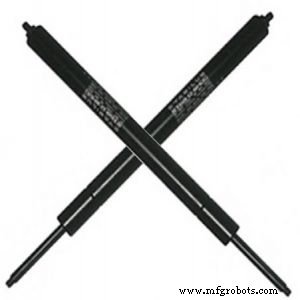
A spring is a device that stores energy. When a load is applied, that energy is transferred into the spring. Most springs use mechanical deformation, but gas springs rely on compressed gas to perform the same function. A gas spring consists of a sealed cylinder filled with nitrogen and a piston rod surrounded by lubricating oil. As a load is applied, the piston moves into the cylinder, compressing the gas and storing the load’s energy.
What Is a Gas Spring?
A gas spring stores energy in compressed nitrogen gas. The cylinder is sealed and contains a piston rod that moves up and down under load. The piston is surrounded by oil to reduce friction. When a load pushes the piston into the cylinder, the gas volume decreases, increasing pressure and storing the load’s energy.
How Gas Springs Operate
Gas springs are surprisingly simple. In their unloaded state the piston sits above the cylinder. When a force is applied, the piston is forced into the cylinder. Because the cylinder is sealed, the nitrogen gas cannot escape. The gas is compressed, its pressure rises, and this pressure pushes back against the piston, providing a counter‑force that resists the applied load.
Comparing Gas and Mechanical Springs
Mechanical springs store energy through elastic deformation of their material – a coiled wire that stretches (tension spring) or shortens (compression spring). Gas springs, by contrast, do not deform their material; they simply shorten as the piston sinks into the cylinder. The energy is stored in the compressed gas rather than in the spring’s structure.
Both types of springs can be used in the same applications – hinges, seat recliners, elevator doors, and more – but gas springs offer smoother operation, less wear, and a more predictable force profile.
Industrial equipment
- Understanding Full Mortise Hinges: Function, Installation, and Benefits
- Electrical Grounding Explained: Safeguarding Systems from Arcing and Fires
- What Are Garter Springs? Design, Function, and Sealing Applications
- Flat Springs Explained: Design, Function, and Selection Guide
- How Casters Work: From Early Designs to Omni‑Directional Innovation
- Springs: How They Store Energy and Return to Shape
- How a Car Radiator Works: Inside the Cooling System
- Inside NASCAR Engines: Design, Power, and Training
- How Air Dryers Work: Keeping Compressed Air Clean & Efficient
- Understanding Electric Brakes: How They Operate and Why They Matter