



GreenWaves Unveils GAP9: Ultra‑Low‑Power AI Accelerator Achieves 50 mW Power with 50 GOPS Performance
LONDON – GreenWaves has announced GAP9, the next‑generation ultra‑low‑power AI accelerator that cuts power consumption by a factor of five compared to its predecessor, GAP8, while handling neural‑network workloads ten times larger. The chip delivers up to 50 GOPS at a total power draw of just 50 mW, thanks to architectural refinements and a cutting‑edge 22 nm FD‑SOI process from GlobalFoundries.
Targeted at edge AI inferencing, GAP9 excels in battery‑powered IoT sensor nodes. GreenWaves reports that the chip can run MobileNet V1 on 160 × 160‑pixel images with a channel‑scaling factor of 0.25 in only 12 ms, consuming 806 µW per frame per second.
Based in Grenoble, France, GreenWaves selected GlobalFoundries’ 22 nm FDX FD‑SOI process to further suppress power usage in an already efficient architecture.
“For GAP9, we refined the GAP8 architecture using customer feedback while moving to a market‑leading semiconductor process,” said Martin Croome, Vice President of Marketing at GreenWaves. “We leveraged FD‑SOI’s body‑biasing capability to achieve even lower power consumption.”
Architectural Improvements
GAP9 incorporates several key enhancements:
- Core Count and Distribution: Ten RISC‑V cores now power the chip. One core functions as a fabric controller and low‑intensity compute engine, while the remaining nine form a computation cluster with a shared L1 data area. The newest core acts as a task‑group master, orchestrating memory movements and coordinating the other eight cores.
- Memory Expansion: Internal RAM has tripled to 1.6 MB, and memory bandwidth has been boosted to 41.6 GB/s for L1 and 7.2 GB/s for L2.
- Clock Speed: GAP8 operated at 175 MHz; GAP9 will run at or near 400 MHz, delivering a substantial performance lift.
- Power‑State Innovations: New states, including a “dozy” mode that keeps consumption below 1 mW while data is acquired, enable rapid wake‑up via a low‑dropout regulator. This reduces time‑to‑first‑instruction to just a few microseconds, a dramatic improvement over GAP8’s ~700 µs delay caused by DC‑DC converter stabilization.
- Transprecision Floating‑Point: All ten cores support IEEE 16‑ and 32‑bit floating‑point, plus additional 8‑ and 16‑bit formats with vectorization. This flexibility reduces energy demands for algorithms requiring floating‑point arithmetic.
- Quantized Vectorization: GAP9 introduces vectorized 4‑bit and 2‑bit operations, catering to applications that exploit deep quantization.
- Audio Interface: The chip now includes bi‑directional multi‑channel audio interfaces, expanding its utility in audio‑centric IoT deployments.
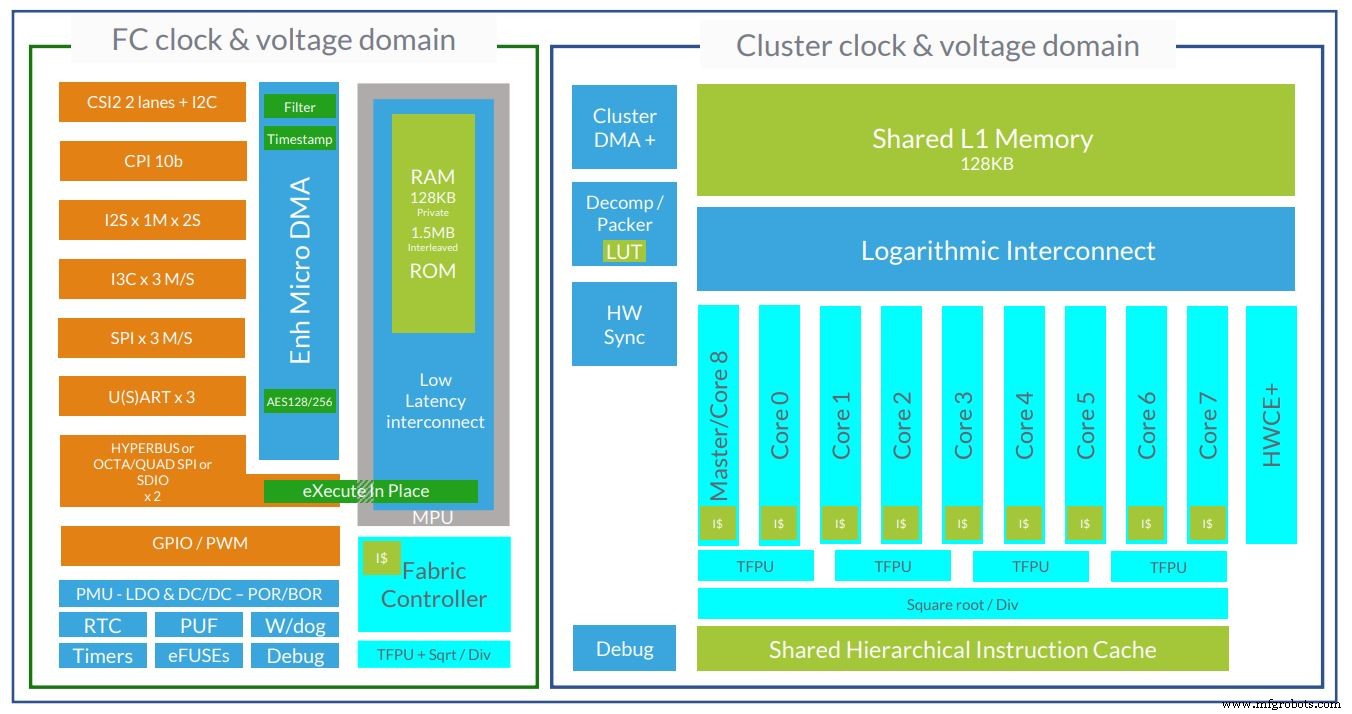
The architecture of GreenWaves’ GAP9 ultra‑low‑power AI chip now uses 10 RISC‑V cores (Image: GreenWaves)
GAP9 is slated for mass production in 2021, with early samples expected in the first half of 2020. Croome noted that the chip will carry a price premium of roughly 50 % compared to GAP8. Despite the higher cost, the company anticipates that both products will serve distinct market segments moving forward.
Embedded
- Aspinity Unveils RAMP: Analog Processor Cuts Edge Power by 10×
- Powering High‑Demand IoT Devices with USB and PoE
- Rutronik Distributes Redpine Signals’ RS14100: Ultra‑Low‑Power, Multi‑Protocol Secure Wireless MCUs
- AImotive Launches aiWare3P Neural Network Accelerator for High-Performance Automotive Vision
- XMOS Launches Xcore.ai: Low‑Cost Crossover Processor Empowering Edge AI Inference
- ROHM Launches BD71850MWV PMIC for NXP i.MX 8M Nano Processors
- Silicon Labs Launches 90‑W PoE Portfolio for Next‑Gen Connectivity
- SamurAI: Low‑Power AI Chip Sets New Benchmark for Image Recognition in IoT
- Kneron Unveils KL720 AI SoC, Boosting Edge Device Power Efficiency
- Wireless Power Revolutionizing Modern Manufacturing: Efficiency, Safety, and Growth