



Aspinity Unveils RAMP: Analog Processor Cuts Edge Power by 10×
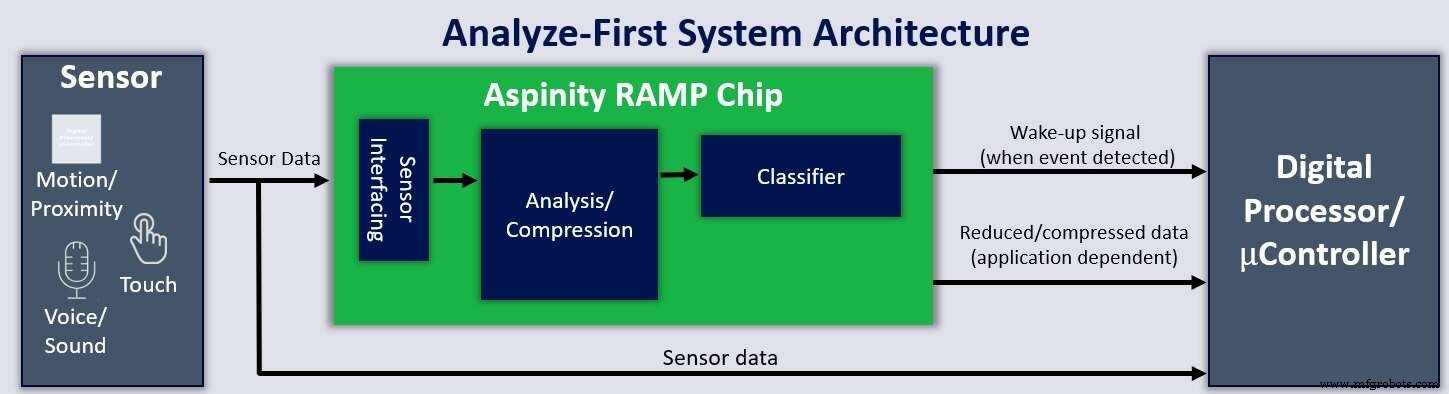
Aspinity, a Pittsburgh‑based startup founded in 2015, is launching Tuesday a Reconfigurable Analog Modular Processor platform, or RAMP. The ultra‑low‑power, analog processing platform is designed to detect, analyze, and classify raw sensor data—such as voice, alarms, or vibration changes—directly in the analog domain. Once it separates signal from background noise, RAMP hands the refined data off for digitization.
 (Source: Aspinity)
By prioritizing analog analysis first, RAMP can slash edge‑device power consumption by up to tenfold and reduce data volume by a factor of one hundred for always‑on applications, Aspinity claims. The platform targets battery‑operated, always‑on sensing devices across consumer, smart‑home, IoT, and industrial markets.
Senior analyst Mike Demler of The Linley Group told EE Times that RAMP’s standout feature is its extreme low power—drawing just 10 µA during active operation, a remarkable achievement for an analog chip.
Founder and CEO Tom Doyle expressed enthusiasm after hearing Gene Frantz discuss the need to bring neural networks back to analog. Frantz, formerly a TI technology fellow and now a professor at Rich University, has long advocated for analog signal processing in AI. “It’s exactly what RAMP does,” Doyle said.
Analog vs. Digital
Other vendors such as STMicroelectronics and Renesas are promoting AI‑enabled endpoint devices for anomaly detection, but they rely on digital circuitry and software. ST uses ARM cores, while Renesas offers a hybrid Dynamically Reconfigurable Processor (DRP). In contrast, RAMP constructs neurons and synapses entirely with analog designs.
Because RAMP samples only the most relevant data points, it can compress vibration data by 100×, dramatically cutting the amount of data that must be transmitted for analysis. This compression is critical for battery‑powered, wireless sensor networks.
Mythic vs. Aspinity
Analog computation was the original approach to neural networks. Today, companies like Mythic and Syntiant are exploring in‑memory analog computation to lower power compared to digital inference engines. By eliminating digital memory transactions, significant power and die‑area savings can be achieved.
Aspinity’s architecture stores both code and data memory interleaved with compute elements, using non‑volatile memory for efficiency. Unlike Mythic, which accepts digital input and uses flash cells as analog conductance elements, RAMP processes raw analog signals through a variety of parametrized analog circuits—amplifiers, filters, adders, and subtractors.
6‑8 Bit Precision
Digital circuits typically provide higher precision, but for many applications 6‑ to 8‑bit analog precision is adequate. This lower precision enables a smaller, lower‑power design that is still effective for tasks like wake‑word detection.
In summary, RAMP targets a niche of ultra‑low‑power acoustic processing for wake‑word and sound detection, enabling devices to enter deep sleep when idle.
While analog has challenges such as process, voltage, and temperature variability, eliminating digital memory transactions can yield substantial power and area benefits.
Applications
Aspinity envisions a growing market for voice‑first devices—smart speakers, wearables, and hearables. Doyle imagines a voice‑first TV remote that runs for a year on a single battery, giving manufacturers a competitive edge.
RAMP’s analog blocks can be reprogrammed with application‑specific algorithms, allowing it to analyze raw analog data from various sensors, including industrial accelerometers for vibration monitoring.
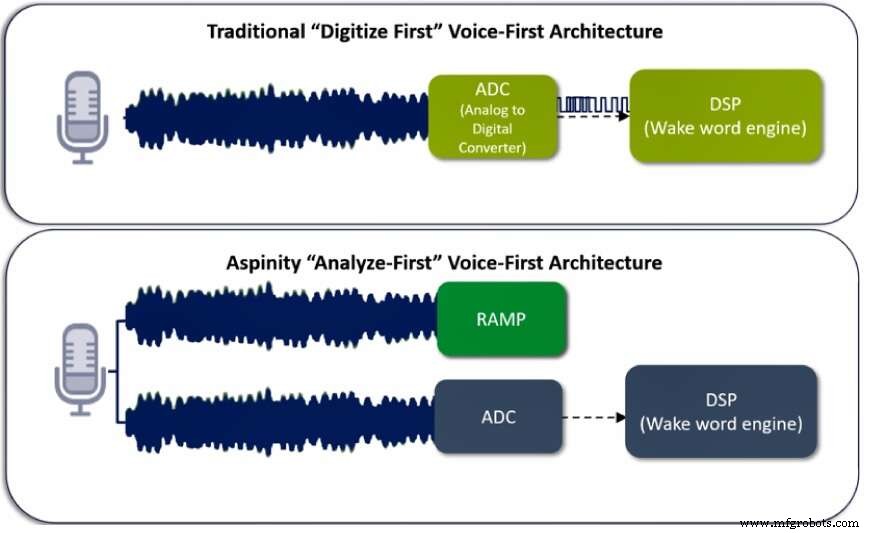 Digitize First vs. Analyze First (Source: Aspinity)
RAMP is a special‑purpose circuit. Designers must weigh the cost versus benefit of adding it to voice‑activated devices, but it can serve as the front end of a speech processor rather than a separate chip.
CEO Doyle plans to expand into IP licensing in addition to selling chips. The company has partnered with several consumer and chipset companies and is sampling the chip today, with volume production slated for early 2020.
Company
Aspinity was founded to commercialize research from West Virginia University, holding exclusive rights to the university’s technology. The startup has raised $3.6–$3.7 million across three funding rounds, with Amazon participating in two rounds. Its team of ten engineers brings extensive analog expertise.
— Junko Yoshida, Global Co‑Editor‑In‑Chief, AspenCore Media, Chief International Correspondent, EE Times
>> This article was originally published on our sister site, EE Times: “Aspinity Puts Neural Networks Back to Analog.”
Internet of Things Technology
- Power Sources: AC and DC Explained
- Bulldozer Technology: Design, Manufacturing, and Future Innovations
- Reducing Standby Power in Smart Home Devices with Power Integrations’ LinkSwitch‑TNZ
- Pulsic Unveils Real‑Time Analog Layout Preview for Cadence Virtuoso
- Maxim Integrated Launches Three Low‑Power Analog ICs to Drive Efficiency in Edge and Cloud Applications
- GreenWaves Unveils GAP9: Ultra‑Low‑Power AI Accelerator Achieves 50 mW Power with 50 GOPS Performance
- SamurAI: Low‑Power AI Chip Sets New Benchmark for Image Recognition in IoT
- Imec & GlobalFoundries Reveal 2900 TOPS/W Processor‑in‑Memory Chip for Ultra‑Efficient AI
- Wind Power: Converting Air Movement into Clean Electricity
- Precise Power Measurement Using Digital and Analog Multimeters