



Synchronous Condenser: Enhancing Power Factor and Grid Stability
Synchronous motors operate with a leading power factor, a feature that effectively offsets the lagging power factor produced by induction motors and other inductive loads.
Historically, large industrial synchronous motors were adopted mainly for this power‑factor correction capability.
Overexciting the Field of Synchronous Motors
By eliminating the mechanical load and applying additional field excitation—known as overexciting—a synchronous motor can deliver an even higher leading power factor. When used without a mechanical load, the motor functions as a synchronous condenser, providing precise reactive‑power control. Adjusting the field excitation allows the device to fine‑tune the leading power factor, enabling the near‑neutralization of any lagging load when the condenser operates in parallel.
Unlike a conventional motor or generator, a synchronous condenser does not produce torque. Consequently, its shaft can be omitted, and the unit is typically enclosed in a gas‑tight shell. Filling the enclosure with hydrogen improves performance: hydrogen’s density is only 7% of air, so windage losses drop to 7% of those in air, while its thermal conductivity is ten times greater, enabling tenfold faster heat removal. A hydrogen‑filled condenser can therefore handle higher power densities or be physically smaller for the same capacity. Safety is assured as long as the hydrogen concentration remains above 70%, usually maintained above 91%.
Mitigating Lagging Currents on Long Transmission Lines
Installing synchronous condensers along lengthy transmission corridors helps counteract lagging currents generated by line inductance. By moving the power factor closer to unity, more real power can traverse a fixed‑size line. Additionally, the condenser’s ability to absorb or generate reactive power on a transient basis provides rapid grid support during short‑circuit events and other transient faults, stabilizing millisecond‑duration voltage sags and dips.
This capability complements slower, quick‑acting voltage regulation systems found in generators. When a line voltage dips, the condenser supplies leading current, boosting generator excitation and restoring voltage—a function that a simple capacitor bank cannot replicate.
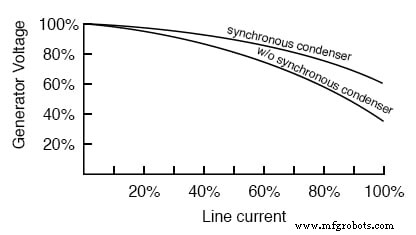
Synchronous condenser improves power line voltage regulation
RELATED WORKSHEET:
- AC Power Worksheet
Industrial Technology
- Understanding AC Circuits: A Beginner's Guide
- Power Sources: AC and DC Explained
- Protective Relays: Safeguarding Industrial Power Systems
- Synchronous Binary Counters: Design, Up/Down Operation, and Encoder Applications
- Amplifiers: Harnessing Active Devices to Boost Power
- Understanding Bels and Decibels: From Power Gain to Voltage Conversion
- Rectifier Circuits: From Half‑Wave to Polyphase Full‑Wave Designs
- Calculating Power Dissipation in Resistive Circuits
- Bulldozer Technology: Design, Manufacturing, and Future Innovations
- Wind Power: Converting Air Movement into Clean Electricity