



Lattice Launches Certus‑NX: Compact, Low‑Power FPGAs with High‑Density I/O and Built‑in Security
 Lattice has unveiled the Certus‑NX family, a new line of general‑purpose FPGAs built on its Nexus platform. These devices offer a 6 mm × 6 mm footprint, low power consumption, high‑density I/O, and integrated security features, making them ideal for data co‑processing, signal bridging, and system control.
Less than a year after CEO Jim Anderson and a new leadership team reshaped the company’s focus around FPGA solutions and a platform‑based development strategy, Lattice introduced the first Nexus product in November 2019. The 28 nm FD‑SOI process powers the Nexus line, which spans 10–200 k logic cells and is engineered for compact, low‑power designs.
The Certus‑NX family is the second Nexus product line and arrived six months after the inaugural release. “Our platform‑centric approach has tripled our product‑cadence versus historical rates,” said product marketing manager Juju Joyce in an interview with EE Times. “More announcements are coming later this year.”
New Brand Identity
Certus represents a fresh brand name for Lattice. While the Certus‑NX line does not directly succeed the earlier ECP‑5 family, it targets the same segments—industrial automation, automotive driver‑assist systems, and communications infrastructure.
Two variants are available: a 17 k logic‑cell device and a 40 k logic‑cell device. Both share the same 6 mm × 6 mm package and feature a hardened PCIe block that supports first‑ and second‑generation PCI interfaces up to 5 Gbps. Fast programmable I/O supports 1.5 Gbps differential signalling. On‑chip ADCs, enhanced PLLs, and a low soft‑error rate—thanks to FD‑SOI—complete the package.
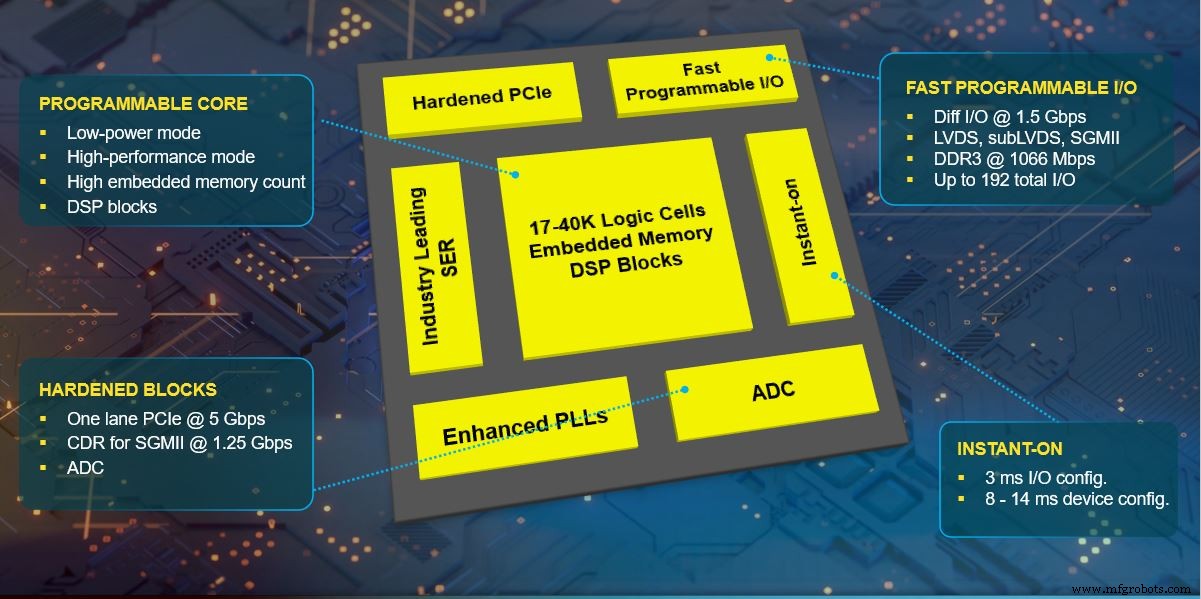
Certus‑NX offers instant‑on: 3 ms to configure I/Os and 8–14 ms for the rest of the device.
Joyce highlighted that “compared to similar‑class devices from other vendors, Certus‑NX delivers packages up to three times smaller while supporting high‑speed interfaces such as PCIe and GigE, and providing twice as many I/Os per area.” He added that the I/Os are up to 70 % faster and the device supports ECDSA bit‑stream authentication for enhanced security.
“We compare against Xilinx Artix‑7 and Intel Cyclone V GT—both launched in 2011—because the market for under‑100 k logic‑cell FPGAs has been largely untouched by newer offerings,” Joyce said. “The biggest players have shifted focus to 1 million‑plus logic‑cell devices for data‑center acceleration.”
“There remains a substantial market for smaller, general‑purpose FPGAs,” Joyce added. “We’ve sold over 1 billion parts in the past four years, and we see a great opportunity to modernize a space that hasn’t seen competition in a decade.”
Certus‑NX devices are already shipping to selected customers.
>> This article was originally published on our sister site, EE Times.
Embedded
- Calculating Power Factor in AC Circuits: Theory, Impact, and Practical Correction
- Renesas Launches Low‑Power, High‑Performance Entry‑Level RA2E1 MCUs
- Mastering Low‑Power Modes on Arm Cortex‑M: Practical Tips & Energy Savings
- ON Semiconductor Launches Low‑Power, High‑Frame‑Rate ARX3A0 Image Sensor for Intelligent Vision
- STTS22H: 0.25 °C Accuracy, Ultra‑Low‑Power Digital Temperature Sensor
- AMS Launches AS621x Series: Ultra‑Low‑Power, High‑Accuracy Temperature Sensors in a Tiny Package
- Lattice CrossLink‑NX FPGA: 75% Lower Power, 10× Smaller, 100× More Reliable for Edge AI
- ROHM Launches BD71850MWV PMIC for NXP i.MX 8M Nano Processors
- Renesas PMIC Reference Designs Streamline Power Management for Xilinx FPGAs
- Low Power Factor Explained: Key Causes & How to Fix Them