



EnSilica Unveils eSi‑MediSense: First Single‑Chip Medical Sensor with Integrated ML Accelerator
EnSilica, a leading custom ASIC designer, has introduced the eSi‑MediSense—a fully customizable single‑chip platform that merges advanced medical sensing with an on‑chip machine‑learning (ML) accelerator. This breakthrough enables rapid development of mass‑market wearable health monitors, reducing both cost and time to market.
The eSi‑MediSense is the first medical sensor ASIC to combine a versatile, ultra‑low‑power core with optional Arm Ethos‑U55 ML acceleration. By embedding AI directly on the chip, developers can process sensor data locally, dramatically cutting the need for wireless transmissions and extending battery life in continuous‑monitoring devices.
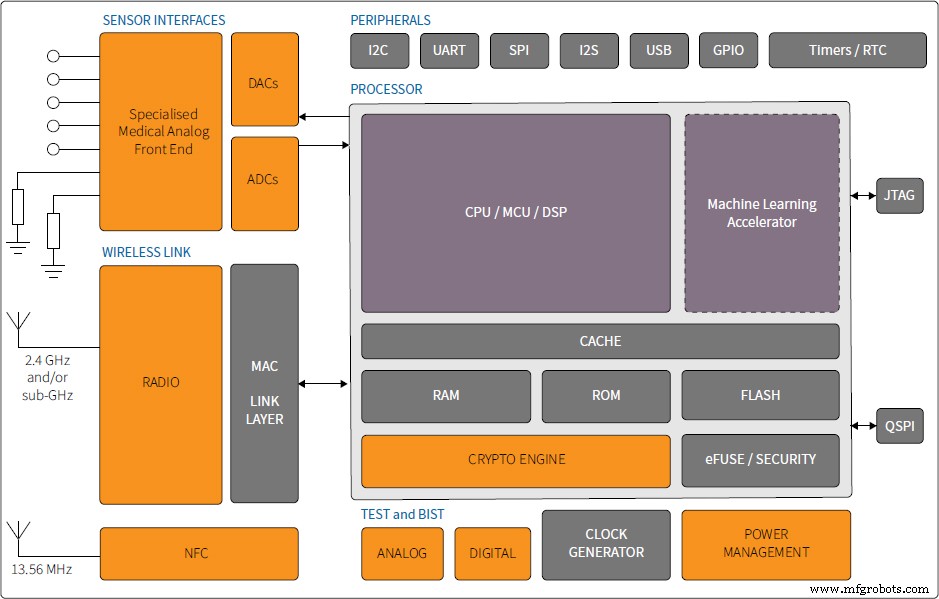
The platform supports a broad spectrum of medical sensors, including ECG, heart rate, respiration, pulse oximetry, temperature, and electrochemical (amperometric, voltammetric, impedance) measurements. Custom sensor interfaces are also available, allowing seamless integration of bespoke sensors and enabling sophisticated diagnostic or remote‑care applications—all on a single die.
Data security is built in: sensor readings are encrypted on‑chip using AES‑256, SHA‑512, and ECC‑384 accelerators, powered by a true‑random number generator that complies with NIST 800‑22. Wireless transmission is supported over the 2.4‑GHz ISM band (Wi‑Fi, Bluetooth, proprietary medical), sub‑1‑GHz MBAN, or ultra‑low‑power standards such as BLE 5.0 and 802.15.4. An optional NFC‑A tag simplifies device pairing and lets smartphones read sensor data directly.
The eSi‑MediSense works with multiple real‑time operating systems—including FreeRTOS, SafeRTOS, ThreadX, and eBed OS—and comes with a comprehensive DSP software library for straightforward algorithm development. Packaging options range from low‑pin‑count QFN or B/LGA to a bare die for flip‑chip bumping, giving designers flexibility for any form factor.
>> This article was originally published on our sister site, Electronic Products.
Embedded
- Understanding the Oxygen (O2) Sensor: Role, Placement, and Failure Signs
- When a DSP Outperforms a Hardware Accelerator
- Choosing Between Hardware Accelerators and DSPs: A Practical Guide
- Oura Ring’s AI Helps NBA Players Detect COVID-19 Days Early
- OmniVision Unveils Ultra‑Miniature 400 × 400‑Pixel CMOS Sensor for Advanced Endoscopy
- Sensirion Launches SCD40: Ultra‑Miniaturized CO₂ and RH/T Sensor
- OmniVision OH02A1S: One Sensor, Dual Imaging – Shrinking Endoscope Footprint
- Bosch Sensortec Unveils AI‑Enabled BME688 Air Quality Sensor to Reduce Virus Transmission Risk
- Graphite‑Based Sensor Boosts Sensitivity & Flexibility for Wearable Medical Devices
- Medical Manufacturing: AI, Automation & 3D Printing Driving Innovation