



TI Introduces TMAG5170: A High‑Precision 3D Hall‑Effect Sensor Empowering Real‑Time Control in Factory Automation
Texas Instruments has announced the launch of the TMAG5170, the inaugural member of a new family of 3D Hall‑effect position sensors designed for real‑time control in factory automation and motor‑drive systems.
The TMAG5170 delivers integrated diagnostics and advanced features that enhance design flexibility, improve system safety, and reduce energy consumption.
Hall‑effect sensors, like all magnetic transducers, involve a trade‑off between ultra‑high accuracy and high throughput. A truly stable sensor maintains its performance across temperature swings, ambient conditions, and external magnetic fields, yet achieving both extreme precision and rapid data rates is challenging.
TI claims that the TMAG5170 bridges this gap, offering both high precision and higher throughput. "The increased throughput translates to lower power consumption when full speed isn’t required," says Steven Loveless, TI’s marketing and applications manager for position sensing products.
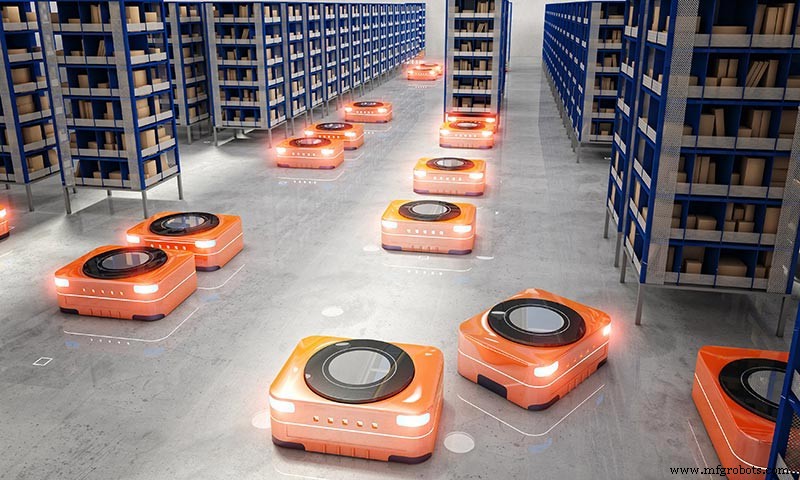
Automated warehouse robots. (Source: TI)
Position Sensors
Position sensing is integral to high‑performance automated systems that regulate motion. The choice of sensor directly influences cost, performance, and reliability. Absolute position measurements using Hall‑effect linear multi‑axis sensors must be exact, rapid, and dependable—ensuring precise real‑time control.
A critical design consideration for 3D Hall‑effect sensors is the ability to detect a freely moving magnet and reliably track its position. Because the magnetic field around a magnet’s pole is typically symmetrical, the same input can arise from multiple locations. Accurate absolute location therefore requires careful design that exploits subtle changes in magnetic flux density to differentiate the magnet’s movement.
Real‑Time Control
In smart factories, highly automated systems must operate seamlessly within an integrated manufacturing flow while continuously gathering data to optimize operations. Real‑time 3D position sensing is essential for high‑efficiency, low‑downtime automation.
"Systems that rely on position or motion feedback are highly dynamic and must respond swiftly to variations in load, speed, and other parameters," says Loveless. The new TI sensor is engineered to capture these dynamic conditions with greater accuracy, enabling faster system responses.
TI reports that the TMAG5170 achieves a 2.6‑percent full‑scale total error at room temperature, with a total error drift of only 3 percent. This eliminates the need for end‑of‑line calibration and off‑chip error compensation, simplifying design and manufacturing. The sensor supports sampling rates up to 20 kSPS, providing low‑latency throughput for high‑speed mechanical motion.
It also removes the need for off‑chip computation and allows variable sensor‑magnet orientations through features such as an angle‑calculation engine, measurement averaging, and gain/offset correction. Regardless of placement, these characteristics simplify design, enhance system adaptability, reduce control loop latency, and ease software development. The integrated calculation engine can lower a system’s processing load by up to 25 percent, enabling engineers to use general‑purpose microcontrollers—such as TI’s low‑power MSP430TM MCUs—while keeping costs down.
The diagram below shows the TMAG5170 monitoring the exact angular position of a motor shaft. A sensor capable of high‑bandwidth readings improves feedback loop speed, boosting overall system performance.
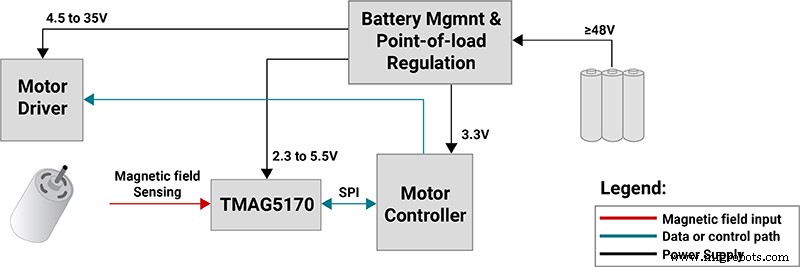
An example of a TMAG5170 application. (Source: TI)
Power consumption is a key factor when selecting a position sensor, especially for battery‑powered or low‑power platforms. Sensors with low‑power operating modes—such as wake‑up, sleep, and deep‑sleep—are common in energy‑constrained systems. TI claims the TMAG5170’s multiple operating modes and sampling rates can boost energy efficiency by up to 70 percent, delivering optimal power usage across a 1‑to‑20 kHz sampling range for battery‑powered devices or low‑use modes when efficiency is paramount.
Magnetic and mechanical design flexibility also benefits from 3D linear Hall‑effect sensors that support variable magnetic sensitivity levels and temperature correction options. Safety and diagnostics are increasingly vital for preventing equipment downtime and ensuring high manufacturing quality as automated systems operate alongside humans. Consequently, precision, speed, power, and adaptability are paramount design considerations.
>> This article was originally published on our sister site, EE Times.
Related Contents:
- Standards are critical for secure connectivity in industrial IoT
- Ransomware catalyzes industrial security revolution
- Using an open source IIoT gateway to speed Modbus device integration
- Interfacing Modbus industrial sensors with an open source IIoT gateway
- Fully‑managed IoT gateway solution simplifies development
For more Embedded, subscribe to Embedded’s weekly email newsletter.
Embedded
- Virtual Sensors: How They Work and Key Applications
- Throttle Position Sensor: How It Works and Why It Matters
- Occupancy Sensors Explained: How They Work and Why They’re Essential for Energy Savings
- Door Sensors: How They Work and Their Role in Home Security
- Inductive Sensors: How They Work and Key Industrial Applications
- IoT Sensors: Functionality, Types, and Real‑World Applications
- Advanced Sensors Empower Wearable Health Tech: From Heart Rate to Temperature Accuracy
- TDK Launches Fault‑Tolerant InvenSense IMUs for Industrial Applications
- Harnessing Real-Time Data for Precise Control of Modern Industrial Systems
- NASA-Developed Inductive Non-Contact Position Sensor for Precise Motion Control