



Isorg Launches 6‑inch Full‑Screen Multi‑Finger Fingerprint Sensor
Isorg’s new fingerprint‑on‑display (FoD) module enables one‑to‑four‑finger authentication across the full 6‑inch smartphone display.
As the digital economy expands, biometric authentication is becoming essential for robust security and data privacy. France‑based Isorg announced it has closed a third financing round to advance its full‑screen FoD sensor for multi‑finger smartphone authentication and to develop more secure biometric recognition solutions.
€16 million
Spun out of the CEA‑Liten research institute in 2010, Isorg pioneered organic photodetector (OPD) technology that prints photodiodes on diverse substrates, enabling large‑area image sensors. The platform works on plastic or glass, leveraging TFT or CMOS backplanes.
The €16 million Series C round, led by Sumitomo Chemical and Mitsubishi, brings Isorg’s total capital raised to €47.8 million. Investors also included Integrated Systems Development, Financières Fonds Privé, Bpifrance, New Science Venture, CEA Investment, and Sofimac Group.
In an interview with EE Times Europe, Nicolas Bernardin, Isorg’s business‑development director, said, “This milestone demonstrates that legacy investors remain confident while major industrial players are convinced.”
Funding is not only about capital—it also delivers technical support. Since 2013, Isorg and Sumitomo Chemical have partnered, culminating in a 2019 agreement to develop OPD products for smartphone fingerprint sensors and hybrid organic‑CMOS image sensors. Bernardin noted, “This partnership signals the maturity of our technology and our ability to capture markets.”
Isorg will deploy the proceeds to accelerate commercial deployment of its OPD technology. Bernardin highlighted key benefits: OPD enables ultra‑thin, flexible, easily integrated, and recyclable modules that maintain high robustness even under intense lighting, making them suitable for both indoor and outdoor use.
Multi‑finger, palm, and vein recognition
Responding to OEM and end‑user demand for heightened security and privacy, Isorg engineered a FoD module that supports one‑to‑four‑finger authentication across the entire display—or even larger—on 6‑inch screens. This capability enhances security for mobile banking, health monitoring, and remote home control.
The FoD module is compatible with flexible and foldable displays for smartphones and wearables. It measures less than 300 µm thick and supports curved‑edge phones using a flexible polyimide‑substrate sensor.
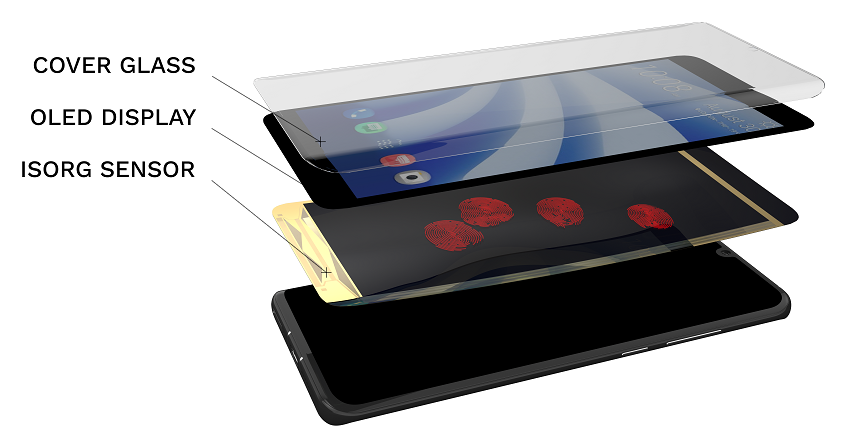
In the coming months, Isorg plans to launch palm‑size modules. Bernardin noted, “In high‑stakes scenarios—border control, law enforcement—a palm scanner can be more secure and reliable than other biometric methods. This next‑generation technology offers unique parameters.”
Isorg also aims to develop a vein‑recognition module. “Instead of fingerprints, we can authenticate users via their vein network,” Bernardin explained. “Our visible‑range sensor is highly sensitive, and we’ve also developed a near‑infrared sensor that penetrates the skin to read the vein network.”
Beyond security, the technology has broad healthcare applications.
Made in France
In 2017, Isorg opened a production facility in Limoges to manufacture OEM organic photonic sensors and offer services from proof‑of‑concept to mass production for optoelectronic systems.
CEO Jean‑Yves Gomez, a French industrialist, emphasized the company’s commitment to “Made in France” products: “Our aim is to deliver products that have been developed here for years.” Bernardin added that Isorg has no intention of relocating manufacturing from France or Europe to Asia, although subcomponents may be sourced globally and assembled in Asia.
When can Isorg’s module appear in smartphones? Bernardin said the company has been in talks with major smartphone makers for years. He cautioned against giving a firm date: “In January 2020, I exhibited at CES in Las Vegas and received strong commitments from big players. The Covid‑19 pandemic disrupted the market and slowed our contacts, but 2022 remains an achievable target.”
In 2018, Isorg raised €24 million in a Series C round to qualify its Limoges production site. In January 2020, CEO Jean‑Yves Gomez projected mass‑production launch within that year.
The pandemic immediately reduced demand and postponed mass‑production plans. Bernardin said the qualification of the production line is almost complete and can commence quickly, but market conditions and Covid‑19 remain significant hurdles.
The Limoges site hosts a Gen 3.5 (780 × 650 mm) manufacturing line for image sensor production with TFT backplane supply.

FBI certification
Isorg targets both the smartphone and security/ID markets.
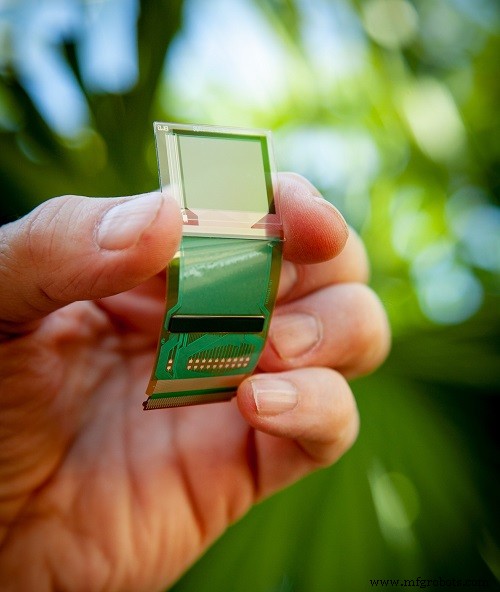
Isorg receives FBI certification for OPD-based module for fingerprint scanners
A major milestone was recently achieved when Isorg’s Fingerprint Acquisition Profile (FAP) 10 module obtained FBI certification. The FAP 10, fabricated by printing organic photodiodes on a TFT backplane, is now approved for security applications, including mobile device identification for access control at airports and other high‑security facilities.
The FAP 10 supports one‑finger authentication over a surface area of 0.5″–0.65″ (1.27–1.65 cm). Isorg expects FBI certification for larger modules, up to four fingers (FAP 60).
‘Without FBI certification, nothing can happen,’ Bernardin said. ‘Even though we achieved excellent results with our fingerprint modules, customers always ask, ‘Are you FDA certified?’ This certification is the key to entering the market.’
Isorg is the first company to secure security approval for an OPD fingerprint sensor.
Local & global presence
Headquartered in Limoges, Isorg maintains a pilot line and dedicated application team at CEA‑Liten. The startup also operates an R&D team in Grenoble, a small R&D line compatible with 8‑inch silicon wafers in Bordeaux, and sales and application offices in Hong Kong.
In the coming months, Isorg plans to open an office in Asia and aims to build a global sales and applications engineering workforce, targeting around 100 employees by the end of 2021.
>> This article was originally published on our sister site, EE Times Europe.
Related Contents:
- Voice biometric solution targets authentication
- Design considerations for low‑power, always‑on voice command systems
- Wearable demonstrates contactless payment design approach
- The fundamentals of facial recognition
- B‑Secur puts secure ECG analysis on Maxim biometric sensor hub
For more Embedded, subscribe to Embedded’s weekly email newsletter.
Embedded
- How PIR Sensor Circuits Work: Design, Operation, and Real‑World Applications
- Sensirion SVM30: All‑in‑One Multi‑Gas, Humidity & Temperature Module for Air Purifiers & HVAC
- AMS Introduces the AS5715: High‑Speed Inductive Sensor for Automotive & Industrial Motors
- Maxim’s Advanced LiDAR Module Enables 15 km/h Faster Autonomous Highway Driving
- MAXM86146: The Thinnest Dual‑Photodetector Sensor Accelerating Wearable Health Design
- Build a Robust Temperature & Sensor API on Raspberry Pi Using the GY‑91 Module
- Arduino PIR Sensor Halloween Prank: Motion-Triggered Scare with LED Lights & MP3 Audio
- Smart 3D Printed Pet Feeder Powered by Arduino Nano
- Master Vibration Detection with Arduino: A Simple Sensor & LED Setup
- SW 420 Vibration Sensor Module: Comprehensive Guide for Arduino & Security Applications