



Leveraging Molecular Modeling to Uncover Novel Therapeutic Targets for SARS‑CoV‑2
In our previous post, we examined how predictive modeling tools can generate atomic‑level structures of viral proteins and fill in experimentally unresolved regions, such as missing hydrogen atoms and flexible loops. We focused on the cryo‑electron microscopy (cryo‑EM) structure of the SARS‑CoV‑2 spike (S) protein published in Science (DOI: 10.1126/science.abb2507).
Here, we delve into how refined structural models—particularly of the S protein—can fuel hypothesis generation for COVID‑19 therapeutics.
Drug Binding Depends on Protein Dynamics
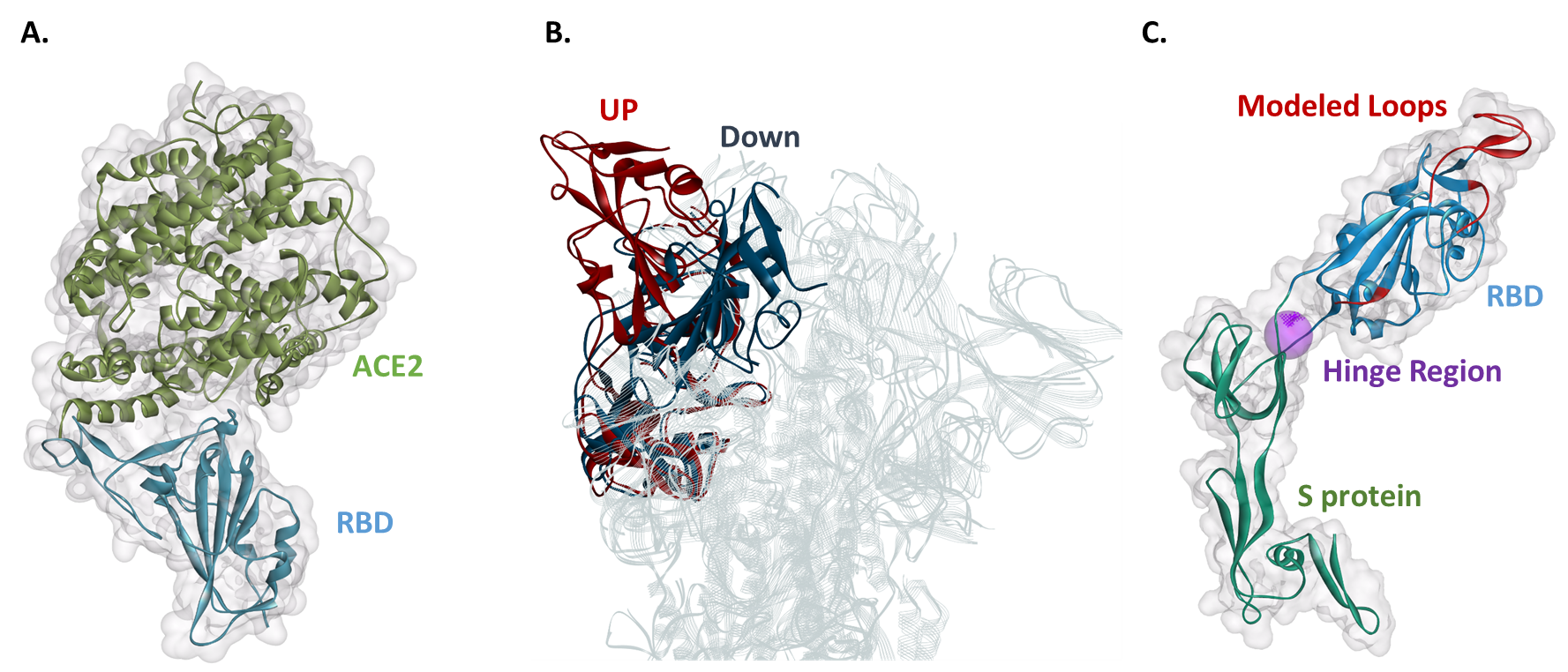
Proteins are not static; their motions are integral to function. As physicist Richard Feynman noted, “the behavior of living systems can be understood in terms of the jigglings and wigglings of atoms.” The SARS‑CoV‑2 S protein exemplifies this: before cell entry, it must bind the host receptor angiotensin‑converting enzyme 2 (ACE2). The receptor‑binding domain (RBD) mediates this interaction (see Figure 1A). The RBD oscillates between an “up” (ACE2‑accessible) and a “down” (ACE2‑inaccessible) conformation (Figure 1B). Studies suggest the down state is more stable, implying that small molecules that lock the RBD in the down conformation could block ACE2 binding and halt viral entry.
The RBD Functions as a Hinge
A flexible linker connects the RBD to the rest of the S protein, enabling the hinge‑like transition between down and up states (Figure 1B). We isolated the RBD with its linker and adjacent domain (Figure 1C). The up‑state structure (PDB 6VYB) lacks three loops critical for ACE2 interaction; therefore, we constructed a homology model using both 6VYB and the crystal complex of RBD‑ACE2 (PDB 6M17). These loops, including one over 20 residues, are essential for binding, and their accurate modeling allows us to assign correct protonation states for physiological pH.
Subsequent molecular dynamics (MD) simulations can capture the RBD’s conformational landscape and reveal potential small‑molecule binding pockets. Using BIOVIA Discovery Studio, we identified a pocket at the hinge of the linker (Figure 1C) that could serve as a target for compounds designed to stabilize the down conformation.
Path Forward
To validate the hinge pocket, researchers can employ normal mode analysis (NMA) or extended MD simulations (~hundreds of nanoseconds) to sample diverse conformations. These ensembles can then feed into high‑throughput virtual screening, docking each compound across multiple protein states. This ensemble‑based approach has been shown to increase hit rates in drug discovery and reflects the reality that ligand binding is contingent on protein dynamics.
Beyond small molecules, the refined S protein model is also a valuable template for designing monoclonal antibodies. In‑silico affinity maturation can refine antibody specificity toward the ACE2‑binding interface.
BIOVIA Dassault Systèmes—leveraging over 30 years of peer‑reviewed research—offers the BIOVIA Discovery Studio platform, which supports the entire drug discovery pipeline from target identification to lead optimization, including biologics design, classical simulations, fragment‑based design, virtual screening, and ADME/toxicity prediction.
In line with our corporate social responsibility, BIOVIA provides a no‑charge, six‑month license to qualifying academic research groups conducting SARS‑CoV‑2 studies. Interested researchers can request the license and download the software. This offer remains available through June 30, 2020.
Biologics
- Pixus Introduces Rugged 6U OpenVPX Faceplates with Enhanced Structural Integrity
- Integrating Asset Management Into Facility Design, Construction, and Startup: A Blueprint for Reliability and Profitability
- DSM & Nedcam Partner to Advance Large‑Scale FGF 3D Printing
- Molecular Dynamics Investigation of Ultra‑Precision Diamond Cutting of Cerium
- Why Robot Simulation Drives Success: 3 Key Benefits for Manufacturers and Users
- B&R Launches Advanced Simulation Tool to Accelerate Digital Twin Development
- 5G and Edge: Emerging Cybersecurity Challenges Facing 2021
- Cultivating an Observability-Driven Culture for IT, DevOps, and SRE Excellence
- Fusion 360: The Versatile 3D Design Tool Every Engineer and Designer Needs
- 13 Essential CFD Applications: Elevating Performance in Aerospace, HVAC, and Electronics