



Copper Alloy 3D Printing: Superior Mechanical Properties & Precision Parts
Designers and engineers these days are more frequently turning to industrial-grade, metal 3D printing (additive manufacturing) for prototype and production parts. At Protolabs, our direct metal laser sintering (DMLS) technology builds fully functional metal prototypes and end-use parts within days.
To meet this increasing demand for metal, and to offer more material options, we have added a copper alloy (CuNi2SiCr). This material is currently available for higher resolution jobs with a 100mm x 100mm x 100mm max build size. Think roughly the size of a softball at its widest point. Instant pricing is available.
3D Printing Copper Alloy
Copper CuNi2SiCr is an alloyed copper material, not elemental copper (UNS designation C18000), which combines excellent mechanical properties with high thermal and electrical conductivity, along with improved corrosion resistance. This alloy can be used in rough environments where pure copper is not feasible.
Our newly added copper alloy joins our other metal choices for DMLS, which include aluminum, cobalt chrome, Inconel, stainless steel, and titanium. A layer thickness as fine as 0.0008 in. (0.02mm) and minimum feature size of 0.039 in. (1.000mm) is possible with 3D-printed copper. Parts get a standard finish or hand polish, and secondary machining options are available to ensure your parts are complete when you receive them. As with all DMLS materials, the following secondary operations are available for your parts: 3- and 5- axis milling, turning, wire EDM, tapping, reaming, hot isostatic pressing (HIP), mechanical testing, and first article inspections.
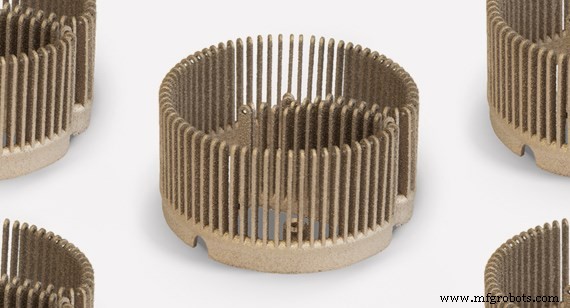 Copper joins a growing list of metal options for 3D printing.
3D-Printed Copper Material Properties
Because both materials are highly conductive compared to other metals, it might be worth carefully considering which material is right for your project, although choosing between aluminum and copper comes down to your specific application. See the table below [Note: Protolabs' copper and aluminum alloy composition may differ from alloys offered by other companies.]:
| MATERIAL | ULTIMATE TENSILE STRENGTH | 0.2% YIELD | ELONGATION | HARDNESS |
|---|---|---|---|---|
| Aluminum (AlSi10Mg) | 35 ksi | 20 ksi | 10% | 47.2 HRB |
| Copper (CuNi2SiCr) | 69 ksi | 58 ksi | 25% | 85 HRC |
--------------------------------------------------------------------------------------------------------
The Option of Machined Copper
Stepping outside the 3D-printing world for a moment, it should be noted that at Protolabs, we also offer the option of machined copper--that is, the elemental copper that exists in nature. Copper is only second to silver in electrical conductivity, a factor that makes it one of the most important metals in use today. For example, copper (and aluminum) wiring basically make electricity possible. Today, copper is an ingredient in more than 570 different metallic alloys. Our metal fabrication guide offers more information about machined copper.
Applications of Copper 3D Printing
Adding copper to the DMLS offering expands the engineering applications of Protolabs’ DMLS metals. The conductivity of copper is effective for thermal transfer applications. When copper is manufactured with 3D printing, an engineer can create complex designs that target internal chambers with heating or cooling. This isn’t possible with subtractive manufacturing methods. Heat sinks and heat exchangers are an ideal application for this material when weight is not a concern. Copper is really the step up when it comes to thermal and electrical conductivity. Copper is structurally stronger, harder, and has higher elongation when compared to aluminum. If conductivity is not the top application requirement, aluminum may serve your needs well, especially if you need a high-performance part that is lightweight, such as in an automotive or aerospace application.
As mentioned, the new copper alloy joins our other metal choices for additive manufacturing. Each offers the flexibility to create parts with complex geometries, compared to machining alone. At Protolabs, we can run a single prototype to full production for both additive and subtractive manufacturing projects. For additional help, feel free to contact a Protolabs applications engineer at 877-479-3680 or ADMIN@MFGROBOTS.COM. To get your next design project started today, simply upload a 3D CAD model for an interactive quote within hours.

Joseph Iannuzzelli is a manufacturing engineer at our 3D printing/additive manufacturing facility near Raleigh, North Carolina. Materials Science is a closer look at manufacturing materials.
Composite material
- Titanium: 8 Key Properties That Make It the Ultimate Marine Metal
- Simplifying Metal 3D Printing: Expert Tips for Managing Support Structures
- How Metal 3D Printing Is Revolutionizing Lightweight Parts for Aerospace and Automotive
- Metal 3D Printing Applications: Advanced Use Cases – Part 2
- 3D Printing Trends 2019: Metal Innovation, Binder Jetting Breakthroughs, and Advanced Plastics
- Metal 3D Printing 101: How Additive Manufacturing Transforms Production
- Metal 3D Printing: Revolutionizing Production with Speed, Cost Savings, and Design Freedom
- Angus 3D Solutions: Pioneering Metal 3D Printing Across Scotland
- Comprehensive Guide to 14 Key Mechanical Properties of Materials with Practical Examples
- Mastering Metal 3D Printing: A Comprehensive Guide