



Fastener Selection for Thermoset Materials: Part One – Hi‑Lo Screws
When engineers select fasteners for thermoset components, the first option that often comes to mind is the Hi‑Lo screw. This specialized thread‑cutting fastener features a low‑thread portion that is roughly 30 % of the height of a high‑thread segment. The high thread is sharper and flatter than a conventional thread, allowing the screw to bite into low‑density thermoset substrates.
Because the Hi‑Lo screw relies on cutting rather than friction, each removal and re‑installation progressively erodes the boss, lowering the strip torque that can be achieved. Strip torque is critical to a part’s performance, so estimating how many times a screw will be cycled is essential. In most applications, if the expected cycle count is less than four, a Hi‑Lo screw remains a reliable choice.
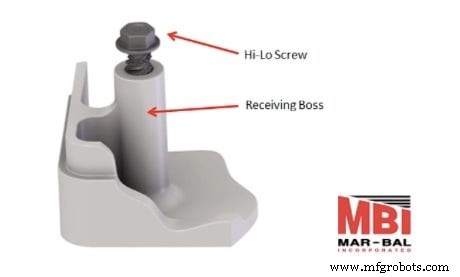
Key Design Considerations for Hi‑Lo Screws
Boss Hole Dimension
The diameter of the hole relative to the screw’s pitch diameter should maximize the ratio of strip torque to driving torque. A well‑matched hole ensures the screw can pull out the material without excessive wear.
Boss Outer Diameter (O.D.)
Empirical testing shows that a boss O.D. that is 2.5 times the external screw diameter offers the best balance between strength and manufacturability. A wall that is too thin risks cracking during insertion, while a wall thicker than 2.5 × offers negligible torque gains but increases cure time and cost.
Length of Engagement
Strip torque scales directly with the length of engagement and reaches a plateau at about 2.5 times the screw’s pitch diameter. Extending the engagement beyond this point yields diminishing returns.
Before recommending a Hi‑Lo screw, consider the customer’s functional requirements. Be prepared with data on strip torque, loss after replacement, and optimal boss geometry.

Composite material
- Structural Screws: The Heavy‑Duty Fasteners Every Builder Trusts
- What Are Machine Screws? A Comprehensive Guide
- Understanding Countersunk Screws: Design, Applications, and Benefits
- Understanding the Anatomy of a Screw: Parts, Functions, and Applications
- What Is a Hammer‑Head Screw? Function, Features, and Key Applications
- Screws: History, Materials, Design, Manufacturing, and Quality Standards
- Designing Thermoset Composite Parts: A Practical Guide & Infographic
- Understanding Screw and Bolt Types for Optimal Assembly
- Screw vs. Bolt: Key Differences, Types, and Applications
- Precision Torque Screwdrivers for CNC Machinists: Achieve Consistent Tightening & Extended Tool Life