



Dye‑Sensitized Solar Cells: Fundamentals, Advances, and Commercial Outlook
Abstract
Dye‑sensitized solar cells (DSSCs) are a promising class of thin‑film photovoltaics that combine low manufacturing cost, simple processing, and minimal toxicity. Despite their early promise, current DSSC efficiencies (≈12 %) still lag behind first‑ and second‑generation silicon and CIGS technologies (≈20–30 %). Key challenges include material scarcity, high production costs, and limited long‑term stability. This review synthesizes the evolution of DSSC architecture, operating principles, material innovations, and practical considerations for commercialization.
Introduction
The concept of harvesting solar energy with organic dyes dates back to the 1960s. Early work at UC Berkeley on chlorophyll‑sensitized ZnO demonstrated photo‑electron injection into a semiconductor. Subsequent optimization of mesoporous TiO₂ electrodes (roughness factor ≈1,000) by Grätzel and O’Regan in the early 1990s yielded the first practical DSSCs with 7–10 % efficiency. Modern DSSCs use Ru(II) polypyridyl dyes, porous TiO₂ photoanodes, iodide/triiodide electrolytes, and platinum counter electrodes. Theoretical limits approach ~20 % PCE, yet commercial devices remain limited by material cost and stability.
Construction and Working of DSSCs
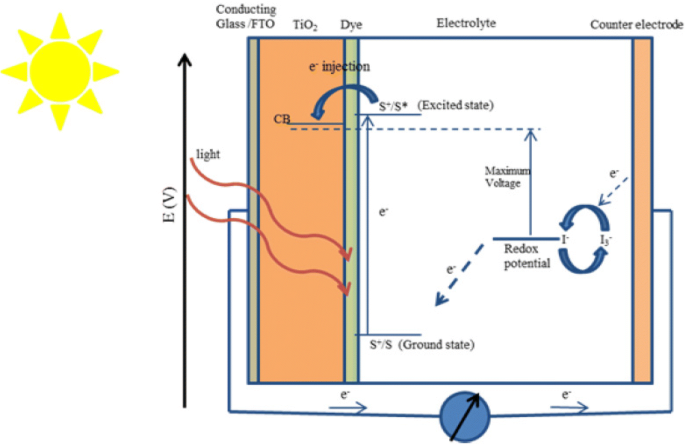
A DSSC consists of a transparent conductive oxide (TCO) substrate, a nanocrystalline TiO₂ photoanode, a sensitizing dye, an iodide/triiodide redox electrolyte, and a counter electrode (typically Pt). The dye absorbs photons, injects electrons into TiO₂, and is regenerated by the electrolyte. Figure 1 illustrates the sandwich structure.
Transparent Conductive Substrate
Fluorine‑doped tin oxide (FTO) and indium‑doped tin oxide (ITO) provide >80 % optical transparency and sheet resistances of 8.5–18 Ω cm⁻². Hybrid FTO/ITO films can lower resistance to ≈1.3 Ω cm⁻².
Working Electrode
Nanocrystalline TiO₂ (anatase) is preferred due to its 3.2 eV bandgap and high surface area. Alternative wide‑bandgap oxides (ZnO, Nb₂O₅) have been explored but TiO₂ remains dominant.
Photosensitizer (Dye)
Key properties: strong broadband absorption (UV‑Vis–NIR), HOMO below the redox potential, LUMO above TiO₂ conduction band, hydrophobic anchor groups to suppress recombination, and high extinction coefficients (ε >10⁴ M⁻¹ cm⁻¹). Common dyes include Ru(N3), Ru(N719), and various metal‑free organics.
Electrolyte
The iodide/triiodide redox couple remains the benchmark due to high diffusivity and low viscosity. Alternatives (Co(III/II), S‑based, ionic liquids) aim to improve stability but face challenges such as viscosity, volatility, and corrosiveness.
Counter Electrode
Platinum provides excellent catalytic activity but is costly. Alternatives such as carbon, metal oxides (Mo, Fe₂N), and metal‑free composites (e.g., TiN/CNT) have shown comparable performance with reduced cost.
Working Principle
- Photon absorption by dye → excited state (S*).
- Electron injection from S* to TiO₂ conduction band.
- Electron transport to TCO and external circuit.
- Oxidized dye regenerated by iodide in electrolyte.
- Triiodide reduced at counter electrode, closing the circuit.
Evaluation of DSSC Performance
Key metrics: short‑circuit current density (J_SC), open‑circuit voltage (V_OC), fill factor (FF), and power conversion efficiency (PCE). The incident photon‑to‑current efficiency (IPCE) links external quantum efficiency to light harvesting efficiency (LHE) and charge‑collection efficiency.
Limitations
Stability is divided into extrinsic (sealant degradation, electrolyte leakage) and intrinsic (dye desorption, electron‑hole recombination) components. Accelerated aging (1000 h at 80 °C) shows >90 % retention for many dyes, yet combined light–heat stress accelerates decay. Sheet resistance of FTO and electrolyte volatility remain major bottlenecks.
Strategies to Boost Efficiency
- Optimize dye regeneration kinetics (≈210 mV driving force).
- Increase TiO₂ porosity for higher dye loading.
- Introduce blocking layers (e.g., TiO₂ compact layer) to reduce dark current.
- Co‑sensitization with complementary dyes to broaden spectral response.
- Employ advanced electrodes (nanowires, CNTs, graphene, TiN).
- Adopt quasi‑solid or solid electrolytes to eliminate leakage.
- Use phosphorescent or luminescent chromophores and energy‑relay dyes for additional photon harvesting.
Recent Advances and Trends
Recent breakthroughs include:
- Pt‑free counter electrodes: carbon‑based composites and transition‑metal nitrides achieving PCE ≈10 %.
- Hybrid nanostructures: TiO₂ nanowires coated with TiCl₄ or graphene, yielding efficiencies up to 12.3 %.
- Plasmonic enhancement: Ag or Au nanoparticles integrated into the photoanode increase absorption via localized surface plasmon resonance.
- Energy‑relay dyes: fluorophores added to the electrolyte transfer energy to the primary dye, boosting IPCE by 5–10 %.
- Solid‑state DSSCs: polymeric or ionic‑liquid electrolytes achieve PCE ≈5–7 % with improved lifetime.
- Organic metal‑free dyes: D‑π‑A structures and carbazole/indole cores reach efficiencies of 9–10 % in conjunction with cobalt redox shuttles.
Conclusions
DSSCs offer a low‑cost, environmentally benign alternative to conventional photovoltaics, but commercial deployment requires sustained improvements in efficiency, stability, and scalability. Continued interdisciplinary research focusing on integrated material design—combining robust dyes, high‑surface‑area electrodes, stable electrolytes, and cost‑effective counter electrodes—will be pivotal for achieving market‑ready modules with >25 year lifetimes.
Abbreviations
- ACN
- Acetonitrile
- FTO
- Fluorine‑doped tin oxide
- ITO
- Indium‑doped tin oxide
- TiO₂
- Titanium dioxide
- J_SC
- Short‑circuit current density
- V_OC
- Open‑circuit voltage
- FF
- Fill factor
- PCE
- Power conversion efficiency
- IPCE
- Incident photon‑to‑current efficiency
- Co‑sensitization
- Use of multiple dyes to broaden absorption
Nanomaterials
- Solar Cells: From Early Experiments to Modern Photovoltaics – Technology, Production, and Future Outlook
- Nano‑Tree ZnO Nanowires Boost Dye‑Sensitized Solar Cell Efficiency
- High‑Efficiency Graphene Solar Cells: 9% Power Conversion with TFSA Doping
- Nano‑Heterojunctions: Boosting Solar Cell Efficiency with Colloidal Quantum Dots
- Optimizing Gold Nanoparticle Placement in TiO₂ Enhances Dye‑Sensitized Solar Cell Efficiency
- Controlled Hydrothermal Synthesis of ZnO Nanocrystals for Enhanced Inverted Polymer Solar Cells
- Optimizing Perovskite Solar Cell Efficiency with Size‑Controlled Ag Nanoparticles in a TiO₂ Compact Layer
- Enhanced Power Conversion in Flexible Fibrous Dye‑Sensitized Solar Cells via Multilayer TiO₂ Photoanodes and Composite Pt Counter Electrodes
- Enhanced Performance of CsPbI₂Br Perovskite Solar Cells via ZnCl₂–MnCl₂ Doping
- High-Performance MoIn₂S₄@CNT Counter Electrodes for Dye‑Sensitized Solar Cells