



Transistors: IGFET (MOSFET) – Depletion & Enhancement Modes Explained
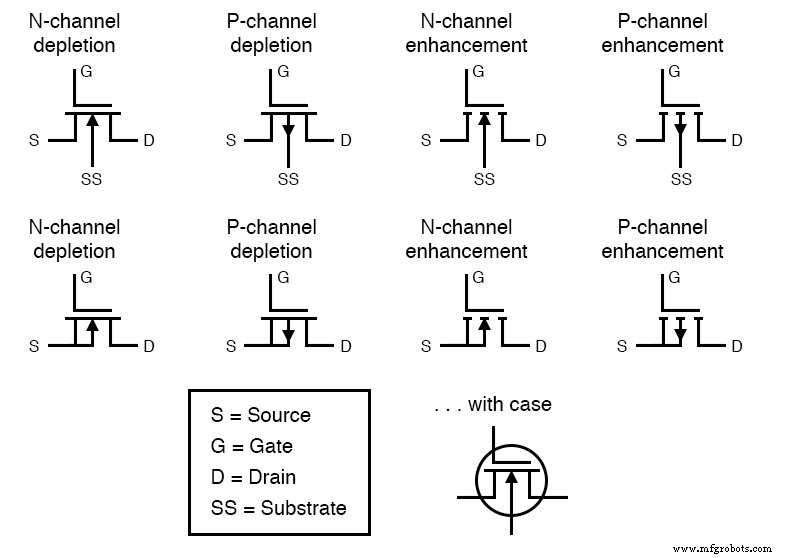
Insulated‑Gate Field‑Effect Transistors (IGFETs), commonly called MOSFETs, are the backbone of modern digital and power circuits. Understanding how their gate voltage controls the conductive channel is essential for reliable design.
In the diagram above, the two symbols—one with a solid line and one with a dashed line—distinguish between depletion‑mode and enhancement‑mode devices.
- Depletion‑mode MOSFET: Applying a gate voltage that is opposite in polarity to the source pulls carriers away, narrowing the channel and eventually turning the device off.
- Enhancement‑mode MOSFET: A gate voltage of the same polarity as the source attracts carriers, widening the channel and enabling conduction from source to drain.
These operating principles mean that depletion‑mode transistors act as normally‑on switches, while enhancement‑mode transistors are normally‑off and require a gate drive to conduct.
RELATED WORKSHEETS:
- Insulated Gate Field‑Effect Transistors Worksheet
Understanding Junction Field-Effect Transistors (JFETs): Gate Current Direction & N‑Channel vs P‑Channel
Hybrid Transistor Design: IGFET‑BJT Combo for High Gain and Low Drop
Industrial Technology
- Understanding Junction Field-Effect Transistors (JFETs): Gate Current Direction & N‑Channel vs P‑Channel
- Hybrid Transistor Design: IGFET‑BJT Combo for High Gain and Low Drop
- CMOS Gate Circuits: Design, Operation, and Comparison to TTL
- Gate Universality: Replicating Any Logic Function with NAND or NOR Gates
- Junction Field‑Effect Transistors (JFET): Design, Operation, and Advanced Variants
- Insulated‑Gate Field‑Effect Transistors (MOSFETs) – Design, Operation, and Power Variants
- Understanding Junction Field‑Effect Transistors (JFET): Fundamentals and Applications
- Understanding Insulated‑Gate Field‑Effect Transistors (IGFETs)
- Common IGFET Quirks & How to Mitigate Them
- Field-Effect Transistor Biosensors Deliver High Sensitivity and Real-Time Detection Across Healthcare, Food Safety, and Environmental Monitoring