



Mops: Types, History, and Modern Manufacturing Insights
Background
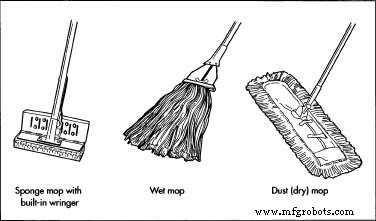
Mops are essential tools in both residential and commercial cleaning, broadly classified into wet and dry (dust) varieties. Wet mops—typically featuring sponge or cloth heads—are ideal for kitchen and bathroom floors. The heads are submerged in a detergent solution, rinsed, and then cleaned themselves to maintain absorbency and effectiveness. Regular drying and trimming of frayed cotton strings prolong their life, and replaceable heads allow for easy upkeep when wear begins.
Dry mops, often called dust mops, boast a large, flat head of yarn or synthetic fibers. The strings capture dust, lint, and hair as the mop glides across the floor. A swivel at the handle‑head junction permits maneuvering under furniture and into tight spaces. To refresh a clogged dry mop, soak it overnight in soapy water; many models feature detachable heads that can be machine‑washed. Applying dust‑mop oil after cleaning preserves the fibers and enhances dust retention.
History
The modern mop’s origins trace back to 1893 when African‑American inventor Thomas W. Steward received Patent No. 499,402 for his "deck mop," a yarn‑based design that quickly gained household and industrial use. Steward’s invention, alongside others such as the eggbeater and bread‑kneading machine, underscores the significant contributions of African‑American innovators to everyday household tools.
In the mid‑20th century, Peter and Thomas Vosbikian—fleeing Europe before World War I—patented over 100 cleaning devices. In 1950, Peter introduced a sponge mop with a lever‑driven metal strip that pressed the wet head to squeeze excess water, eliminating the need to bend over. This innovation leveraged post‑war advances in plastics, enabling the creation of absorbent plastic heads.
Further refinements emerged in 1999 when Scotch Brite released a cellulose‑based wet mop reinforced with an internal polyester net. The natural cellulose does not shed lint and can absorb up to 17 times its dry weight.
Raw Materials
All mops consist of three core components: the head (with a frame), the mechanical attachment (connecting head to handle), and the handle itself. Dust mops typically use yarn—cotton or nylon—mounted on a rigid carrier substrate (fabric, vinyl, or molded plastic). Wet mop heads may be loosely woven yarn or sponge; sponges are usually made of natural cellulose or synthetic polyurethane foam.
Mechanical attachments vary by design. Dust mops use steel, plated metal, or plastic frames that often incorporate a swivel for easy maneuvering. Plastic attachments are commonly injection‑molded from durable resins. Wet mop frames are stamped steel, usually zinc‑plated for corrosion resistance, and may include a single plate, a double‑hinged “butterfly” hinge, or a roller system to squeeze water from the head while the operator remains upright.
Handles for both types are commonly tubular steel or wood; newer models may feature fiberglass or aluminum, though these are less frequent and more expensive. Tubular steel coated with plastic or chrome‑plated is the prevailing choice for wet mops.
Design
Modern mop designs balance functionality with aesthetics. Innovations focus on lighter materials, ergonomic handles, and fibers that attract static electricity for better dust capture. Since the 1990s, static‑cleaner cloths have been marketed as alternatives, yet durable nylon mops continue to outperform them in dust and hair removal.
Manufacturing Process
- Raw materials and subcontracted components are inspected, logged, and stored. Most components—plastics, metal parts, wood handles, and sponges—are sourced from specialized suppliers, while yarn is bulk‑ordered and processed in‑house.
- Yarn is cut, sewn, and attached to carrier substrates by industrial machines. Workers then assemble frames onto substrates, stitching them into place to shape the mop.
- Frames are connected to mechanical attachments—often swivels for dust mops—using stamped metal guides and snap‑fit features. Handles are inspected for smoothness and uniform coatings before attachment.
- Finished mops are bundled, labeled, and packaged in protective wrappers or plastic bags. They are then shipped in bulk to retailers.
Quality Control
Inspectors oversee every assembly stage, checking materials, processes, and final products for defects such as scratches, cracks, or loose threads. Only fully compliant mops proceed to packaging, ensuring consumers receive reliable, high‑quality tools.
Byproducts/Waste
Waste is minimal, primarily consisting of yarn trimmings and dust from fiber loss. Strict quality control eliminates defective units, and OSHA guidelines govern safe disposal. No hazardous waste is generated during production.
The Future
As flooring technologies evolve, manufacturers continuously adapt mop designs to new surfaces, enhancing efficiency and performance. Advances in microfiber technology, cleaning media, and ergonomic features promise even more effective and user‑friendly mops in the years ahead.
Where to Learn More
Books
Aslett, Don. Do I Dust or Vacuum First? Cincinnati: C. J. Krehbiel Co., 1982.
Moore, Alma Chestnut. How to Clean Everything. New York: Simon & Schuster, 1977.
Vare, Ethlie Ann, and Greg Ptacek. Mothers of Invention: From the Bra to the Bomb: Forgotten Women & Their Unforgettable Ideas. New York: William Morrow & Company, Inc., 1988.
Other Resources
OCedar Brands, Inc. Web Page. December 2001. https://www.ocedar.com
Quickie Manufacturing Corporation Web Page. December 2001. https://www.quickie.com/aboutbody.html
Robinson, Maisah B. "African-American History. 19th Century African American Inventors—Part 1." Feb. 26, 2001. https://www.suite101.com/article.cfm/africanamericanjhistory/61415
Manufacturing process
- What is VMC Machining? An Expert Overview of Vertical Machining Centers
- Expert Guide to Aluminum Laser Marking: Precision, Durability, and Industry Applications
- MIG vs. TIG Welding: Selecting the Right Arc Welding Technique for Your Project
- Comprehensive Guide to Laser Marking: Types, Benefits, and Applications
- Key Considerations for High‑Volume Swiss Machining
- CNC Prototyping Guide: Precision, Speed, and Cost‑Effective Production
- Expert Shaft Manufacturing: Precision Processes & Custom Solutions
- Fiber Laser Marking: Precision, Speed, and Versatility for Modern Industries
- Mops: Types, History, and Modern Manufacturing Insights
- iRobot Unveils Advanced Roomba s9+ and Braava Jet m6: The Ultimate Cleaning Duo