



Maracas: History, Craftsmanship, and Cultural Significance
Background
Maracas, a pair of rattles traditionally carved from gourds, are a hallmark of Latin and South American music. Their unmistakable rhythm underpins everything from folk ensembles to contemporary pop.
These oval or egg‑shaped instruments belong to the idiophone family—percussion objects that produce sound by vibrating their own material. Unlike struck idiophones such as cymbals or castanets, maracas generate sound by shaking, causing beads, seeds or stones to collide with the gourd walls.
History
Evidence of rattling instruments dates back to the Stone Age. Maracas emerged independently across several cultures: African tribes incorporated them into drum ensembles; South Pacific Islanders fashioned coconut‑based rattles; and in pre‑Columbian America, indigenous peoples used gourds for both music and ritual. In many South American traditions, witch doctors regarded maracas as conduits to spirits, with the gourd representing the spirit’s head.
The word maraca is traced to the Araucanian people of central Chile, where it denoted all gourd rattles. Legends from West Africa recount a goddess creating a maraca by sealing white pebbles in a calabash, while the Hopi and other Native American groups repurposed turtle shells, baskets, and later European metal containers to produce rattles.
Regional variants abound: Colombia’s “typical” maracas use local gourds; the Andes employ smaller “gapachos” filled with seeds from the gapacho plant; Paraguay’s porrongo maracas are played exclusively by men; and Venezuelan groups reserve maracas for vocalists to emphasize rhythmic lines.
Modern classical composers have also embraced the instrument. Prokofiev’s Romeo and Juliet (1935) calls for maracas during the fiery sections, while Bernstein’s Jeremiah Symphony (1942) incorporates maracas as drumsticks for dramatic effect.
Raw Materials
Three core components define a maraca: the bell, the filling, and the handle.
Bell – Traditionally a dried gourd or seedpod, the bell may also be crafted from leather, plastic, or fiber. Modern manufacturers often use Caribbean wood or high‑grade plastics for a uniform, durable finish.
Filling – Classic fillings are dried gourd seeds; alternatives include beans, beads, metal pellets, shells, or buttons. Adjusting material type and quantity directly shapes the instrument’s timbre.
Handle – Historically carved from wood, contemporary models may use plastic. Handles are meticulously shaped on a lathe to achieve ergonomic comfort and aesthetic appeal.
Design
While the fundamental silhouette remains oval, designers experiment with color, ornamentation, and size. Vibrant pigments—red, yellow, green—are common, as are dark brown motifs depicting landscapes or cultural scenes. Hawaiian performers, for example, sometimes attach feathers to the handle binding, allowing them to sway in rhythm.
The Manufacturing Process
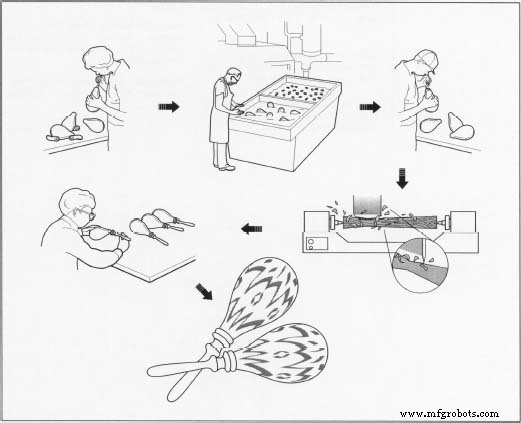
- Manufacturers source gourds or synthetic bells from suppliers, then trim the narrow ends with a fine‑blade saw. Internal membranes and seeds are removed with specialized knives; seeds are cleaned and stored.
- The gourds undergo a controlled drying cycle lasting several months to a year, preventing shrinkage or wrinkling of the outer skin.
- Handles are cut to length and shaped on a lathe. Where the gourd’s neck is retained, it is fitted with a funnel‑shaped handle; otherwise, a simple dowel is used.
- After drying, the bell’s exterior is sanded for smoothness. The instrument is then partially filled with the chosen material, balancing resonance and weight.
- Handles are affixed to the bell, either directly or via a transitional wooden bridge. High‑strength adhesive ensures a lasting bond, and the joint is sanded flush.
- Maracas receive hand‑applied enamel in multiple layers, followed by a shellac coating to seal the paint.
- Each pair is individually wrapped and boxed, then shipped to distributors.
Quality Control
Craftsmanship remains paramount. Skilled artisans oversee each step, from gourd selection to final polish. Sound tests ensure that fillings move freely; any maraca with stuck or uneven materials is discarded. This meticulous attention to detail preserves the instrument’s integrity.
Byproducts/Waste
Production generates minimal waste. Gourd membranes and leftover seeds can be composted as green waste, while wood shavings and sawdust from handle fabrication are kept in small quantities.
The Future
Maracas continue to thrive as a gateway instrument for children and as a symbol of cultural identity. Musicologists document their use worldwide, ensuring that traditional rhythms are preserved for future generations. The global surge in Latin and world‑music popularity has amplified the maraca’s presence, expanding its audience across genres and continents.
Where to Learn More
Books
Baines, Anthony, ed. Musical Instruments Through the Ages. New York: Walker and Company, 1976.
Buchner, Alexander. Folk Music Instruments. New York: Crown Publishers, Inc., 1972.
Hunter, Ilene, and Marilyn Judson. Simple Folk Instruments to Make and to Play. New York: Simon and Schuster, 1977.
Sadie, Stanley, ed. The Grove Dictionary of Musical Instruments. Vol. 2. London: Macmillan Press, 1984.
Other Resources
Jansky, Charlotte. “Allegro Music.” Web Page, December 2001.
Mambiza Drums & Percussion. Web Page, December 2001.
Gillian S. Holmes
Manufacturing process
- What is VMC Machining? An Expert Overview of Vertical Machining Centers
- Expert Guide to Aluminum Laser Marking: Precision, Durability, and Industry Applications
- MIG vs. TIG Welding: Selecting the Right Arc Welding Technique for Your Project
- Comprehensive Guide to Laser Marking: Types, Benefits, and Applications
- Key Considerations for High‑Volume Swiss Machining
- CNC Prototyping Guide: Precision, Speed, and Cost‑Effective Production
- Expert Shaft Manufacturing: Precision Processes & Custom Solutions
- Fiber Laser Marking: Precision, Speed, and Versatility for Modern Industries
- Electropolishing vs. Passivation: Choosing the Right Stainless Steel Finishing
- Maracas: History, Craftsmanship, and Cultural Significance