



Nuclear Submarines: Evolution, Construction, and the Future of Underwater Warfare
Background
A nuclear submarine is powered by atomic energy, enabling it to remain submerged for months while carrying advanced weapons. Unlike diesel‑electric subs, which rely on batteries and surface operations, nuclear subs offer unparalleled endurance and stealth, making them a cornerstone of modern naval strategy.
History
The concept dates back to 1578 when William Bourne proposed a double‑hull design. The first working model was built by Cornelis Drebbel in 1620, propelled by oars in the Thames. Subsequent experiments, such as the 1747 goatskin ballast idea, foreshadowed modern ballast tanks.
Submarines entered warfare during the American Revolution. David Bushnell’s Turtle attempted to attach explosives to a British warship, while Robert Fulton’s Nautilus carried a crew of four and proved the viability of submerged operations, though it was ultimately rejected by France and Britain.
In the Civil War, the Confederacy’s H. L. Hunley sank the Union’s Housatonic on 17 February 1864, marking the first successful submarine attack. The late 19th and early 20th centuries saw rapid progress from hand‑propelled vessels to diesel‑electric designs used in both World Wars.
Post‑WWII, Hyman Rickover and engineers Ross Gunn and Philip Abelson launched the Nautilus in 1954, the world’s first nuclear submarine. By 1959, nuclear‑armed strategic submarines entered service, and in 1982 the British attack sub Conqueror sank the Argentine General Belgrano during the Falklands conflict.
 Robert Fulton
Raw Materials
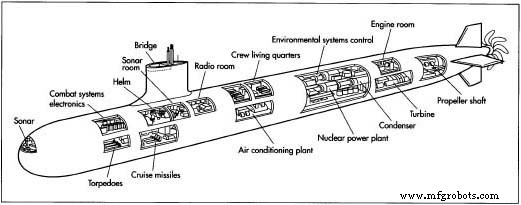
The primary material is high‑strength steel, forming both the inner and outer hulls. The space between hulls houses ballast tanks that control buoyancy. Additional alloys—copper, aluminum, brass—are used for fittings, while glass, plastics, silicon, and germanium compose electronic components. The reactor core relies on enriched uranium.
The Manufacturing Process
Preparing for Manufacture
- 1. Production is authorized by a national government; in the U.S., the Undersea Warfare Division of the Navy requests a fleet “flight.”
- 2. Contractors bid for component fabrication; the Electric Boat Division of General Dynamics builds the hull.
- 3. Funding is approved through the defense budget, and the Naval Reactor Program supplies the reactor—technology kept highly classified.
Making the Hull
- 4. Thick steel plates (2–3 in) are cut with acetylene torches and then rolled into curved panels using massive rollers.
- 5. Panels are laid over a wooden template, hand‑welded into sections, then auto‑welded for a seamless joint.
- 6. Curved, T‑shaped steel ribs are forged, heated, and hammered into shape, providing structural integrity.
- 7. Inner and outer hulls are assembled, separated by ballast tanks. Internal bulkheads and decks are welded and inspected with X‑ray and helium leak tests.
- 8. Exposed seams are polished with high‑speed grinders and coated with protective paint.
Finishing the Exterior
- 9. Rudders, propellers, and other components are cast in sand molds or machined from metal.
- 10. All external fittings are attached, then covered with steel sheeting to reduce hydrodynamic drag.
Finishing the Interior
- 11. Bulk equipment—reactor, propulsion, navigation—is installed as the hull is completed; lightweight items are added later.
- 12. After launch, the vessel is towed to a fitting‑out dock for final systems, periscopes, and crew accommodations.
- 13. The reactor starts during sea trials; the crew trains on an Atlantic cruise. Upon successful shakedown, the sub is commissioned as USS.
Quality Control
Every component undergoes rigorous inspection: steel dimensions to 1/16 in, welds with X‑ray, pipe helium leak tests, and comprehensive system checks. The Naval Reactors Program boasts the safest record among nuclear power operations.
Byproducts / Waste
Radioactive waste from the reactor is managed with the same stringent safety protocols as civilian plants. While volume is smaller, concerns remain about potential releases if a sub is lost at sea.
The Future
Nuclear submarines will continue to shape naval defense. Upcoming designs aim to enhance speed, depth, and stealth detection, while the New Attack Submarine program seeks cost‑effective replacements for the expensive Seawolf class.
Manufacturing process
- Zirconium in Nuclear Reactors: The Essential Cladding Metal
- Why Zirconium Is Essential for Nuclear Reactor Safety and Efficiency
- Nuclear Submarines: Evolution, Construction, and the Future of Underwater Warfare
- Application Spotlight: 3D Printing Drives Innovation in Nuclear Power
- Perry Nuclear Plant Enters Shutdown for Motor Replacement and Maintenance
- Susquehanna Nuclear Power Plant Completes Scheduled Maintenance, Restores Unit 2 Operation
- Heysham 2 Nuclear Plant Sets 940‑Day Record, Begins Planned Maintenance
- China Builds 13‑Times Hotter ‘Artificial Sun’ – A Leap Toward Clean Fusion Energy
- Submarine Cables: Construction, Features, Laying & Joints
- Unveiling Nuclear Fusion Inside Large Gas Bubbles