



Why Zirconium Is Essential for Nuclear Reactor Safety and Efficiency
Why Zirconium Is Essential for Nuclear Reactor Safety and Efficiency
Zirconium is a rare metal prized for its corrosion resistance, high melting point, hardness, and strength. Its unique properties make it indispensable in aerospace, defense, and especially nuclear energy.
While early studies suggested that zirconium might absorb too many thermal neutrons, cutting reactor efficiency, Oak Ridge Institute research revealed that only the 2.5 % hafnium impurity accounts for the high neutron‑capture cross‑section.
Zirconium and hafnium co‑occur in ore and are hard to separate. In the 1850s, the Naval Nuclear Propulsion program adopted zirconium for the Nautilus submarine’s water‑cooled reactor, despite limited purity standards.
Initial efforts focused on increasing zirconium purity, but even ultra‑pure material still contained trace nitrogen that compromised high‑temperature corrosion resistance. Experiments later showed that controlled additions of tin, iron, chromium, and nickel actually improved corrosion resistance, leading to the first zirconium alloys.
Zirconium alloys boast a remarkably low thermal neutron capture cross‑section of 0.185 b and outstanding corrosion resistance, making them ideal for core‑cladding, grids, guide tubes in boiling‑water reactors and pressure vessels in pressurized‑water reactors.
In a fission reactor, neutrons strike uranium‑235 nuclei, causing them to split into barium‑140, krypton‑93, and additional neutrons—fueling a self‑sustaining chain reaction. A material that captures many neutrons would sap the chain reaction’s energy, while inadequate corrosion resistance would lead to costly repairs and safety risks.
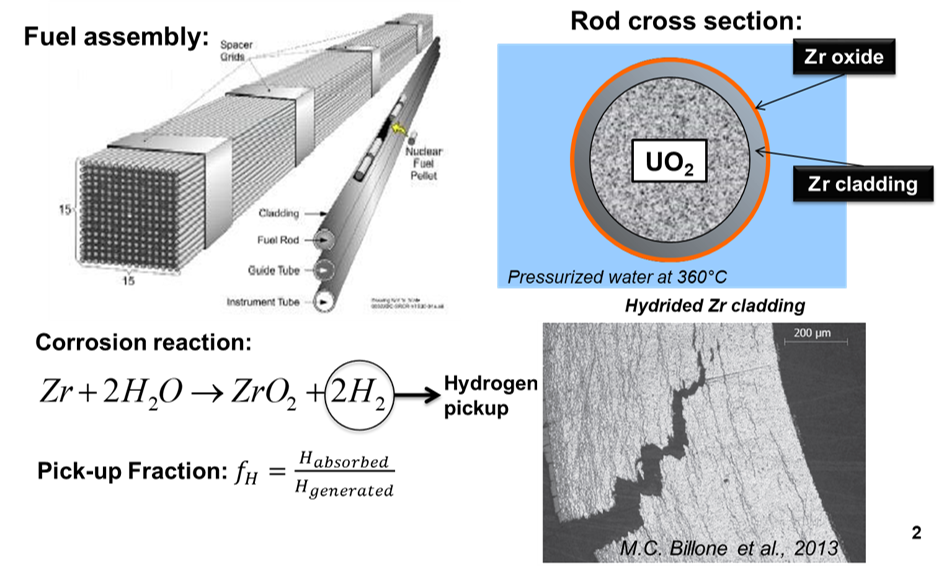
Hydrogen Pickup Measurements in Zirconium Alloys
Materials with a high neutron capture cross‑section absorb neutrons from the reactor core, reducing the reaction rate. Simultaneously, the intense heat generated is removed by circulating coolant to prevent overheating. If the cladding corrodes, it must be replaced, increasing operational costs and compromising safety.
Conclusion
Thank you for reading Why Zirconium Is Essential for Nuclear Reactor Safety and Efficiency. For deeper insights into zirconium and its refractory metal applications, visit Advanced Refractory Metals (ARM), where we supply high‑quality refractory materials at competitive prices.
Metal
- Zirconium in Nuclear Reactors: The Essential Cladding Metal
- Zirconium Applications: How This Rare Metal Shapes Modern Technology
- Zirconium Metal: The Industrial Powerhouse
- Why Zirconium Is Classified as a Transition Metal
- The Key Role of Zinc in Modern Alloys: Corrosion Resistance, Low Melting Point, and Galvanization
- Why Fiberglass Cloth Revolutionized Surfboard Design
- Why Aerospace Manufacturers Rely on Stainless Steel Carts for Heavy‑Duty Parts Handling
- Inconel Alloys: Key Applications and Benefits in High‑Temperature, Corrosion‑Resistant Environments
- Why Titanium is the Preferred Metal for Orthopedic Implants
- Why Bronze Is the Preferred Material for Ship Propellers