



Wheelbarrow: From Ancient China to Modern Construction
Background
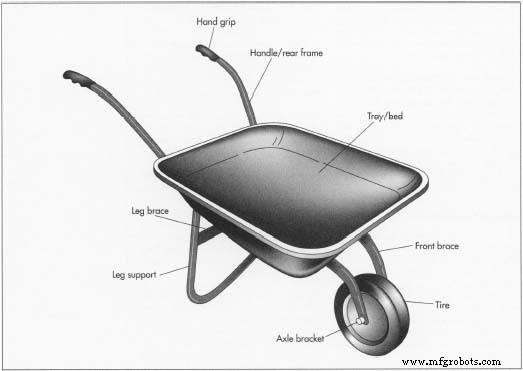
A wheelbarrow is a single‑wheeled carrier consisting of a tray, two handles, and two legs. While widely known as a gardener’s tool, it has been indispensable on construction sites, in industry, and for everyday transport of heavy loads.
The modern wheelbarrow traces its roots to China, possibly as early as 100 B.C.. Early models featured a large front wheel with a load placed behind it. Operators would lift the rear end and push. A later 300 A.D. design by Chuko Liang added a large wheel housing and side platforms, enabling the carriage of people and goods much higher off the ground—akin to a rickshaw.
European wheelbarrows evolved differently, intended for lighter loads over shorter distances. Their development likely began in the late Middle Ages, possibly influenced by Arab trade routes and Crusader encounters with Eastern designs. The first documented use in England dates to 1222, when eight wheelbarrows were purchased from Canterbury for the construction of Dover Castle.
Today’s wheelbarrows come in one, two, or four‑wheel configurations, often with storage compartments or tool‑clips. They remain a cost‑effective, motor‑free solution for a single operator to move heavy material.
Raw Materials
The tray or bed is commonly made of steel, wood, or plastic. Steel frames attach the tray to metal legs and a wheel, with rubber tires for smooth travel. Handles may be metal with foam or hard‑plastic grips, or solid wooden for a classic look.
The Manufacturing Process
Manufacturing methods vary by design and material. Below is a typical workflow for a garden wheelbarrow with a plastic tray, steel legs, a rubber tire, and wooden handles.
Making the Tray
- 1. Polyethylene—derived from petroleum‑based ethylene—is the primary plastic for trays. High‑density polyethylene (HDPE) is chosen for its rigidity.
- 2. Polymerization under 250–500 psi produces HDPE sheets.
- 3. Sheets are extruded into thick panels, then cut to length.
- 4. Vacuum forming shapes the panels over a mold that matches the tray’s final geometry. The cooled sheet is then removed.
Making the Legs and Braces
- 5. Steel is forged from iron ore and coke in a blast furnace. Carbon is removed via oxygen blowing to produce molten steel.
- 6. Steel strips are stamped into components with precise holes for bolts.
- 7. Components receive an electrostatic paint finish—electric charges ensure a uniform coat—followed by oven curing for durability.
Making the Wheel and Tire
- 8. Wheels may be steel or molded plastic; tire production follows standard rubber manufacturing.
- 9. Natural rubber comes from latex harvested from rubber trees, whereas synthetic variants like styrene‑butadiene rubber are petrochemical‑derived.
- 10. Rubber is heated, poured into a mold, and cooled to form the tire, which is then mounted on the wheel.
Making the Handles
- 11. Lumber is dried, cut, and shaped by saws and lathes. Drill holes for bolt attachment, then finish with varnish for weather resistance.
Packaging and Shipping
- 12. Components are packed in sturdy cardboard boxes and shipped unassembled to retailers, reducing space and shipping costs.
Quality Control
Key to quality is precise fit: each component is measured against a standard and holes are drilled to exact positions. Shipping packages must include all parts and clear assembly instructions. Weight checks of bolt batches verify correct quantities. Sample wheelbarrows undergo functional testing—assembly, load simulation, and maneuverability—to confirm ease of use and structural integrity.
The Future
From handheld carriers to multi‑wheel lawn carts, wheelbarrows have evolved over millennia. With gardening’s surge as a hobby and an aging population in the U.S., future designs will prioritize versatility, ergonomics, and lighter materials, ensuring the wheelbarrow remains a staple in homes and industries alike.
Manufacturing process
- What is VMC Machining? An Expert Overview of Vertical Machining Centers
- Expert Guide to Aluminum Laser Marking: Precision, Durability, and Industry Applications
- MIG vs. TIG Welding: Selecting the Right Arc Welding Technique for Your Project
- Comprehensive Guide to Laser Marking: Types, Benefits, and Applications
- Key Considerations for High‑Volume Swiss Machining
- CNC Prototyping Guide: Precision, Speed, and Cost‑Effective Production
- Expert Shaft Manufacturing: Precision Processes & Custom Solutions
- Fiber Laser Marking: Precision, Speed, and Versatility for Modern Industries
- Electropolishing vs. Passivation: Choosing the Right Stainless Steel Finishing
- Wheelbarrow: From Ancient China to Modern Construction